


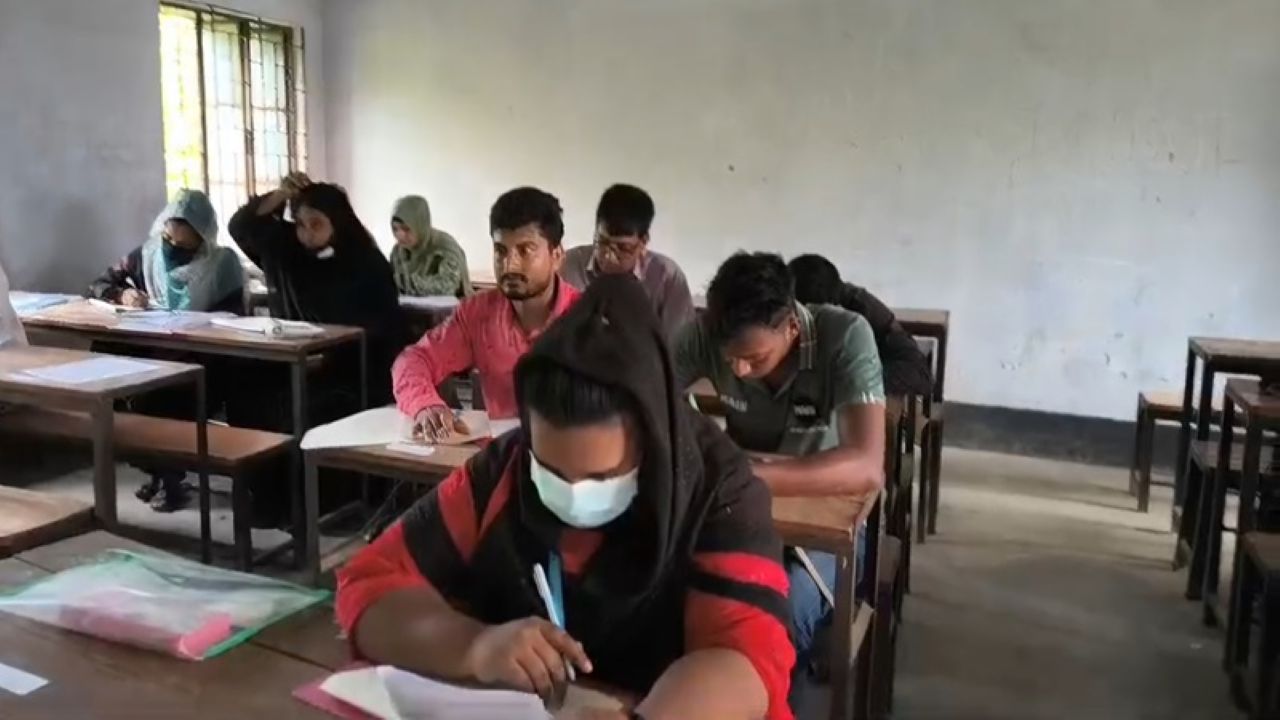




Behind their deceptively attractive façades, hazardous, overcrowded flats squeeze 15–20 women tenants into each unit, leaving barely any room to move.
Each room in these flats, measuring a maximum of 1,600 square feet, is packed with four to five occupants.
Compounding the problem, intermittent earthquakes cause profound anxiety, leaving residents frozen in fear with nowhere to turn.
This is the stark reality of private hostels in Dhaka, where female students and young professionals, desperate for accommodation, are forced to accept such hazardous alternatives.
However, while they provide a place to sleep, they fail to guarantee safe, quality housing.
Hundreds of students reside in these buildings entirely under the radar of government agencies.
Operating on a “do as you please” basis, owners exploit a complete lack of regulatory oversight, residents of these hostels told TIMES of Bangladesh.
Suraiya Begum, an additional secretary at the Ministry of Women and Children Affairs, confirmed to TIMES that no specific guidelines exist for private women’s hostels.
She declined to comment on whether regulations should be introduced, saying that only the ministry’s secretary and minister hold that authority.
Neither Minister AZM Zahid Hossain nor Secretary Yasmin Parveen could be reached over the phone.
High demand, dire condition
Every year, thousands of female students and working women move to the capital for university admissions, coaching, higher education, or employment.
Very few have the financial means to rent an entire flat, and many house owners are notoriously reluctant to let properties to single women.
Those arriving for short-term university coaching face the greatest ordeal, as finding accommodation for just three to four months is exceptionally difficult, leaving private hostels as their only viable alternative.

However, residents complain that most of these hostels lack adequate lighting and ventilation. Because the number of bathrooms and kitchens is vastly disproportionate to the number of occupants, women face long queues every single day.
Furthermore, a severe lack of furniture and storage space forces residents to dry clothes, store personal belongings, and keep food utensils all within the same cramped space, meaning these items frequently end up piled onto their beds and study tables.
This substandard living environment comes at a steep price, with monthly rent in these private women’s hostels ranging from Tk7,000 to Tk15,000.
For short-term coaching students, the rate sits even higher at between Tk10,500 and Tk12,500. On top of these steep monthly fees, many hostels also levy a hefty upfront admission service charge of Tk8,000 or more.
The grim reality on the ground
RH Home Center is a high-rise complex on Green Road in Farmgate, where five to six women’s hostels operate due to its close proximity to several private universities and major coaching centres. Sagarika Chhatri Nibas and Syntax VIP Hostel among them and each of their flat crams in more than 15 residents.
Rooms are partitioned using particle boards or glass panes into single, double, triple, and quadruple occupancies.
Most of these makeshift rooms lack windows entirely, severely restricting natural light and ventilation.
The larger three- or-four-bed rooms are equipped with just a single electric fan and one small window, leaving them stiflingly hot during the summer.
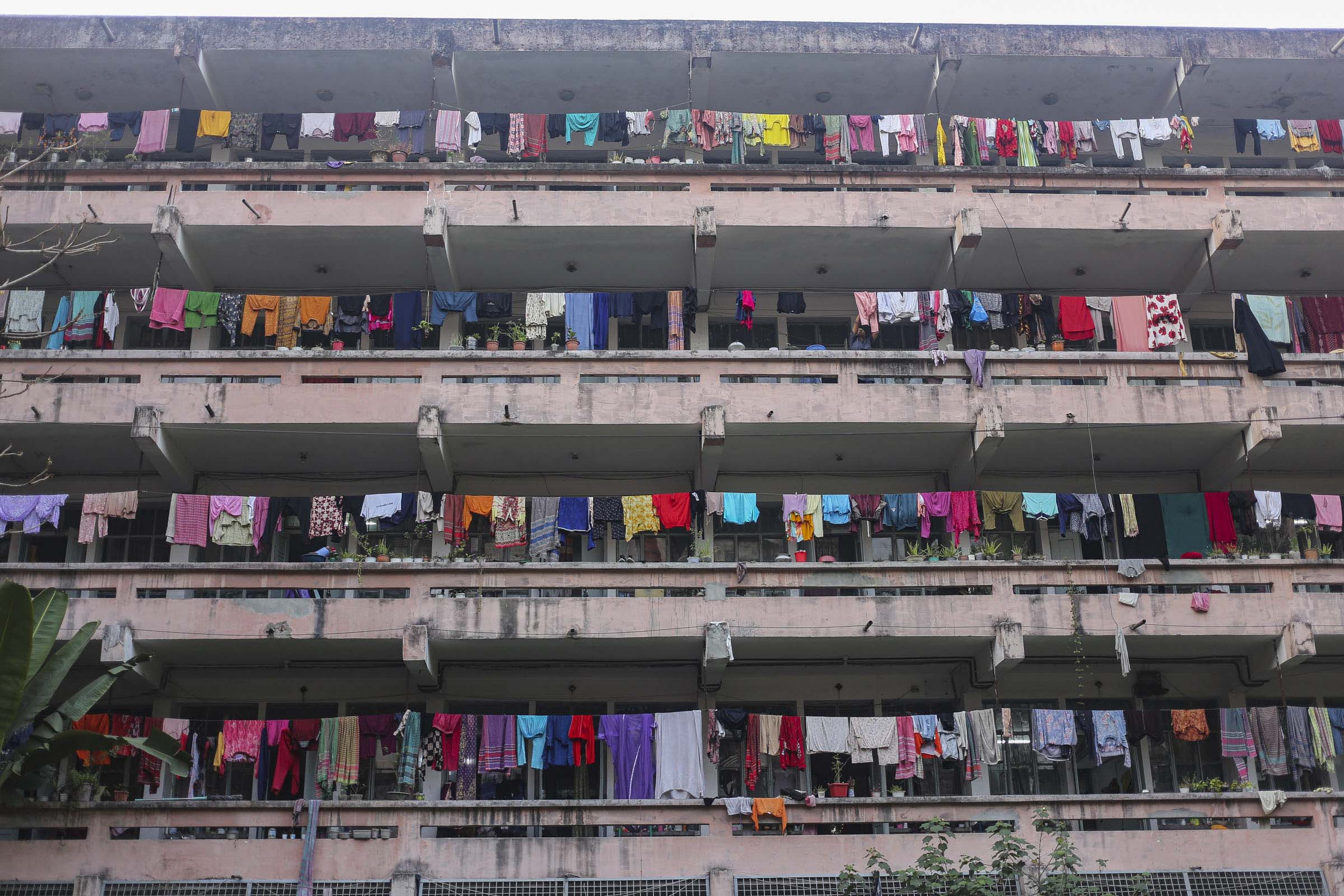
Space is so scarce that once the beds and study tables are put in place, there is barely any room to move, forcing residents to string up ropes inside to dry their clothes.
In some units, beds have even been placed directly next to the kitchen sink, while loose electrical wires hang precariously from the walls.
At Sagarika Hostel, each block contains eight flats per floor, totalling 40 to 42 flats across the establishment. Although each flat is equipped with two washrooms, residents from all eight flats on a floor must share a single, communal kitchen.
An anonymous representative of this hostel claimed that occupancy fluctuates and usually averages between seven and ten people per flat. However, when challenged on observations that flats actually housed more than 12 residents, he equivocated, saying that numbers vary and seats occasionally remain empty.
Meanwhile, the Syntax VIP Hostel houses between 250 and 300 residents. Some of its rooms are so narrow that a single bed and a small study table completely consume the floor space. It was found that in a single-bed room, although a window exists, it cannot be opened because another room has been constructed directly against it on the other side.
Despite these conditions, a hostel worker insisted their security was robust, pointing to fire alarms, emergency exits, and four fire extinguishers per floor.
Evacuation and building management present further hazards across women’s hostels in Dhaka.
Tania Akhter, a former resident of Meherunnesa Memorial Hostel at Hatirpool, noted that while cleanliness was satisfactory, the building lifts were shut down after 10 pm, frequently forcing her to climb the stairs up to the 16th floor, parts of which were in poor condition. Management at this hostel did not respond to multiple phone calls seeking comment. Hygiene and safety standards are similarly neglected elsewhere.
A resident at the Noor-e-Jannat Hostel in Azimpur revealed that washrooms and kitchens are only cleaned once a fortnight, while bedrooms are swept just once a week. Operating across the second and fifth floors of its building, the Azimpur hostel relies on a single staircase as its sole emergency exit.
Fire and earthquake risks
The Meherunnesa Memorial Hostel in Hatirpool operates across the 5th, 6th, 7th, 14th, 15th, and 16th floors of its building. A resident told TIMES, “Although the hostel has two staircases, one is completely dark and the other is in a terrible state of disrepair. There are no railings on the stairs on the upper floors, meaning there is no realistic way to evacuate quickly in the event of an earthquake or fire.”
This vulnerability was put to the test when a fire broke out in an adjacent building, triggering widespread panic among the residents. When students frantically called the supervisor, the lifts remained grounded and the main doors stayed shut.
Compounding the danger, one of the emergency staircases had been locked for nighttime security, leaving the trapped residents with no viable escape route.
Professor Mehedi Ahmed Ansari of the Civil Engineering Department at the Bangladesh University of Engineering and Technology (BUET) emphasised that three elements are critical for building safety: earthquake-resistant design, effective fire safety systems, and regular drills.

He noted that advance training is essential so that occupants can navigate exit routes in an orderly manner without panicking during a crisis.
“If the staircases are narrow, a sudden rush of people trying to escape during an emergency risks a catastrophic crush,” Professor Ansari warned.
Lieutenant Colonel MA Azad Anwar, Director of Training, Planning and Development at the Fire Service and Civil Defence Department, said, “Buildings exceeding six floors must secure approval for a fire safety plan and obtain an official fire service operational certificate.”
When asked whether these women’s hostels hold this certification, he replied, “While many newer buildings now secure fire safety approvals during construction, several older structures remain entirely outside this process.”
Widespread health risks
Dr Razia Sultana, a consultant in transfusion medicine, told TIMES that severe overcrowding and unhygienic conditions carry profound health risks.
“Living in such confined, densely populated spaces allows infectious diseases to spread rapidly,” she explained. “Respiratory tract infections and influenza, in particular, can transmit with ease.”
Dr Sultana further noted that poor ventilation, inadequate cleanliness, and the communal use of toilets and other facilities significantly heighten the risk of skin diseases and gastrointestinal infections.
She added that prolonged exposure to such a substandard environment takes a heavy toll on both the physical health and mental well-being of the residents.

