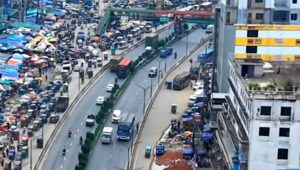
In Old Dhaka, traffic congestion and disorder have become inseparable parts of daily life. Roads narrowed by illegal occupation, shops spilling onto streets, goods blocking pavements and thousands of rickshaws competing for space have left residents questioning whether any solution can bring lasting change to one of the capital’s most crowded areas.
While artificial intelligence (AI)-powered cameras are beginning to improve traffic discipline in other parts of Dhaka, many residents of Old Dhaka are uncertain whether they will benefit from the new technology.
The main modes of transport in areas including Sadarghat, Chawkbazar, Bangshal, Sutrapur, Nawabpur and Banglabazar are rickshaws and battery-powered autorickshaws.
But many of these vehicles operate without digital registration or number plates, making it impossible for AI cameras to automatically identify them or issue electronic traffic fines.
“Rickshaws often travel in the wrong direction or stop in the middle of the road to pick up passengers. This makes congestion worse,” Abdul Salam, a resident of Ray Saheb Bazar, told TIMES of Bangladesh.

The presence of numerous small factories and chemical warehouses inside residential neighbourhoods has further intensified the problem. The movement of small and large vehicles carrying goods regularly adds to congestion, while roads already reduced in width by encroachment become heavily gridlocked during working days.
Dhaka’s traffic authorities have recently introduced AI-based cameras at eight major intersections to monitor violations and restore discipline. The system uses vehicle number plates to identify offences, records violations automatically and collects owner information from the Bangladesh Road Transport Authority (BRTA) database before preparing digital cases.
Authorities plan to expand the number of AI-enabled intersections to 60 within six months and 120 within a year. So far, the system has detected more than 2,000 traffic violations, with legal action underway in more than 400 cases.



However, Old Dhaka has largely remained outside this initiative.
Businessman Abu Taher, also from Ray Saheb Bazar, said the biggest traffic problem in the area was uncontrolled movement of rickshaws and auto-rickshaws. “Even if AI cameras are introduced, their benefits will remain limited unless these vehicles are brought under control,” he said.
A Dhaka Metropolitan Police (DMP) traffic official working in Old Dhaka, speaking on condition of anonymity, said the technology currently had no way to identify rickshaws and automatically issue fines.
“Through AI cameras, there is no technological opportunity yet to identify rickshaws and issue automatic cases. Therefore, in areas like Old Dhaka, where the number of rickshaws is very high, the effectiveness of AI-based monitoring may remain limited,” the official told Times of Bangladesh.
Technology alone cannot fix the problem
Transport expert and professor of civil engineering at Bangladesh University of Engineering and Technology (BUET), Md Hadiuzzaman, said AI cameras alone could not solve Old Dhaka’s traffic crisis.
“Small factories, chemical warehouses and commercial establishments scattered across Old Dhaka should be relocated in a planned way to areas such as Keraniganj or other suitable locations to reduce pressure on roads,” he told TIMES of Bangladesh.
He also called for making river routes around the Buriganga River part of an effective transport network and expanding rail-based public transport options.
On rickshaw management, Hadiuzzaman said bringing rickshaws under a licensing system with proper number plates would make technology-based monitoring more effective. “In the current uncontrolled situation, simply installing AI cameras will be difficult to produce the desired results,” he said.
According to him, Old Dhaka’s traffic crisis is ultimately a failure of urban planning.
He said land use, transport, drainage and waste management systems needed to be redesigned together, adding that in the long term, parts of Old Dhaka may require redevelopment and restructuring similar to approaches taken in other historic cities around the world.
“Without reducing population density, decentralising industrial and commercial activities, expanding river and rail-based transport and implementing integrated urban planning, a sustainable solution to Old Dhaka’s traffic problems is not possible,” Hadiuzzaman said.