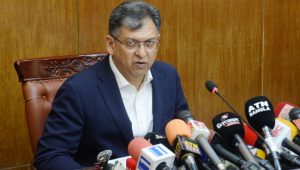
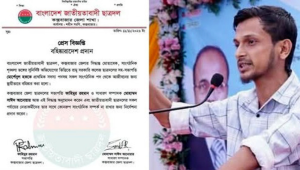
BNP Acting Secretary General Ruhul Kabir Rizvi has alleged that the house of Nusrat Tabassum, a woman member of parliament (MP) from the National Citizen Party (NCP), was set on fire because she had led the July Movement.
He said planned acts of sabotage were being carried out across the country, targeting young leaders who had spearheaded the movement.
Rizvi made the remarks while speaking to journalists at North South University in Dhaka on Thursday afternoon.
He said attempts were being made from different quarters to create instability in the country, suggesting that the activities might have the backing of influential individuals and a powerful foreign country.
Those involved in such activities had substantial financial resources, he said, adding that a huge amount of money had been laundered, part of which remained within the country.

The BNP leader said no activity could be sustained without public support. Recalling the Liberation War in 1971, he said ordinary people had provided shelter and food to freedom fighters.
Similarly, after 1975, when groups such as the Kaderia Bahini allegedly arrived to carry out sabotage after receiving training in India, ordinary people informed security forces and police about their activities.
Rizvi expressed confidence that the activities currently being carried out would also fail to secure public support.



Speaking about Revolution and Solidarity Day, the BNP leader said its central lesson was the need to become stronger in thought and self-reliance. He said it was possible to emerge from a dark situation and that the people of the country could bring about such change.
Describing the periods from 1972 to 1975 and 2009 to 2024 as periods of fascist rule, Rizvi said intellectuals had faced repression during those years.
He stressed the need to ensure that people could move around, express their opinions and speak freely without fear, saying these were essential conditions for democracy.
“A person will move without fear, express their opinion without fear, speak without fear. This fearless environment is indeed a democratic environment,” he said.
Rizvi also criticised political influence in the education system, alleging that politicisation had affected various areas, from teacher recruitment to textbook preparation.

Citing a report by Transparency International Bangladesh (TIB), he said there were reports of financial transactions ranging from Tk4.5 lakh to Tk15 lakh in primary school teacher recruitment. Allegations of monetary transactions had also emerged in the recruitment of teachers at public universities, he added.
He said education was not merely about obtaining certificates but was closely linked to humanity, conscience and morality.
Those who stood up for the truth even in adverse circumstances were the true intellectuals, he said.
Rizvi criticised individuals who had taken positions in favour of fascism even after students, workers and ordinary people were killed during the 2024 movement.
Possessing knowledge and engaging in intellectual pursuits alone did not make someone truly educated, he said, adding that education must also be accompanied by morality and human qualities.