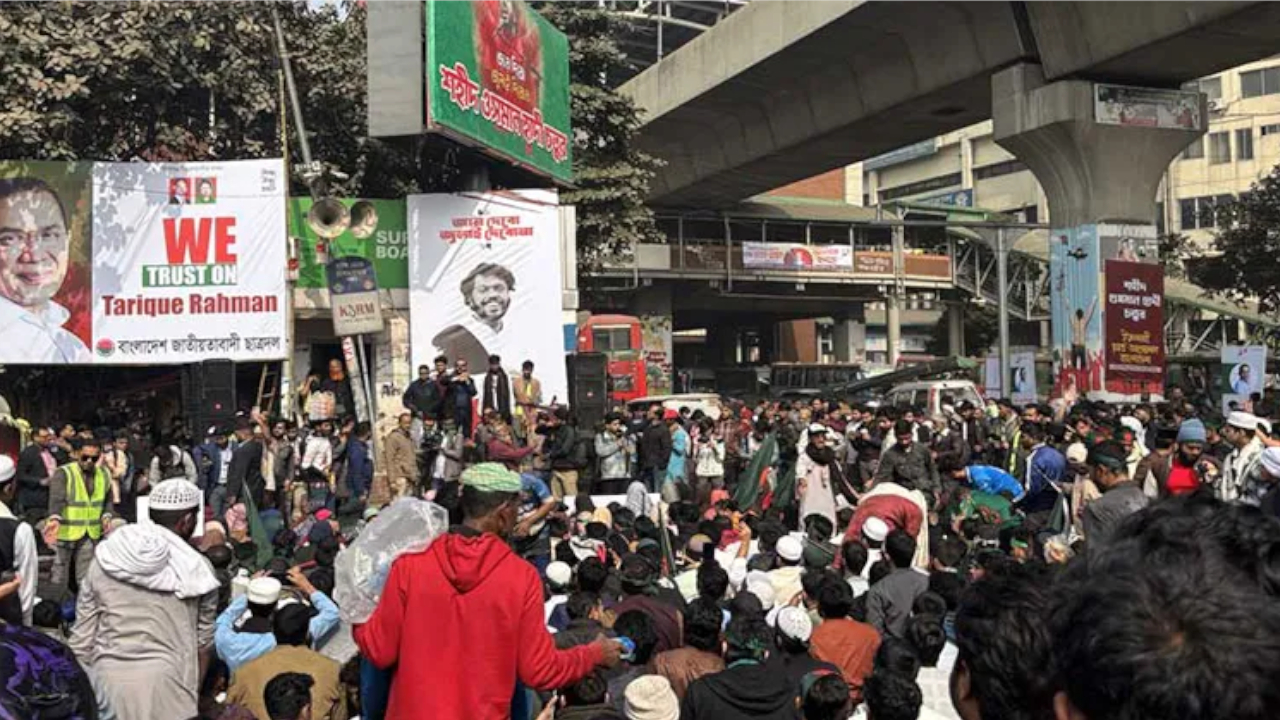

Leaders and activists of Inqilab Mancha took position in Shahbagh after Juma prayers on Friday, demanding the arrest of those responsible for the killing of Sharif Osman Hadi and announcing that they would continue their blockade until the perpetrators are brought to justice.
The very fact that a street movement is required to demand the arrest and trial of those accused of killing a high-profile political figure points to a deeper frustration. After Hadi’s death, the government declared a state mourning day, and the Chief Adviser publicly pledged to ensure justice. Yet months later, there has been no visible progress. For Hadi’s supporters, particularly those who see him as one of the key figures of last year’s July uprising, the gap between official assurances and concrete action has turned grief into anger. The demand is not limited to identifying the immediate attackers, but also extends to uncovering the political context behind the killing and holding any influential figures involved to account.
The contrast becomes starker when set against the killing of Dipu Das in Bhaluka, Mymensingh. The brutality of the incident, where a man was tied to a tree, beaten to death and then set on fire in broad daylight, reportedly in front of hundreds of onlookers, defies easy comparison. What is equally disturbing is the apparent public desensitisation: many present recorded the scene on their phones, treating it less as a crime than as a spectacle. Despite the severity of the violence, the incident failed to generate sustained political discussion or official reflection. Senior political figures remained largely silent, and the case did not appear to shape broader debates about law, order, or social violence.

This selective attention was reflected in political speeches as well. Upon returning to Bangladesh after 17 years, BNP Acting Chairperson Tarique Rahman referred to Sharif Osman Hadi in his remarks but made no mention of Dipu Das. The omission prompted public debate, with some questioning why an act of such extreme violence did not register in the emotional or political responses of national leaders.




A similar silence surrounds the killing of Siam Majumder, a 21-year-old who died after a cocktail was thrown from the Mogbazar flyover, one of the busiest points in the capital. The incident has barely featured in public discussion, and the police have yet to identify who threw the explosive. Whether this reflects investigative failure or a lack of urgency remains unclear, but the absence of answers has gone largely unchallenged.
Taken together, these cases suggest that official reactions, public sympathy and demands for justice vary significantly depending on the political weight attached to each incident. Expressions of concern and calls for accountability appear uneven, shaped less by the severity of the crime than by the political narratives surrounding the victim. In such a context, the language of justice risks losing substance, becoming reactive and selective rather than consistent and principled.
The writer is the Chief Editor & publisher at Notundesh