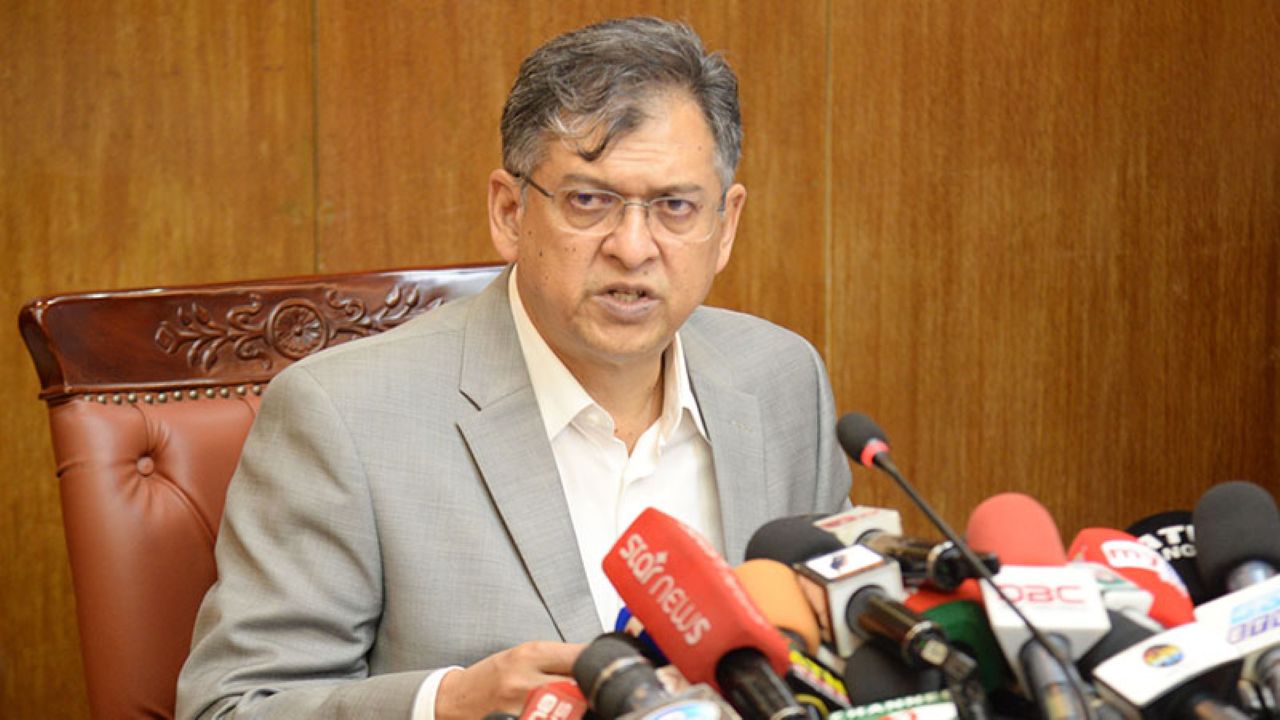



Home Minister Salahuddin Ahmed on Monday reiterated the government’s “zero tolerance” policy on crime prevention and law enforcement, declaring that there is no scope to spare any criminal based on political identity or party affiliation.
He warned that strict legal action would be taken against anyone committing crimes, regardless of their background.
Salahuddin was speaking as the chief guest at an exchange of views meeting on the overall law and order situation and development of the district, organised by the Sylhet District Administration at the Sylhet Circuit House auditorium today.
Impartial list of criminals ordered
During his speech, Salahuddin ordered the strict and completely impartial preparation of lists of terrorists, extortionists, drug dealers, and smugglers in the Sylhet region.
Pointing out that local criminals are known to everyone, he cautioned authorities against harassing innocent people for political motives or omitting actual criminals due to political considerations.
He directed the responsible officials to present visible results of this directive within the next month. “We have introduced a ‘reward and punishment policy’ in the police force,” he said, directing both the Range Police and Sylhet Metropolitan Police (SMP) to strictly adhere to this guideline.

Scrutiny of post-uprising cases
Reviewing various cases filed following the anti-discrimination movement, Salahuddin noted that in many instances, general accusations were made against 500, 1,000, or even 2,000 individuals in the First Information Report (FIR).
He stated that in numerous places, third parties – rather than the victim families – filed lawsuits to serve their own interests, harass people, or extort money, thereby depriving actual victims and martyr families of justice.
Citing the example of Wasim Akram, the first martyr of Chittagong, Salahuddin remarked that while his family could not file a case, another political individual filed a lawsuit naming 1,500 accused, whereas the actual perpetrators could have been identified using video footage and circumstantial evidence.




In this context, he directed the police of Sylhet Range and Metropolitan areas to scrutinise these cases and exclude the names of innocent and unnecessarily harassed individuals under Section 173 of the Code of Criminal Procedure (CrPC).
He warned against any form of lobbying, negotiation, or unethical transactions during this process, emphasising that the actual masterminds and offenders must not be spared under any circumstances.
Zero tolerance for mob anarchy
Declaring that the government will not tolerate the culture of “mob justice” or anarchy, Salahuddin Ahmed urged the public to raise their demands through conventional democratic channels – such as submitting memorandums or holding press conferences – instead of blocking roads or laying sieges.
He noted that mob incidents in the country dropped by more than 50 percent in 2026 compared to 2025, and called for keeping the Sylhet region completely free of mob activities.
Reopening of quarries and border monitoring
Addressing the environmental and social impacts of closed sand and stone quarries in Sylhet, the Home Minister shared that a national committee under his leadership is already working to balance environmental protection with local employment opportunities.
He said that work is moving forward based on resolutions prepared by coordinating directives from the Ministry of Environment, Ministry of Power, Energy and Mineral Resources, and the courts.
He instructed the authorities to co-ordinate with the Attorney General’s Office to resolve legal complexities swiftly to cut down court delays.
Moreover, he urged the strengthening of supervision through monitoring teams to prevent changes in river courses and environmental damage caused by hill torrents in border areas. He also instructed law enforcement officials to reinforce precautionary measures and collect intelligence quickly to take effective action against crime.
Commerce minister urges focus on top drug dealers
Speaking as a special guest, Commerce Minister Khandakar Abdul Muktadir stressed that the police administration must deliver maximum performance to eliminate drugs and improve the law and order situation in Sylhet.
He advised the police not to chase ordinary users but rather to draft a specific list of at least the top 50 drug dealers to bring about visible change within one to one and a half months.
Noting that SMP is geographically the largest metropolitan police area in the country, the Muktadir drew Salahuddin’s attention to the need to resolve SMP’s logistics crisis, establish new police outposts, and supply adequate police vehicles.
He called on every police unit to play a responsible role in earning public trust.
Dignitaries present
The meeting was also addressed by Sylhet City Corporation Administrator Abdul Qayyum Chowdhury, Sylhet-3 MP Abdul Malek, Sylhet-6 MP Emran Ahmed Chowdhury, Sylhet-5 MP Mufti Mohammad Abul Hasan, and Border Guard Bangladesh (BGB) Director General Major General Mohammad Ashrafuzzaman Siddiqui.
Sylhet Development Authority Chairman Rezaul Hasan Koyes Lodi, Sylhet Divisional Commissioner Md Mashiur Rahman, Sylhet Metropolitan Police Commissioner Sarwar Murshed Shamim, Deputy Commissioner Abdullah Al Mamun, and Superintendent of Police Dr Chowdhury Md Jaber Sadek were present at the meeting, which was moderated by Sylhet Additional District Magistrate Pinky Saha.