





What was once a farming community dependent largely on seasonal rice cultivation has evolved into one of northern Bangladesh’s most successful centres for commercial betel leaf production, bringing higher incomes and greater financial security to hundreds of rural families.
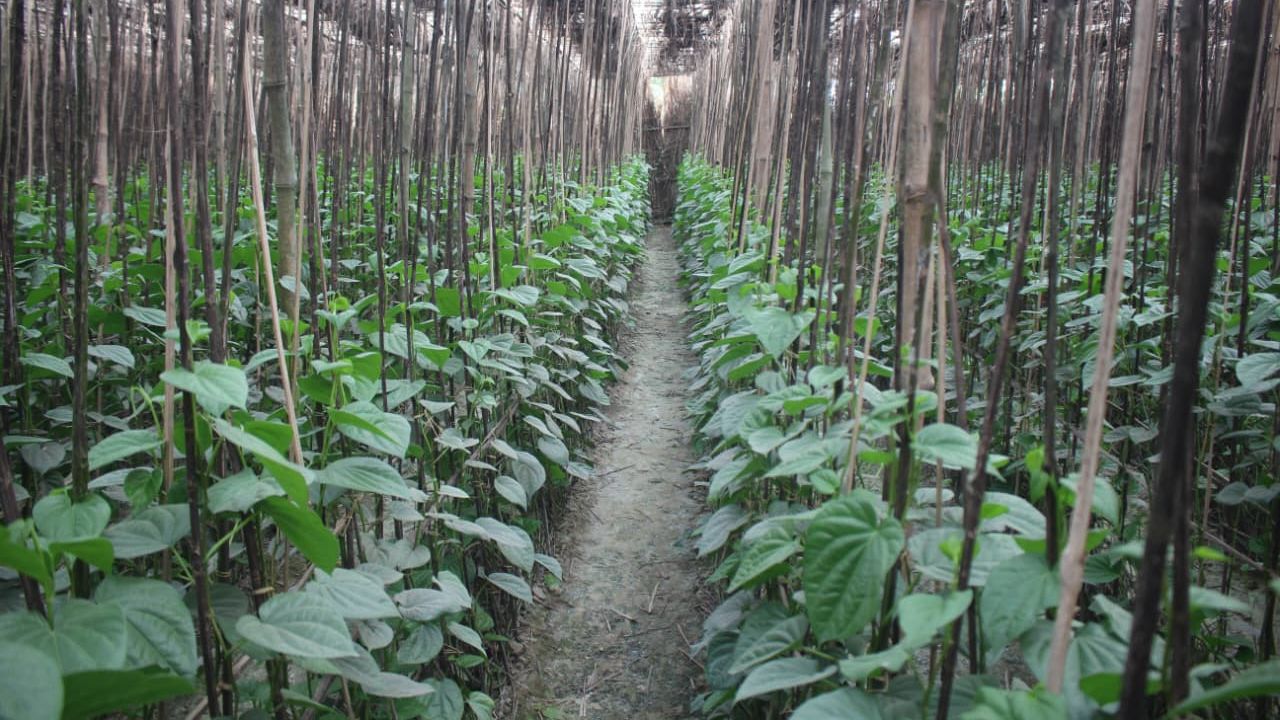
The villages of Jalm, Magura and Jageshwar, located around 11 kilometres from Naogaon Sadar in Kritipur Union, have emerged as the district’s principal hub for betel leaf cultivation. The villages are now widely known locally as the “betel villages”, where rows of lush green plantations have replaced much of the traditional paddy fields.
Around 2,500 people live in the three villages, where betel leaf gardens stretch from household courtyards to vast areas of agricultural land. For many residents, the crop has become the foundation of a new rural economy, offering year-round income and improved living standards.
Farmers said the area’s elevated, flood-free sandy loam soil and favourable climate make it highly suitable for betel cultivation. Combined with controlled irrigation, effective drainage, regular maintenance and guidance from the Department of Agricultural Extension (DAE), growers have developed an efficient and sustainable production system.
According to the DAE, commercial betel cultivation has expanded steadily over the past 15 years. Around 300 farmers now cultivate more than 700 betel gardens across the three villages.
Several varieties, including Bangla, Mitha, Sachi, Karpuri, Gach, Natiabasut, Ujani and Maghi, are supplied to markets across the country.
Farmers Arup Kumar Mondal and Bikash Chandra Mondal of Magura village said interest in betel cultivation had risen significantly in recent years because it offers substantially higher returns than rice farming while providing harvests throughout the year.
“It is no longer just a means of livelihood but a reliable source of financial stability,” they said.
Experienced grower Bidhan Chandra of Jalm village has been cultivating betel leaves for around 15 years and now operates five bighas of plantations.
He said establishing a betel garden requires an investment of about Tk1,10,000 per bigha, covering bamboo structures, irrigation facilities, fertiliser, pesticides and labour.
Although the initial investment is relatively high, the steady production allows farmers to recover their costs quickly, he said.
A betel garden generally remains productive for five to six years, with leaves harvested at least twice a week.
On average, each harvest yields more than 4,000 leaves. Depending on quality, large betel leaves currently sell for between Tk3,500 and Tk4,000 per poa, medium-sized leaves fetch Tk1,500 to Tk2,500, while smaller leaves sell for Tk500 to Tk1,500 per poa.
Sunil Chandra Pramanik of Jageshwar village, who cultivates seven bighas of betel gardens, said each bigha can generate sales of between Tk150,000 and Tk200,000 during a season.
The produce is supplied to markets in Joypurhat, Dinajpur, Rajshahi and several other districts, with many wholesalers purchasing directly from farmers in the villages.
Despite its profitability, farmers said betel cultivation is not without challenges.
During the monsoon, plantations are vulnerable to dalapacha, a fungal disease that can damage crops. However, growers said timely application of recommended treatments, following advice from agricultural officials, has helped keep the disease under control.
Jillur Rahman, Sub-Assistant Agriculture Officer for Kirtipur Union, said commercial betel cultivation in Naogaon is concentrated mainly in these three villages.
“The success achieved here is encouraging farmers in neighbouring areas to take up betel cultivation. Because production continues throughout the year, it has become a sustainable and profitable agricultural enterprise,” he said.
Naogaon DAE Deputy Director Md Manjur Rahman said betel leaf was cultivated on 43 hectares across the district during the current season.
He said the department continues to provide farmers with training and technical support to increase production and improve profitability.


