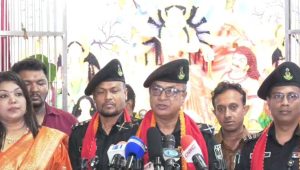
The government may increase the number of International Crimes Tribunals, prosecutors, investigators and logistical resources if required to ensure faster disposal of cases related to the July uprising violence and crimes against humanity, Home Minister Salahuddin Ahmed told Parliament on Tuesday.
He said 590 cases are currently under trial at the International Crimes Tribunal, while investigations into another 12 cases have been completed and are awaiting the formal framing of charges.
The minister made the remarks while taking part in a parliamentary discussion titled “Recent discussion on the trial of the July uprising and genocide”, raised by National Citizen Party (NCP) member secretary and Rangpur-4 lawmaker Akhtar Hossain.
Deputy Speaker Barrister Kayser Kamal presided over the session.
Salahuddin said the BNP had been demanding a trial of the Awami League as an organisation from the beginning and that legal provisions for such proceedings were later established through amendments.
On constitutional reform, he urged opposition parties to return to discussions, saying the government is committed to building a democratic state system, ensuring judicial independence, protecting media freedom and preventing authoritarianism in the future.

He said five seats have been kept vacant for opposition representatives in the Constitution Reform Committee.
Highlighting government support for victims of the July uprising, the home minister said each martyr’s family had received Tk30 lakh as one-time financial assistance. He added that injured victims under categories A, B and C received Tk5 lakh, Tk3 lakh and Tk1 lakh respectively.
Monthly allowances have also been introduced for martyr families and injured victims, he said, adding that arrangements would be made for overseas treatment of critically injured individuals if necessary.
The government is also taking steps to expand the activities of the July Foundation, he added.




Salahuddin announced that the July Memorial Museum would be inaugurated on 5 August.
On freedom of expression, he said the government supports the right to free speech but added that reasonable restrictions in the interest of the state, as mentioned in Article 39 of the Constitution, would be enforced according to law.
Regarding foreign policy, the minister said the government remains firm in protecting the country’s sovereignty and that relations with neighbouring countries would be based on mutual respect, dignity and equality.
Efforts underway to bring back Sheikh Hasina
Speaking about former prime minister Sheikh Hasina, Salahuddin said the government’s efforts to bring her back under the extradition treaty are continuing.
“If she returns, legal steps will be taken following court orders,” he said.
The minister said government records show 843 people have been recognised as martyrs of the July uprising, while the number of recognised July fighters, including injured victims, stands at 15,212.
He said 751 murder cases, one unnatural death case, 33 criminal cases and 48 cases filed with the International Crimes Tribunal are currently pending over incidents related to the uprising.
Salahuddin said the government was determined to ensure justice for all victims, including martyrs, injured protesters and those subjected to torture, and would take necessary legal and institutional measures to complete the trials.
July uprising was a mass movement of entire nation
The home minister said the July Declaration was the first major achievement of the uprising, followed by the formulation of the July National Charter through the National Consensus Commission.
He said these developments were not adequately highlighted during the parliamentary discussion on the July uprising.
According to him, the July Declaration and National Charter contain commitments regarding protection of martyr families, support for injured July fighters, constitutional recognition and the establishment of a democratic state.
Salahuddin said the uprising was not driven by any single political party or student organisation but represented a mass movement involving people across Bangladesh.
He added that the movement followed 17 years of democratic struggles during which thousands of people allegedly faced enforced disappearances, killings, extrajudicial violence and torture in secret detention facilities.