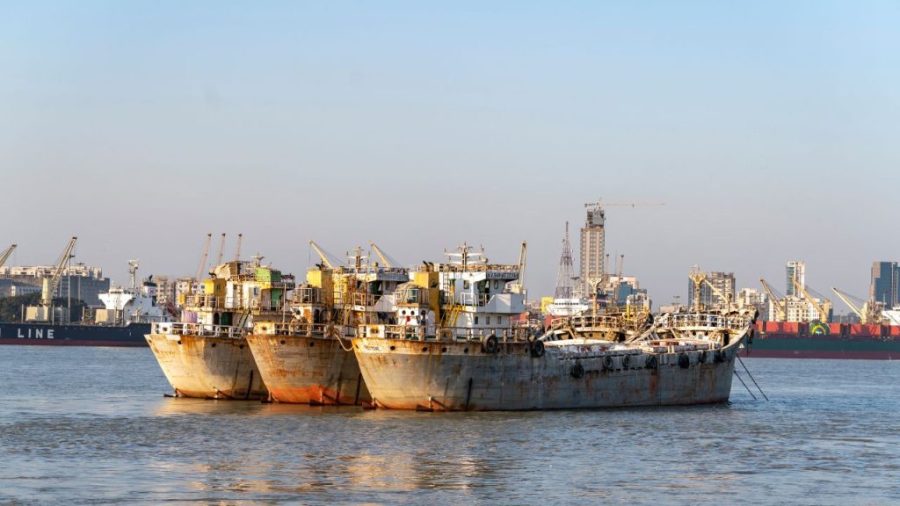



A persistent shortage of lighter vessels is disrupting cargo handling at Chittagong Port, with an estimated 1,000 to 1,200 vessels, nearly half the country’s fleet, tied up at river ports and terminals, according to port data and industry stakeholders.
The port data showed 86 vessels at the jetties and outer anchorage as of 8:00am on 22 November. Of these, 68 were at the outer anchorage, including five container ships awaiting berth, while 63 bulk carriers required lighter vessels to discharge cargo. The bulk carriers included 15 carrying general cargo, seven carrying food grains, four carrying fertiliser, 18 carrying cement clinker, one carrying sugar and six oil tankers.
Allocation figures cited in the report show the gap. On 19 November, 124 lighter vessels were requested to handle cargo from 59 mother vessels, but only 59 were allocated. On another occasion, 126 vessels were sought for 77 mother vessels, while 46 were provided. Against a demand for 157 vessels to serve 81 mother vessels, 80 were allocated.

The shortage has persisted for 15 days. Inland Vessel Owners Association of Chattogram (IVOAC) Vice-President Parvez Ahmed said no allocation meetings were held on 14 and 15 November, one took place on 16 November, and none on 17 and 18 November. Meetings resumed on 19, 20 and 21 November, but the shortage remained unresolved, he added.
Bangladesh Ship Handling and Berth Operators Association Chairman Sarwar Hossain said the growing number of mother vessels, particularly those carrying large quantities of wheat, was creating a bottleneck. “Lighter vessels are remaining occupied for extended periods because of the huge volume of cargo, particularly wheat. The situation is already critical, and the pressure will increase further as Ramadan approaches,” he said.




Department of Shipping Director General Commodore Md Shafiul Bari said the problem was not simply a shortage of lighter vessels. Slow unloading, inadequate jetty facilities and the use of vessels as floating warehouses were also contributing, he said. Chattogram Port normally handled around 35 to 40 commercial vessels at a time, but 55 to 62 were currently waiting at the outer anchorage.
Loading cargo onto a lighter vessel takes around eight to 13 hours, but unloading can take seven to 10 days, with a vessel sometimes remaining at a jetty for up to 10 days and around 70 workers required to complete the process, he said.


The Department of Shipping has introduced second-trip and third-trip arrangements, alongside stronger digital monitoring. Under the new arrangement, a vessel occupied beyond the stipulated 18-day period requires the importer or responsible party to pay an additional second-trip charter fee to the vessel owner.
Shafiul Bari warned that a commercial vessel idle at the port or outer anchorage can incur demurrage charges of up to $30,000 a day.
Former Chittagong Chamber of Commerce and Industry director Mahfuzul Haque Shah described the crisis as a longstanding failure of coordination and effective government intervention. “It is very unfortunate that the country loses huge amounts of foreign currency every year because of this situation, while importers also suffer significantly. We have been witnessing this problem for the past 20 to 25 years, yet a permanent solution remains elusive,” he said.
A fleet of approximately 2,000 lighter vessels transports goods to around 34 destinations across the country, including 16 jetties in Chattogram.