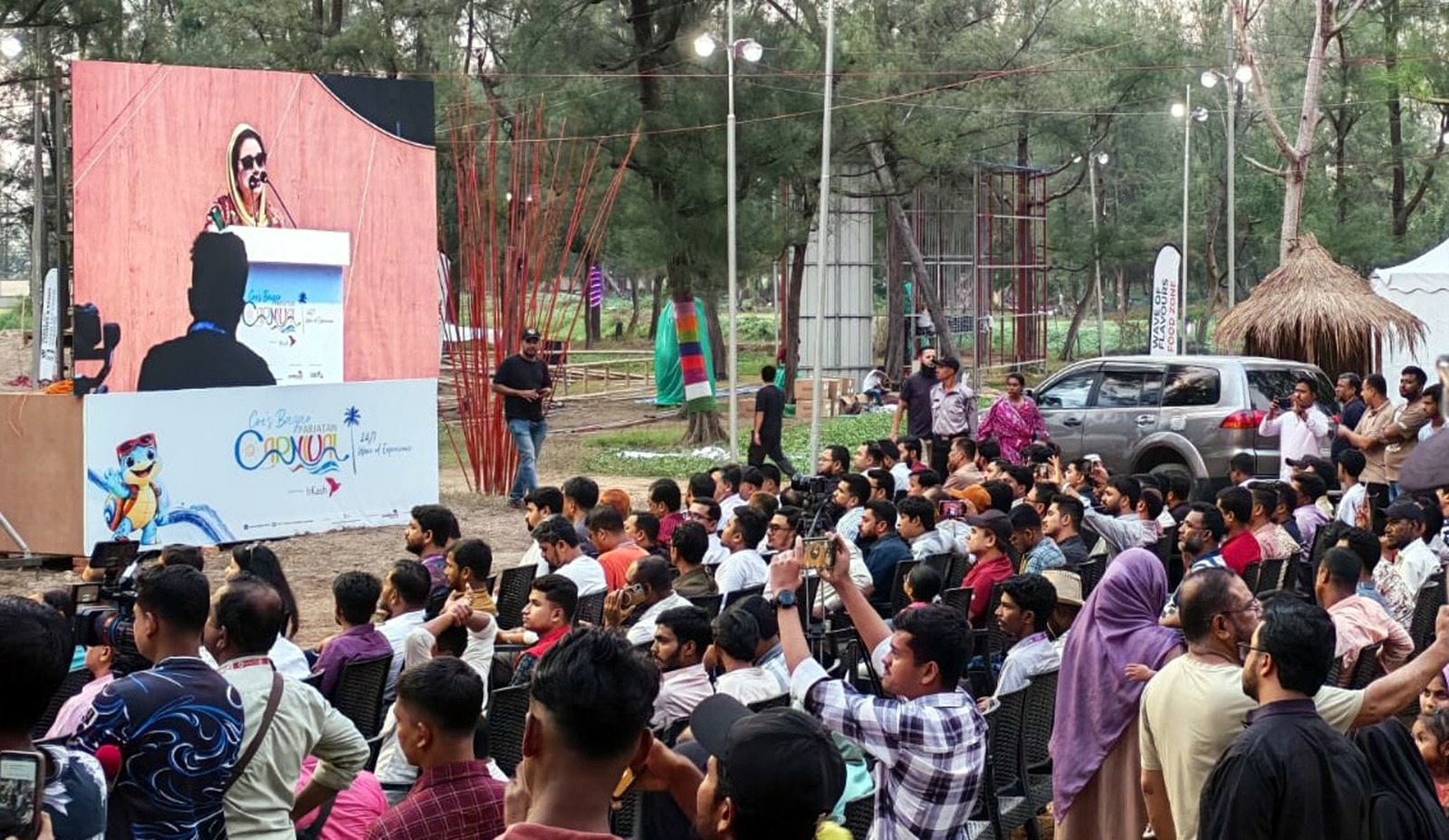
The three-month Cox’s Bazar Tourism Carnival has begun amid allegations of tree felling and attempts to take control of 35 acres of government tourism land under the guise of organising the event.
Organised by the Bangladesh Parjatan Corporation, the carnival opened at Jhau Bagan near Kabita Chattar on the sea beach on Sunday, a week behind schedule, with organisers rejecting allegations surrounding the initiative.
The carnival aims to promote Cox’s Bazar as an international tourism destination, attract domestic and foreign visitors and increase the tourism sector’s contribution to the national economy.
However, the event has drawn criticism over allegations that jhau trees, considered a natural protective barrier along the coast, were cut down to make space for the carnival.
Critics have also alleged that the event is being used as a pretext to lease 35 acres of land belonging to the tourism corporation to private investors.
According to those raising the allegations, the previous Awami League government had sought to lease land associated with Hotel Shaibal to the private-sector Orion Group but reportedly withdrew the decision following opposition from local residents.
They now allege that a similar initiative to lease the land to private investors is being pursued under the current government through the carnival.

The Bangladesh Parjatan Corporation and other authorities concerned have repeatedly denied the allegations.
The carnival was originally scheduled to begin on 15 November but was postponed until Sunday because preparations remained incomplete.
Reserved-seat Member of Parliament and Cox’s Bazar District BNP General Secretary Shamim Ara Swapna inaugurated the event on Sunday afternoon.
The first-ever carnival features entertainment programmes, exhibitions of locally produced and traditional goods, children’s recreational facilities and cultural performances.




At the inauguration, Shamim Ara Swapna said tourists visiting Cox’s Bazar often spent their mornings swimming and enjoying the beach but had limited entertainment options later in the day.
She said the three-month event would help visitors spend their afternoons and evenings more enjoyably through cultural and recreational activities.
The attractions include children’s play facilities, stalls selling local products, exhibitions of traditional goods from Rangamati and Myanmar, Jamdani sarees and cultural performances. Visitors will also have opportunities to read books, socialise and spend their leisure time in a relaxed environment.
The arrangements are expected to benefit both tourists and local residents.


Shamim Ara Swapna said Cox’s Bazar, home to the world’s longest natural sandy sea beach, had enormous tourism potential that needed greater international promotion.
She said the opening of Cox’s Bazar International Airport would create more opportunities for foreign tourists, while initiatives such as the carnival could help attract international visitors.
Bangladesh Parjatan Corporation Chairman Shamim Uzzaman said the corporation had operated four units — Shaikat, Upal, Prabal and Laboni — in Cox’s Bazar since its establishment in 1972.
However, those facilities had not been developed to the expected standard, while private entrepreneurs had established modern hotels, motels and other tourism services in the district.
He said the corporation wanted to attract international tourists by showcasing Bangladesh’s natural beauty, history, heritage, hills, mountains, rivers, forests, ethnic diversity, culture and culinary traditions.
Such initiatives could increase tourism’s contribution to the economy and generate substantial employment opportunities, he added.
Citing global tourism statistics, Shamim Uzzaman said the sector generated $11.6 trillion worldwide in 2025, accounting for approximately 9.8 per cent of global GDP, and directly employed 36.6 crore people.
In contrast, tourism contributed only two per cent to Bangladesh’s GDP, he said.
Bangladesh Parjatan Corporation Director Ganiul Azam acknowledged the criticism surrounding the carnival, saying the organisers wanted to consider the concerns positively and use them to improve the event.
He said implementing such initiatives at the government level was challenging, but the corporation had undertaken the carnival to promote tourism.
Experience gained from an initial seven-day trial operation would be used to make the three-month event more organised, attractive and tourist-friendly, he added.
Ensuring enjoyment, entertainment and comfort for visitors remained the initiative’s primary objective, he said.