Iran and Oman have agreed on a temporary maritime navigation corridor for merchant vessels travelling through the Strait of Hormuz.
However, the breakthrough announcement by Iran’s Deputy Foreign Minister, Kazem Gharibabadi, came with a stern warning: the strategic waterway will not fully reopen until the United States fulfils its commitments under a lapsed interim peace deal signed in June, reports Al Jazeera.
This development marks the latest chapter in a deep geopolitical crisis that has severely disrupted global energy markets.
The Strait of Hormuz, which connects the Gulf to the open ocean, is the only sea route connecting the Gulf to the open ocean. It has been effectively closed to shipping since the US-Israel war on Iran commenced with strikes on Tehran on 28 February.

In peacetime, more than 20 per cent of global petroleum and liquefied natural gas (LNG) supplies pass through the channel. Disagreements over this critical waterway continue to block a lasting peace.
Following US airstrikes on parts of Iran in July, Tehran has refused direct talks with Washington, insisting it will negotiate only with Oman regarding the waterway, which passes through their respective territorial waters.
Navigating the new temporary route
Under the bilateral agreement, a transit corridor spanning seven miles (11.3 kilometres) in width will be established.
Gharibabadi stated on state television that the entry point to the approved route will begin in Iranian territorial waters, and a portion of the exit route will also traverse Iranian waters.

Negotiations began a month ago between Oman and the Islamic Revolutionary Guard Corps (IRGC). An IRGC spokesperson confirmed both sides agreed on water boundaries and the sharing of generated revenues.
However, key operational details remain unclear. The precise geographic coordinates have not been released, and it is unknown when vessels can safely begin using the route, how revenues will actually be generated, or if any specific flags or vessels will be barred.
Gharibabadi emphasised that the corridor is strictly temporary and that Iran does not consider the strait reopened.

Moreover, Mohammad Akraminia, an Iranian army spokesperson, stated that vessels will be subject to Iranian surveillance and must obtain explicit permission from Tehran prior to passage.
Oman, known for its neutrality and role as a mediator between the US and Iran, has not publicly declared any intention to permanently co-manage the strait with Iran.



Following talks in Tehran between Iran’s Foreign Minister, Abbas Araghchi, and Oman’s Foreign Minister, Badr Albusaidi, the two nations issued a joint statement outlining their discussions on the navigation corridor and a mine-clearance project.
Albusaidi expressed hope on social media that the corridor would be announced “soon,” adding that a permanent solution would be pursued in subsequent technical talks focusing on navigational security, information sharing, and support services.
Strait of Hormuz crisis: What caused it?
The crisis represents a major escalation from the peacetime baseline, during which roughly 130 merchant ships crossed the strait daily. Prior to the conflict, global Brent crude prices stood at approximately $66 per barrel.
Following the 28 February strikes on Tehran – which occurred during peace talks in Oman – Iran closed the strait in early March, allowing only “friendly” vessels to pass. By April, the IRGC issued a route map forcing approved ships to sail closer to the Iranian coast and restricting large portions of Omani territorial waters.
In response, the US enforced a naval blockade on Iranian ports to restrict its fuel exports. This triggered severe global energy shortages, particularly in Asia, which is heavily dependent on Gulf shipments.
Consequently, Brent crude prices surged past $100 on multiple occasions, most recently on 23 July, having peaked at nearly $120 a barrel in March.
A temporary ceasefire occurred on 17 June when the US and Iran signed a 60-day memorandum of understanding (MoU). Iran agreed to keep the strait open for free for 60 days.
However, vague wording led to disagreements, and the waterway fractured into two disputed routes: a northern route approved by Iran, and a southern route approved by Oman and backed by the US.
Commercial carriers have relied on this southern course under US naval protection. Following more disputes and subsequent US bombings of Iran in July, active warfare paused, replaced by severe economic pressure, and direct US-Iran talks broke down.
Diplomatic friction and the US stance
The exclusive bilateral negotiations have drawn sharp criticism from Washington. Under international law, transit tolls through natural straits are prohibited, though fees for auxiliary services like insurance, environmental protection, and docking can be charged.
It remains unclear if the Iran-Oman revenue-sharing deal addresses this legal framework. However, an exclusive understanding directly contradicts a core US demand that Iran relinquish control of the strait.
Analysts note that a formal bilateral agreement lends greater legitimacy to Iran’s authority over the channel.
In response, US President Donald Trump announced a “most crushing economic operation” against Iran, threatening secondary sanctions on any nation doing business with Tehran. US Treasury Secretary Scott Bessent subsequently announced sanctions against 60 global entities accused of facilitating Iranian oil sales.

Trump has also directed aggressive rhetoric toward Oman, warning during a Fox News interview on 17 August that the US would bomb Oman if it “gets in the way” of a peace deal. This followed a similar warning in May, when he asserted that Oman must behave or face military destruction.
Laleh Khalili, a professor of Gulf studies at the University of Exeter in the UK, suggested that a regional solution managed by Oman and Iran – without US intervention – exposes the limits of American influence in a waterway that lies fully within the territorial waters of the two coastal states.
Although Trump claimed his administration opened a direct backchannel to the IRGC, Iranian officials denied this, with an IRGC spokesperson accusing the US of actively obstructing and delaying the bilateral negotiations.
The looming threat of sea mines
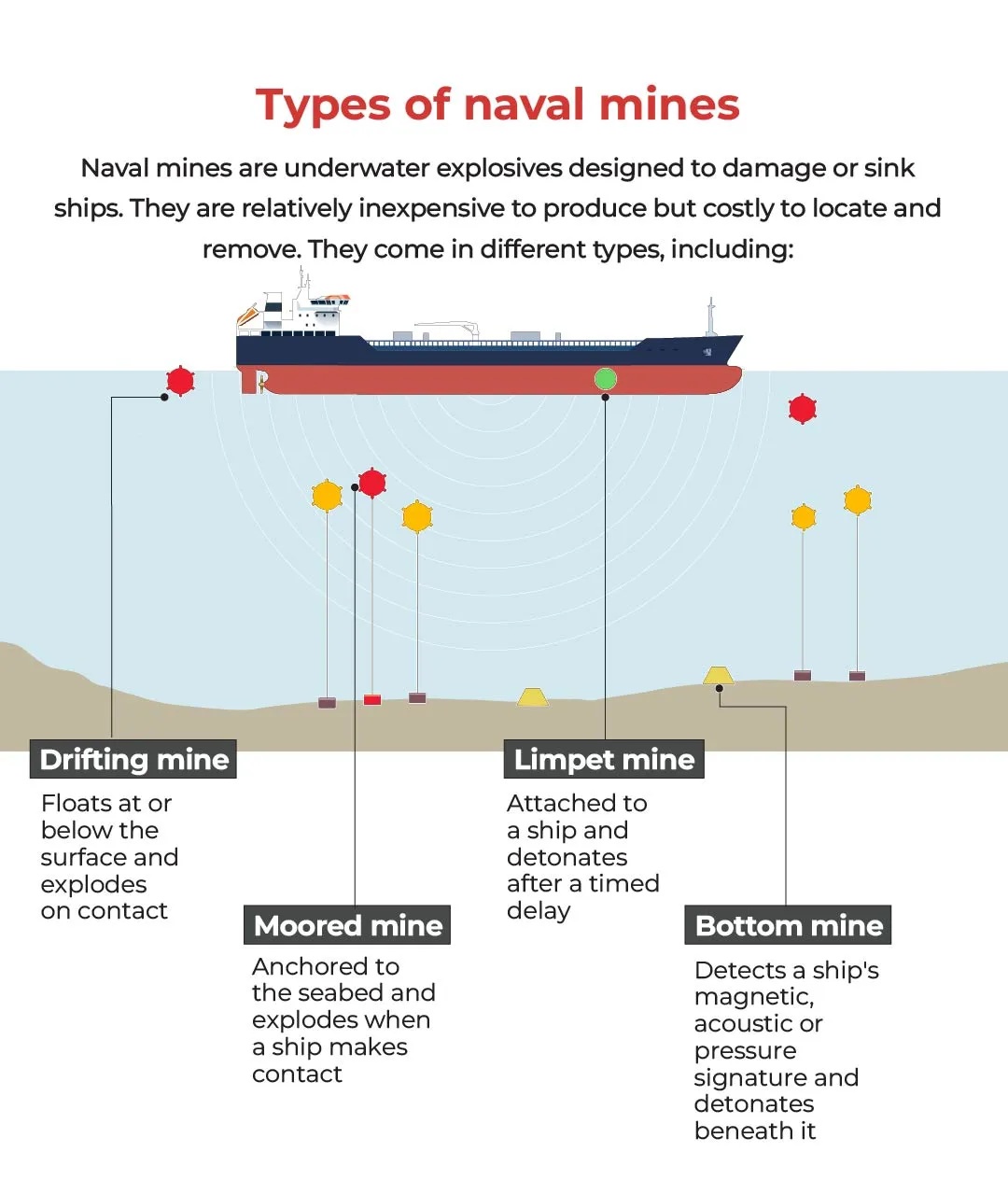
Adding to the volatility is the threat of underwater explosives. The US has accused Iran of planting sea mines – including moored contact mines and sophisticated bottom mines with magnetic or acoustic sensors.
While Iran has not officially confirmed this, it previously argued that its April route map minimised the risk of encountering them. The exact quantity and location of these mines remain unknown.
While President Trump claimed that US forces destroyed all 28 of Iran’s mine-laying vessels, Gharibabadi dismissed this as a political fabrication intended to calm global energy markets.
He warned that US mine-detection vessels would become “very good targets” if they entered the area.
The critical security situation was highlighted on Tuesday when the United Kingdom’s Maritime Trade Operations (UKMTO) reported that an oil tanker was disabled by an unidentified projectile near Oman’s Ash Shishah, close to the strait’s entrance, proving that despite the temporary accord, safe navigation remains highly precarious.