


Law Minister Md Asaduzzaman has called for effective international engagement to ensure the safe, voluntary, dignified and sustainable repatriation of Rohingyas to Myanmar
Asaduzzaman said the crisis is an international responsibility rather than a problem for Bangladesh alone.
He said repatriation would not constitute a lasting solution unless the Rohingyas’ citizenship, security, human rights, education and dignity were guaranteed in Myanmar.
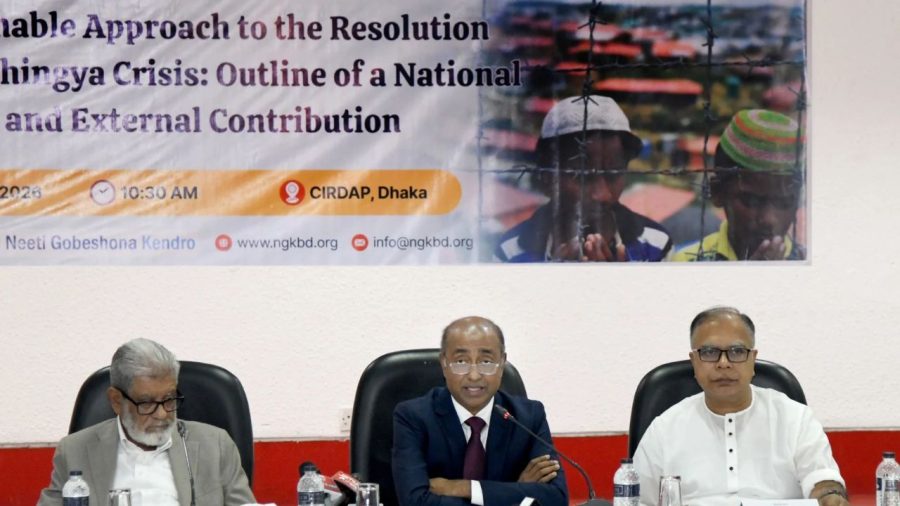
The minister made the remarks at a policy dialogue on the Rohingya crisis organised by the Policy Research Centre at the CIRDAP Auditorium on Topkhana Road in Dhaka on Sunday.
Asaduzzaman said resolving the crisis was not simply a bilateral matter between Bangladesh and Myanmar. Although the crisis originated in Myanmar, the country must take responsibility for resolving it, with the international community playing an active role.

He noted that the Rohingya crisis had been raised as an important issue at the United Nations General Assembly, where relevant international organisations, including the United Nations High Commissioner for Refugees (UNHCR), had demonstrated concern and engagement.
The law minister said Bangladesh was actively considering the human and civil rights of the Rohingyas. Their access to education, security, dignity and citizenship, as well as their right to return home safely and voluntarily, must be protected through a sustainable repatriation process backed by international support.
Recalling a meeting with the UNHCR on the sidelines of the UN General Assembly, Asaduzzaman said forcibly returning Rohingyas to Myanmar or imposing decisions on them would not resolve the crisis.
Every Rohingya must have the opportunity to return home safely and with dignity, with their citizenship, human rights, education and other entitlements as citizens guaranteed, he said.




Highlighting the challenges of hosting the refugees, the minister said Bangladesh was among the world’s leading refugee-hosting countries. Nearly 1.2 million Rohingyas are living in the country, placing considerable pressure on Bangladesh’s limited economic resources.
He said between 82 and 90 children were born in the Rohingya camps every day, warning that a prolonged crisis would intensify demographic, economic and social pressures on Bangladesh.
Beyond its humanitarian dimension, the crisis also involves national security, law and order and social stability, requiring a coordinated response, he said.
A national committee has been formed under the leadership of Prime Minister Tarique Rahman to formulate a national policy and review effective international initiatives to address the crisis.
Responding to calls at the dialogue for improved education and facilities for Rohingyas, Asaduzzaman said proposals aimed at protecting their dignity and rights were logical.
However, he stressed that decisions must take into account Bangladesh’s economic capacity, social realities and national security concerns to ensure they were practical and effective.

He also said the current government intended to pursue an effective resolution by drawing on initiatives and experience from previous governments led by Begum Khaleda Zia and the late President Ziaur Rahman.
Welcoming the Policy Research Centre’s initiative, the minister described the Rohingya crisis as a complex policy and international issue.
He said the government was keen to benefit from the experience of researchers and experts, describing institutions such as the Policy Research Centre as watchdogs and guides. Their constructive recommendations would receive serious consideration, he added.
The government would review future specific proposals and presentations on the crisis and seek to implement them, he said.
The dialogue was moderated by Policy Research Centre Executive Director Dr Shakil Ahmed. Ambassador Mohammad Sufiur Rahman, adviser to the centre, presented the keynote paper.
Researchers, experts, organisers and invited guests attended the programme.