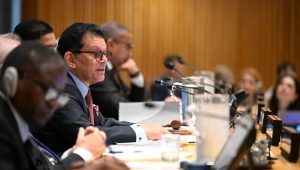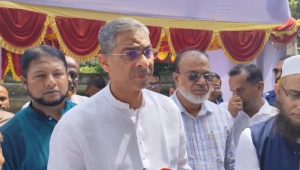

Bangladesh is emerging from a “dark era” of widespread human rights violations and moving toward a more acceptable situation, though a full transformation will rest with the next elected government, advisers to the interim administration said on Wednesday.
Speaking at an event marking International Human Rights Day, they said the interim government has initiated institutional reforms to address long-standing abuses—such as enforced disappearances, torture, and weak judicial independence—but stressed that sustainable progress requires continuity beyond the interim period.
The event, titled “Human Rights Day 2025: Strengthening Bangladesh’s Commitment to Justice and Rights for All,” was held at Hotel InterContinental Dhaka. UNDP Bangladesh organised it in partnership with the Legislative and Parliamentary Affairs Division of the Ministry of Law, Justice and Parliamentary Affairs.
Dr Asif Nazrul, adviser for law, justice and parliamentary affairs, said human rights have been placed “at the core” of governance since the formation of the interim government, which emerged in response to public demands for an end to abuses and the rebuilding of democratic institutions.

He highlighted Bangladesh’s ratification of major international human rights instruments, noting that the country is the first in South Asia to join all 10 core conventions of the International Labour Organization (ILO).
Nazrul described the National Human Rights Commission Ordinance 2025 as a major step forward, aligning the commission with the Paris Principles to ensure independence and effectiveness. Under the new law, the commission’s jurisdiction extends to all security forces, with unrestricted access to detention centres, measures expected to help secure the commission’s internationally recognised ‘A’ status.
On torture prevention, he said measures are being taken under the Optional Protocol to the Convention Against Torture (OPCAT), including the creation of a National Preventive Mechanism empowered to conduct unannounced inspections and confidential interviews. The government is also considering withdrawing reservations to Article 14(1) of the convention.




Addressing enforced disappearances, he cited the Enforced Disappearance Prevention and Remedy Ordinance, which authorises the human rights commission to investigate such cases and provides for special tribunals to ensure swift justice.
Nazrul also announced reforms aimed at strengthening judicial independence, including the upcoming Supreme Court Secretariat Act, which will shift administrative and financial powers from the law ministry to the Supreme Court. Additional initiatives—covering arrest and remand procedures, legal aid, and the establishment of new courts—are intended to expand access to justice.
Nazrul termed the invitation to the UN Office of the High Commissioner for Human Rights (OHCHR) to investigate July uprising-related violations a “bold step” toward transparency, noting that plans are underway to establish a full OHCHR office in Dhaka. However, he cautioned that legal reforms will fall short without strong institutions, adequate resources, and proper implementation.
Environment, Forest and Climate Change Adviser Rizwana Hasan said human rights cannot be protected through laws and institutions alone, stressing the need for rights-respecting social values.
Sharing personal experiences of facing gender-based attacks while in office, she said such incidents reflect deeper societal shortcomings. She noted that one year is insufficient for comprehensive reforms, making it crucial for future governments to build on the foundations laid by the interim administration.
Rizwana said Bangladesh has moved from near the bottom of global human rights rankings to a more acceptable position, though the journey remains long. She highlighted progress in environmental legislation, including recognising the rights of traditional forest dwellers in forest and wildlife laws for the first time.
Housing and public works adviser Adilur Rahman Khan said the July 2024 student–people’s uprising ended more than 15 years of rights deterioration, calling it a turning point that restored democratic aspirations.
While praising key ordinances and trials relating to disappearances and extrajudicial killings, he expressed regret that laws on victim protection and human rights defenders—including journalists—could not be enacted during the interim period.
Other speakers included Legislative and Parliamentary Affairs Division Secretary Dr Hafiz Ahmed Chowdhury, UNDP Resident Representative in Bangladesh Stefan Liller and Swiss Embassy Deputy Head of Cooperation Corinne Thevoz.