




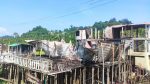
Transparency International Bangladesh (TIB) has called for ensuring the fair rights of indigenous people to fulfill the dream of a discrimination-free Bangladesh. At the same time, the organisation stated that indigenous people in the plains and hilly regions are falling victim to irregularities and corruption in the government’s social security programmes.
In a report presented at a press conference held at TIB’s Dhanmondi office on Tuesday, it was said that union parishad members, chairmen, village police, officers of the upazila social services office, and many others are involved in extorting bribes from indigenous people in obtaining services from social security programmes.
This information has emerged in TIB’s research report titled “Inclusion of Indigenous Communities in Social Security Programs: Challenges of Good Governance and Ways to Overcome Them”.
The report states that in various allowance-based and goods-based programmes, indigenous communities have to pay bribes ranging from a one-time minimum of Tk500 to a maximum of Tk10,000.

Additionally, there exist issues such as the reduction of allocations for indigenous people in social security programmes, legal and policy framework deficiencies, not being included at the expected level, not adopting demand and population-based programmes, and lack of transparency in beneficiary list preparation.
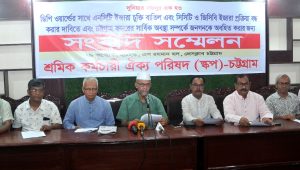
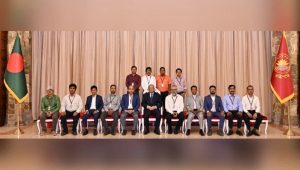
Present at the press conference were TIB’s Executive Director Iftekharuzzaman, Adviser and Executive Manager Sumaiya Khair and Director, Research and Policy, Muhammad Badiuzzaman. The press conference was conducted by Mohammad Touhidul Islam, Director, Outreach and Communication. The report was presented by Razia Sultana, Research Fellow, TIB.

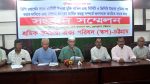
Iftekharuzzaman said that a primary condition for establishing peace is eliminating discrimination and ensuring the fair rights of the concerned communities. Pointing out that the fair entitlements of marginalised communities, especially indigenous communities in the plains and hilly regions, have not been ensured under the social security programmes, TIB’s Executive Director said, “In each of the seven indicators of the research, deficits in good governance and transparency and a concerning picture of corruption and irregularities have been revealed.”
From this, it is clear that the state is failing to ensure the fair entitlements of indigenous people. Establishing equal rights is a fundamental prerequisite for building a discrimination-free and peaceful democratic society, and indigenous people have not been successfully included in the mainstream of social protection and security aimed at that goal. Indigenous people are trapped in a cycle of irregularities and corruption, he added.
Iftekharuzzaman said, “A kind of majoritarianism exists within the state structure. As a result, we do not see the realisation or recognition of the fair dues and rights of indigenous people.”
Among the pictures of irregularities and corruption that emerged in the research in allowance-based and goods-based programmes, it was found that in the Old Age Allowance (Lifelong) program, indigenous people in the plains have to pay a one-time bribe ranging from Tk500 to a maximum of Tk10,000 taka for the Old Age Allowance (Lifelong), and indigenous people in the Chittagong Hill Tracts from Tk2,500 to Tk6,000 taka.
Similarly, for the allowance-based programme VWB, indigenous people in the plains have to pay a one-time bribe of Tk2,000 to Tk10,000 taka, and hill indigenous people Tk2,000 to Tk6,000.
The research report further stated that in terms of financial allocation, it was found that the rate of social security budget in GDP has gradually decreased from the 2020-21 fiscal year to the 2025-26 fiscal year. Likewise, although the ILO Convention includes the identity of “indigenous” and recognition of traditional land rights, Bangladesh has not ratified it.
The research also found that the average rate of applicants and those selected among them compared to the eligible population in five social security programmes is 19.7 percent. The websites of the 22 union parishads covered by the research did not publish beneficiary lists for most programmes and necessary information about social security programmes, and if available, the information was not updated.