




NBR collected more revenue than the previous fiscal year, but the gains were not enough to bridge a Tk87,527 crore gap as income tax, local VAT and import duty fell short of their FY2025–26 targets.
According to provisional data from the NBR’s Research and Statistics Wing, the revenue authority collected Tk415,473 crore against its revised target of Tk503,000 crore for FY2025–26.
Overall collection increased by slightly more than 12 per cent from around Tk370,875 crore in FY2024–25, but the growth remained insufficient to achieve the revised target.
The shortfall was spread across all major revenue heads, with import duty, import-stage VAT, import-stage supplementary duty, excise duty, local VAT, local supplementary duty, turnover tax, income tax and travel tax all remaining below their revised targets.
Three sources widen revenue gap
Income tax posted the largest shortfall, with the NBR collecting Tk143,173 crore against a revised target of Tk183,479 crore — a gap of more than Tk40,000 crore.
Local VAT collection stood at Tk96,600 crore against a revised target of around Tk122,411 crore, leaving a shortfall of approximately Tk25,800 crore.
Import duty collection reached Tk35,421 crore, compared with a revised target of Tk51,835 crore, resulting in a gap of around Tk16,400 crore.

Revenue growth fails to lift tax-to-GDP ratio
The increase in revenue collection failed to improve Bangladesh’s tax-to-GDP ratio, according to Mustafizur Rahman, fellow at the Centre for Policy Dialogue.
Mustafizur said real GDP growth of around 4 per cent and average inflation of 9 per cent would imply nominal GDP growth of approximately 13 per cent. During the same period, NBR revenue grew by around 12 per cent, meaning there was virtually no improvement in the tax-to-GDP ratio.
He said the NBR had repeatedly been given revenue targets that were overly ambitious compared with economic realities.
“Without major structural and administrative reforms and an improvement in the macroeconomy, achieving such targets will not be possible,” he said. “Stagnant investment, weak import growth and low implementation of the Annual Development Programme prevented VAT and import duty collections from growing at the expected pace.”




He called for expanding the direct tax base, reducing tax evasion, strengthening digital systems and establishing greater interoperability among revenue-related systems. He also stressed investing in technology and skilled personnel at the NBR.
“If these initiatives are not implemented effectively, achieving the revenue target will remain difficult and the government’s dependence on borrowing could reach a riskier level,” he said.
Four categories see year-on-year decline
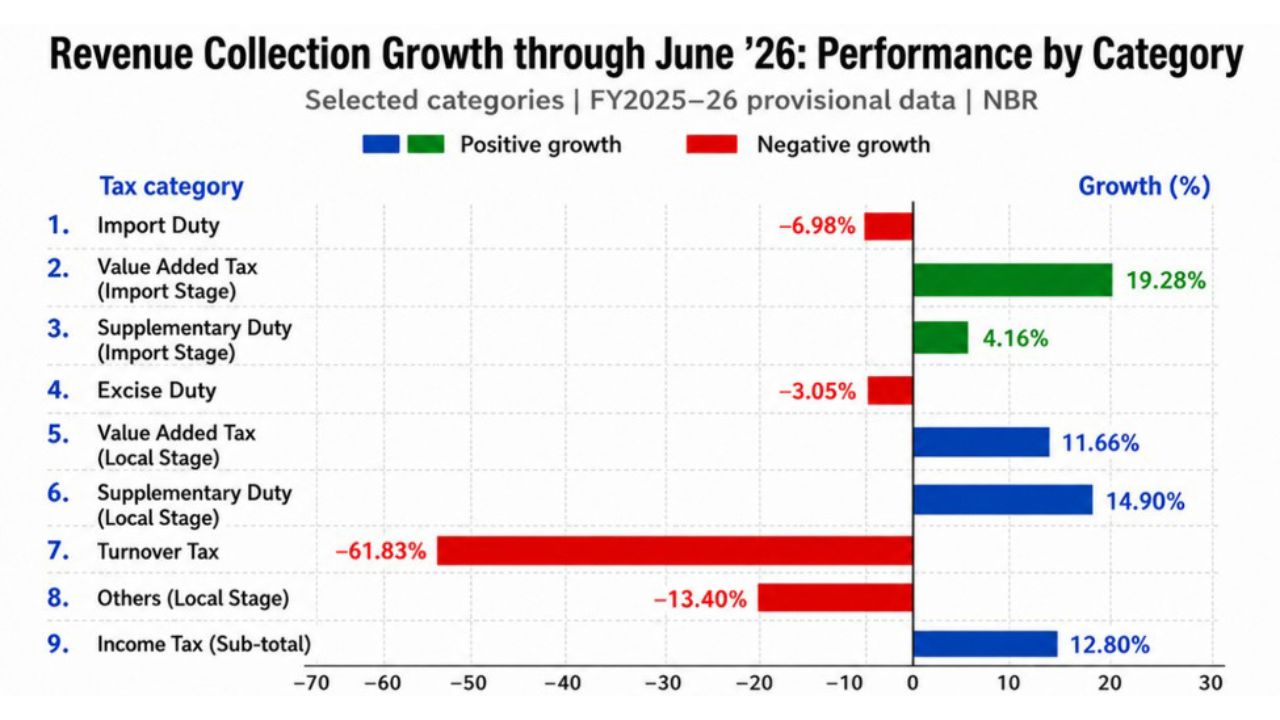
Alongside missing targets, collections declined from the previous year in four categories: import duty, excise duty, turnover tax and local-stage “other” revenue.
Import duty collection fell by around Tk2,659 crore, or nearly 7 per cent, from approximately Tk38,080 crore in FY2024–25 to Tk35,421 crore in FY2025–26.
Excise duty collection declined to Tk5,207 crore from around Tk5,371 crore, while turnover tax dropped to Tk6 crore from approximately Tk16 crore.
Revenue from the local-stage “other” category fell to around Tk3,594 crore from Tk4,150 crore.
By contrast, collections increased year-on-year from import-stage VAT, import-stage supplementary duty, local VAT, local supplementary duty and income tax. These increases pushed overall NBR revenue above the previous year’s level.
A divergent trend was also visible among import-related taxes. While import-stage VAT and supplementary duty increased, import duty declined, despite all three being collected at the import stage.
Target debate continues
Former NBR chairman Muhammad Abdul Majid said the large shortfall resulted from unrealistic target-setting that did not reflect the economy’s actual capacity, combined with stagnant investment and business activity.
He said the performance of the revenue system should not be judged solely by the size of the gap against the target. The nearly 12 per cent year-on-year growth in revenue should also be taken into account.
According to Majid, weak economic activity, high inflation, sluggish investment and business uncertainty made a large shortfall almost inevitable. Revenue cannot be increased sustainably merely by imposing greater administrative pressure without revitalising the economy.
“When business and investment expand, production, imports, incomes and transactions also rise, naturally widening the government’s revenue base,” he said.
Majid also pointed to institutional weaknesses at the NBR, including failure to detect tax evasion, inability to bring potential taxpayers into the tax net, complicated income tax laws and harassment of taxpayers.
He called for simpler and more transparent laws and taxpayer-friendly services.
However, he said the NBR alone could not be held responsible. Many people obtain taxpayer identification numbers but do not file returns regularly, while others conceal taxable income.
Majid described Bangladesh’s low tax-to-GDP ratio as a symptom of deeper economic problems, including weak administration, income inequality, irregularities and inadequate accountability.
He stressed realistic target-setting, an investment-friendly environment, expansion of the tax net, prevention of tax evasion and institutional reforms at the NBR.