


For 17 years, 9.58 seconds was the closest humanity had come to touching the impossible.
Usain Bolt ran that time beneath the Berlin sky in 2009, his impossibly long stride eating up the track as the world watched. It was more than a record. It was a line drawn around the limits of the human body. Then, in Beijing, something crossed that threshold.
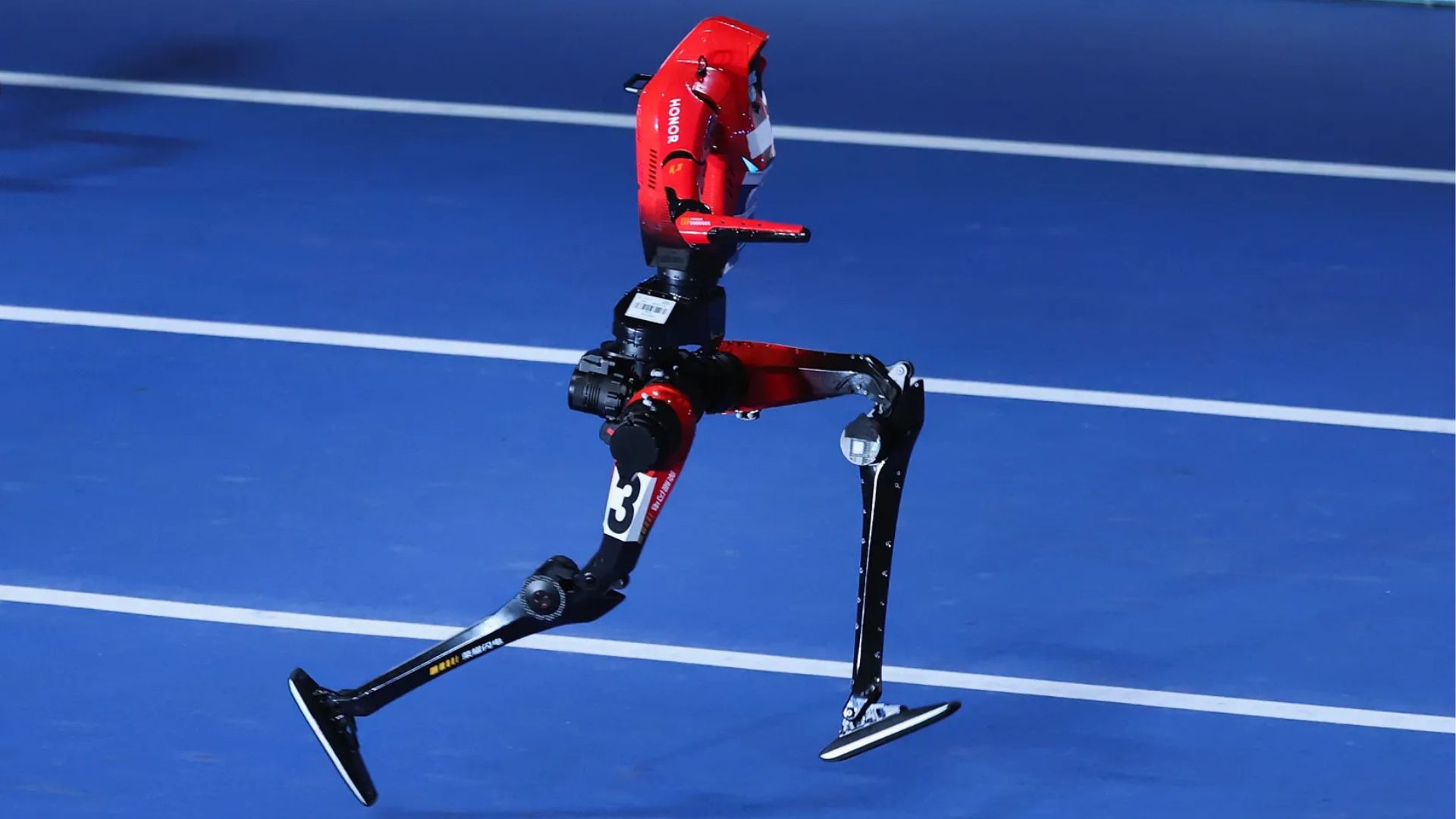
Inside the National Speed Skating Oval – better known as the “Ice Ribbon” – the future arrived on two mechanical legs. Tiangong Ultra, a Chinese humanoid robot developed by the Beijing Humanoid Robot Innovation Centre, ran 100 metres in 9.39 seconds and that was only the beginning.
By the end of the Games, Tiangong Ultra had lowered its own mark to 8.64 seconds. The machine had not merely beaten Bolt; it made his record look average.
And yet, watching the robots run, there was something strangely human about the spectacle. They stumbled, they wobbled, they crashed and some could barely stop. The machines had learned how to run faster than us. They had not yet learned how to stop like us.

The extraordinary part is not simply that a robot ran 100 metres in less than 10 seconds. It is how quickly it learned to do so. At the inaugural World Humanoid Robot Games a year earlier, Tiangong Ultra won the same race in 21.50 seconds. Twelve months later, that time had been cut by more than half.
That is a rate of improvement biology simply cannot match. A human sprinter spends years teaching muscles, tendons, nerves and instincts to cooperate. A machine can be redesigned, its joints can be strengthened, its software can be rewritten, its balance algorithms could be refined.
China has understood this potential early. Humanoid robotics has become a strategic industry, backed by government policy, research institutions, manufacturers and enormous amounts of engineering talent. The objective is not merely to build robots that resemble people. It is to build machines capable of moving through a world designed for people. The sprint is therefore less a sporting event than a demonstration.




Every stride is a calculation; every landing requires the machine to predict where its centre of gravity will be a fraction of a second later, every movement demands coordination between motors, sensors, batteries and software.
The numbers are extraordinary, although the comparison needs a footnote: This is a robot competition, not an officially sanctioned athletics event, and the conditions are not identical to those under which Bolt’s record was set.
But perhaps that is beside the point. The significance lies in what happened between 21.50 and 8.64 seconds. The robots did not merely improve. They exploded forward.
A human sprinter crosses the line and begins to slow almost instinctively. Bolt could turn to the crowd, raise his arms and strikes the iconic pose that became one of the most recognisable images in sporting history.
Tiangong Ultra had no such luxury, after reaching its astonishing speed the machine struggled to shed its momentum, it veered beyond the finish and crashed toward the protective barriers, while Lightning (the robot that came second) slammed into a crash mat.
The crowd watched a machine capable of outrunning the fastest human alive fail at something every child learns instinctively: How to stop.
It was funny and slightly frightening. Yet, strangely, it was reassuring because it revealed the enormous distance still separating a machine that can perform a spectacular task from one that can truly understand the world around it.

More than 2,000 robots from 666 teams and 16 countries took part in 51 events, ranging from sprinting and football to industrial and household tasks. The real prize was never the medal. It was data.
A robot that learns to balance at high speed is learning something that could eventually help it move through a warehouse. A machine trained to manipulate objects could someday work alongside humans in factories. The same technologies could find their way into disaster response, logistics, hospitals and homes. The 100-metre dash simply gives us a spectacular way of seeing the progress.
For decades, one of the fastest things on two legs was a human. Now it isn’t. Perhaps that should not make us afraid. Perhaps it should make us curious because the most remarkable thing about Beijing was not that a machine finally outran Usain Bolt.
It was that, for the first time, we could watch the future sprinting toward us and unlike Bolt, it is only getting faster.