


The government has rejected a request from deposed prime minister Sheikh Hasina for a passport and national identity card (NID), yet her party, the Awami League, is pressing ahead with its plan to bring her back to Bangladesh in December.
The request, submitted to the Bangladesh High Commission in New Delhi by British law firm Matrix Chambers on Hasina’s behalf, has triggered fresh political debate over her possible return and added another point of tension to Bangladesh-India relations.
The move also appears to be part of a broader Awami League effort to put political pressure on the BNP government by turning Hasina’s return into a public and diplomatic issue.
The development came just a day before Prime Minister Tarique Rahman was scheduled to leave Dhaka for a three-day visit to Turkey to attend the COP31 summit.
Despite the government’s position, several AL leaders say preparations are under way for Hasina’s return in December. They claim party leaders and activists have been instructed to gather in Kolkata by November to take part in a planned mobilisation around her return.
According to AL leaders, the law firm will send follow-up notice if Dhaka does not respond to the request.
They said that if the government fails to respond, Hasina may attempt to enter Bangladesh through the Benapole border, travelling from Petrapole in India. From there, she could travel through Jashore to Tungipara before heading to Dhaka as part of a planned long march.
The leaders said such a move would depend on whether the Indian government allows her to travel to the Petrapole border and facilitates her passage to the immigration point.

If she reaches Benapole, Bangladeshi authorities would have to take her into custody in accordance with the legal process, given her conviction and outstanding legal obligations, they said.
Former state minister Mohammad Ali Arafat told TIMES that Hasina would return to Bangladesh in December with thousands of party leaders and activists.
“Sheikh Hasina will return home in December with thousands of leaders and activists at any cost. This is final. No one can turn it back,” he said.
Arafat argued that the request for a passport and NID was intended to facilitate her return and challenged the government to issue the necessary travel document.
“No political leader in the history of the world has wanted to return home with a death sentence on his head. Sheikh Hasina is asking for a passport and NID to return home. The government should give her a passport or travel pass and see if she comes,” he said.
Referring to comments by the law minister, Arafat said India did not view Hasina in the same way as the Bangladesh government did, adding that she was being treated with respect as a guest of the Indian government.



Passport and NID request
Matrix Chambers sent an email to the Bangladesh High Commission in New Delhi seeking the issuance of a passport and NID for Hasina.
Press Minister of the Bangladesh mission in Delhi Saidur Rahman confirmed that the mission had received the email. However, he questioned whether the request was genuine, saying the law firm had not provided an authorisation letter or supporting documents establishing that it was acting on Hasina’s behalf.
“We are not sure whether the request is genuine. There is no way for us to verify whether the request was actually made on behalf of Sheikh Hasina, as the email sent by the law firm did not include any authorisation letter or supporting documents proving that the firm was authorised by her to make such a request,” he said.
The email was forwarded to the Ministry of Foreign Affairs for consideration, he added.
Govt’s position
The government has played down the significance of the request, while saying that its authenticity and legal basis are being examined.
Home Minister Salahuddin Ahmed said the foreign and law ministries were reviewing whether the application had been submitted properly and whether Hasina had a legal right to seek the documents under the circumstances.
The ministries would examine the relevant laws and regulations before deciding on any action, he said.
The minister also pointed out that Bangladesh had already approached the country where Hasina is staying, seeking her extradition under the bilateral extradition treaty.
State Minister for Foreign Affairs Humaiun Kobir said on Monday that the government did not attach importance to the application submitted by Hasina’s lawyer.
He reiterated that Bangladesh wanted India to hand over Hasina through the formal extradition process and that Dhaka would pursue the matter under the existing treaty between the two countries.

Legal debate over eligibility
Former Awami League minister SM Rezaul Karim argued that Hasina was entitled to a passport as a Bangladeshi citizen.
“The Passport Act of 1973 states that any Bangladeshi citizen, subject to the validity of his identity and citizenship, is entitled to a passport. The word means that any citizen whose citizenship is valid is entitled to a passport,” he told TIMES.
He also referred to Article 36 of the Constitution, which guarantees citizens the right to move freely, reside and settle anywhere in Bangladesh, as well as to leave and re-enter the country, subject to reasonable restrictions imposed by law.
The legal argument, however, does not by itself settle whether Hasina is eligible to obtain a passport under the applicable laws and regulations in view of her conviction and other legal circumstances.
Diplomatic implications
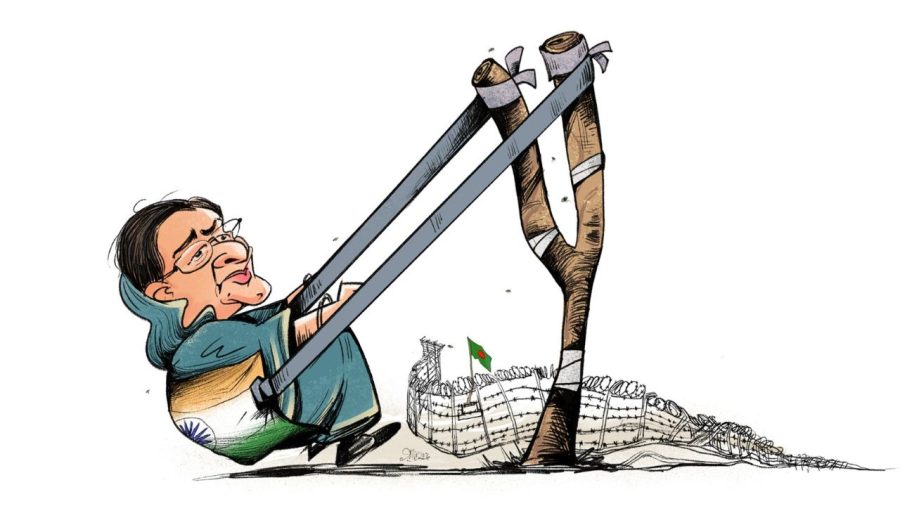
The Hasina issue is likely to remain a major point of friction between Dhaka and New Delhi as long as she remains in India and Bangladesh continues to seek her extradition.
A former diplomat, speaking on condition of anonymity, said it remained uncertain whether the AL could turn the issue into an effective international campaign.
He recalled that more than 30 countries had urged the then Bangladesh government to allow former prime minister Khaleda Zia to travel abroad for medical treatment.
However, he questioned whether the Awami League could secure comparable international support, referring to the UN report that attributed responsibility to the former government and its security forces for the killing of around 1,400 people during the 2024 crackdown.
On Bangladesh-India relations, the former diplomat said New Delhi would continue to use the Hasina issue as an instrument in bilateral dealings.
“India has been and will continue to use the Hasina card at its will, and the former prime minister will dance to the tune of Delhi,” he said.
He added that developments within India could also influence how much attention the issue received from the BJP-led government. If the Indian ruling party faced domestic political instability or sustained opposition protests, Bangladesh might receive less priority, he said.