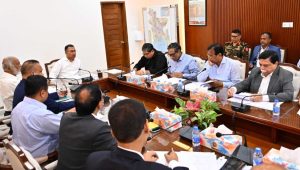
Health and Family Welfare Minister Sardar Md Sakhawat Husain has said that the government’s priority is to ensure primary healthcare for all citizens and provide services meeting the highest standards.
He made the remarks at a discussion meeting on expanding urban primary healthcare held at a hotel in Dhaka on Thursday morning.
The event, organised by the Directorate General of Health Services (DGHS), focused on evidence-based findings, implementation experiences and lessons from the ‘Alo Clinic’ model, which will help shape future government initiatives to strengthen urban primary healthcare.
The health minister said kidney dialysis services were being introduced at the upazila level as part of the government’s efforts to expand healthcare facilities beyond major cities.

“The government is working to develop all types of healthcare services at the upazila level,” he said.
Sakhawat said the government was working with international organisations, development partners and donor agencies to improve the quality of public healthcare.




He added that healthcare coverage was being expanded to ensure that no one loses their life due to a lack of treatment. Ambulance services would also be extended to bring patients from remote areas to advanced medical facilities, he said.
The workshop was chaired by DGHS Director General Prabhat Chandra Biswas, while Swedish Ambassador Nicolas Weeks and UNICEF Deputy Representative Emmanuel Abreu also spoke at the event.
Speakers said that although Bangladesh’s urban population continues to grow rapidly, many children and families still face challenges in accessing affordable and quality healthcare.
Since 2021, six Alo Clinics established in Dhaka North, Dhaka South, Gazipur and Narayanganj have been providing free, integrated and fully digital primary healthcare services under the national Essential Services Package (ESP++).
The Alo Clinic model provides a range of services, including maternal, newborn and child healthcare, vaccination, nutrition screening, diagnosis and treatment.
On average, 168 patients receive services from each clinic every day. Four of the clinics also operate 24-hour midwife-led normal delivery centres, where more than 1,000 safe deliveries have been conducted since January 2025.
The workshop reviewed more than four years of experience from implementing the Alo Clinic model and discussed lessons that could support future expansion of urban primary healthcare.
UNICEF developed and implemented the Alo Clinic model in partnership with the Government of Bangladesh, with financial support from the Government of Sweden.