


Winter is yet to arrive in Sylhet. A walk around the city offers hardly any signs of the approaching chill. But take a stroll around the Sylhet International Cricket Stadium at night, and the air tells a different story. The fragrance of Chattim flowers drifts through the grounds, carried by a gentle, soothing breeze. Meanwhile, the lush green gallery and the tea garden beside the stadium are slowly turning grey as the season begins to leave its mark on the landscape.
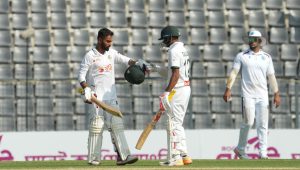
The grey will eventually give way to green again when winter passes. But Hasan Mahmud has already left a mark that will last much longer. On the second day of the Sylhet Test against West Indies, the Bangladesh pacer provided the hosts with a timely burst of pace, particularly valuable in an attack that had gone into the match with only two specialist fast bowlers. His figure of 6-90 helped bowl West Indies out for 356, earning him his first five-for on home soil.
The achievement took Hasan to five Test five-wicket hauls, the most by a Bangladesh fast bowler. Three of those have come in 2026, a year in which he has found success across different conditions and continents. He has also become only the second bowler after Nathan Lyon to take each of his first five Test five-wicket hauls in five different countries.
The journey began in Chennai, followed by Rawalpindi, Darwin and Abu Dhabi, before Hasan added Sylhet to the list. Each venue presented a different challenge, but his ability to adapt and maintain his discipline has remained a constant.
His resurgence gathered momentum after a successful stint with Kent in the English summer and early autumn, where he claimed 26 wickets in four matches. Since then, Hasan has carried that form into international cricket, taking wickets on the lively surface in Darwin against Australia, finding success on the flat track in Abu Dhabi and now producing a match-defining spell in Sylhet.

Different conditions, different challenges, but the same consistency.
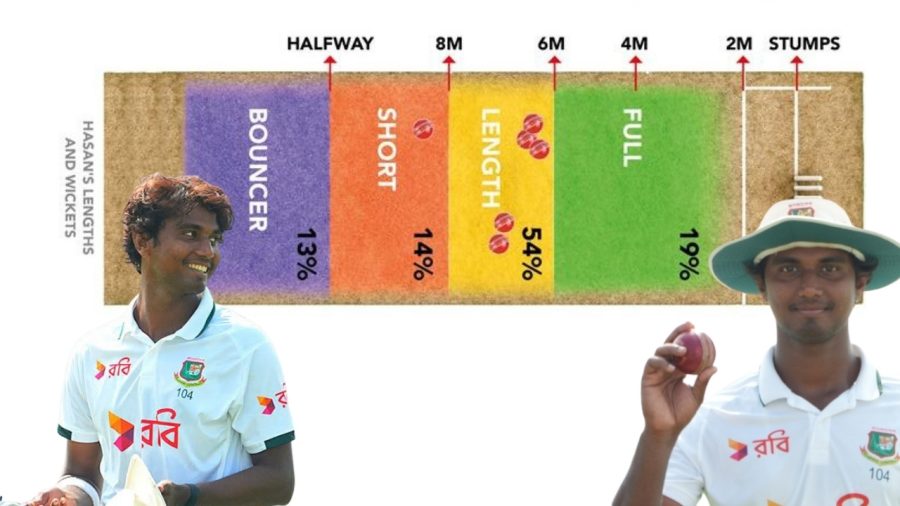
The numbers from his 24 overs in the first innings of the Sylhet Test offer a glimpse into how he went about his work. More than 54 per cent of his deliveries landed around the six-metre mark, a good length that accounted for five of his six wickets. He went fuller with around 19 per cent of his deliveries, using them to draw batters forward, while 13 per cent were bouncers to keep them guessing.
His first breakthrough came on the opening day against Kavem Hodge. Having troubled the batter with deliveries around the good length and movement away from him, Hasan brought one back sharply. Hodge left it alone, only to see the ball crash into his middle stump.




A day later, Hasan used a similar method to end Amir Jangoo’s resistance. The West Indies centurion had been the backbone of the innings with 133 off 212 balls. After Bangladesh took the second new ball in the 81st over, Hasan began the next over with three fuller deliveries from around the wicket before bringing the fourth sharply back into Jangoo.
Expecting the ball to move away, the left-hander left it alone, only to see it jag back in and crash into the top of off stump. The ball moved 0.6 degrees, leaving Jangoo with no chance to adjust.
Jangoo’s dismissal ended his 106-run stand with Justin Greaves, having earlier shared a 131-run partnership with debutant Kevin Wickham.
The centurion later acknowledged Hasan’s consistency and ability to move the ball in either direction.
“I think he bowled a consistent area. The ball was either seaming away or seaming in. So for me, I thought when the ball pitched on that length, I thought it would have seamed away. So for me, it was just poor judgment on my part. But having said that, credit to him, Hasan, for bowling those areas consistently for that period of time,” Jangoo said after the day’s play.
Hasan followed up Jangoo’s dismissal by moving the ball sharply into captain Roston Chase, who edged it through to Litton Das. That left the pacer on a hat-trick, but Joshua Bishop survived after successfully reviewing an lbw decision. UltraEdge showed a thick inside edge before the ball struck his pad.
Hasan’s fifth wicket, however, was perhaps the most unusual of his career. With Bishop looking to negotiate the seam movement, Litton moved closer to the stumps after a discussion with captain Najmul Hossain Shanto. Hasan delivered a fuller ball outside off stump, tempting Bishop into a drive. The batter missed, lost his balance and lifted his back foot. Litton whipped off the bails, and the third umpire confirmed that Bishop’s foot was in the air.
The dismissal made Hasan the first Bangladesh pacer to claim a Test wicket through a stumping. He later completed his six-wicket haul by bowling Shamar Joseph with a delivery that moved slightly off the seam.

There was a method behind the variety. Hasan used fuller deliveries to invite drives, mixed in bouncers after setting a leg-side-oriented field and relied heavily on the hard length that brought him most of his success. The aim was not simply to bowl a good delivery, but to make the batter anticipate one thing before offering something different.
Explaining how he sets up a batter, Hasan said he tries to create an expectation over the course of an over before delivering the ball designed to take the wicket.
“Out of six deliveries, I try to bowl two or three in a way that makes the batter anticipate a particular delivery. I build that expectation through our bowling,” he said.
“Then, for the wicket-taking delivery, I use a slightly different plan. The batter might think that a certain delivery is not coming, or expect something fuller, and commit to playing it.”
And the satisfaction of beating a batter with that plan?
“It feels really good, actually, when you beat the batter,” Hasan said.