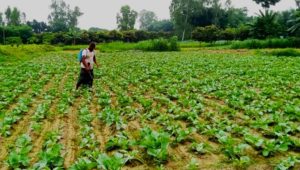
Nazrul Islam, a farmer from Jhenaidah, depends on agriculture for his livelihood. Alongside rice, he also cultivates different flowers. But this year, he has fallen into serious trouble due to a fertiliser shortage.
Despite visiting his dealer multiple times, he did not receive enough supply.
Sharing his predicament, Nazrul told TIMES of Bangladesh, “I cultivated rice and flowers on eight bighas of land. But the dealer gave me only 10 kilograms of fertiliser. When I asked why, they said the government did not send enough supply.
“Buying fertiliser from outside at higher prices means I cannot make any profits – most of my farming expenses go toward fertiliser.”
The same complaint has been heard from farmers in Lalmonirhat, Chuadanga, Meherpur, Dinajpur and Moulvibazar. TIMES district correspondents reported that farmers are not getting fertiliser as per their respective requirements.
Dealers and a new political syndicate are allegedly behind the artificial crisis and price hike.

Earlier, fertiliser from surplus districts, especially single- and double-crop regions, could be transferred to deficit areas. But since 5 August, such inter-district redistribution has stopped. As a result, fertiliser demand in some districts remains unmet.
Farmers growing crops outside government subsidy are forced to buy fertiliser at inflated prices.
According to field reports, after the recent political change, a new syndicate has emerged. This group allegedly takes a portion of fertiliser from dealers and sells it illegally at higher prices. Weak monitoring by government agencies has made the situation worse.
A senior agriculture official, requesting anonymity, said fertiliser demand is submitted to the government based on crop type, but allocations often fall short.



“Tobacco cultivation has no government allocation, yet farmers demand fertiliser. Some dealers secretly sell fertiliser to them at higher prices,” he said.
Jhenaidah Sadar Upazila Agriculture Officer Nur-e-Nabi, however, claimed there is no fertiliser crisis in his area.
“Most complaints come from tobacco farmers, who are not entitled to government-supplied fertiliser,” he said. “Some farmers also hoard more than they need, which creates temporary shortages.”
The Agriculture Ministry echoed his remarks, insisting that the country has enough fertiliser in stock. Officials said dishonest dealers try to create artificial shortages each year to make extra profit when demand is high.
Md Khorshed Alam, joint secretary of the fertiliser management and monitoring wing, told TIMES that “there is no shortage.”
He added that fertiliser is being supplied according to field demand and that local administrations are taking action against hoarders and overpricing.
“We have sufficient stock to meet demand until next January, and more imports are already in the pipeline,” Alam said.
Home and Agriculture Adviser Jahangir Alam Chowdhury recently gave the same assurance.
When asked about pro-Awai League dealers who have gone into hiding, he said district administrations are overseeing distribution in those areas. He added that a new dealership policy is being finalised to appoint fresh dealers where needed.
However, Meherpur BCIC Fertiliser Dealers’ Association President Hafizur Rahman said the shortage stems mainly from lower allocation than actual demand.
“Some dishonest traders are bringing fertiliser from other districts and selling it at higher prices, destabilising the market,” he said. “To restore normalcy, the government must ensure sufficient allocation and strengthen supervision.”
Agricultural economist Jahangir Alam Khan said proper distribution would leave no room for manipulation.
“If dealers are creating artificial crises, why is there no punitive action?” he asked. “The fertiliser management system is failing – the dealers are not beyond the government’s reach.”
Khan warned that continued shortages could affect the upcoming Boro season and threaten food security. He urged the government to pass the new dealership law quickly and double the number of dealers to reduce the risk of future crises.
According to the Agriculture Ministry, fertiliser demand peaks during the Rabi season, from November to March, when nearly 40% of the annual requirement is used.
The total demand this fiscal year is about 7 million tonnes, with 80% dependent on imports. The remaining 20% comes from domestic factories under the Bangladesh Chemical Industries Corporation and the Bangladesh Agricultural Development Corporation.