BNP promised the Family Card as part of its election campaign, and immediately after taking office, the government moved to implement it without delay.
Now, it is time to know what the ‘Family Card’ is, who is eligible, and how it will work.
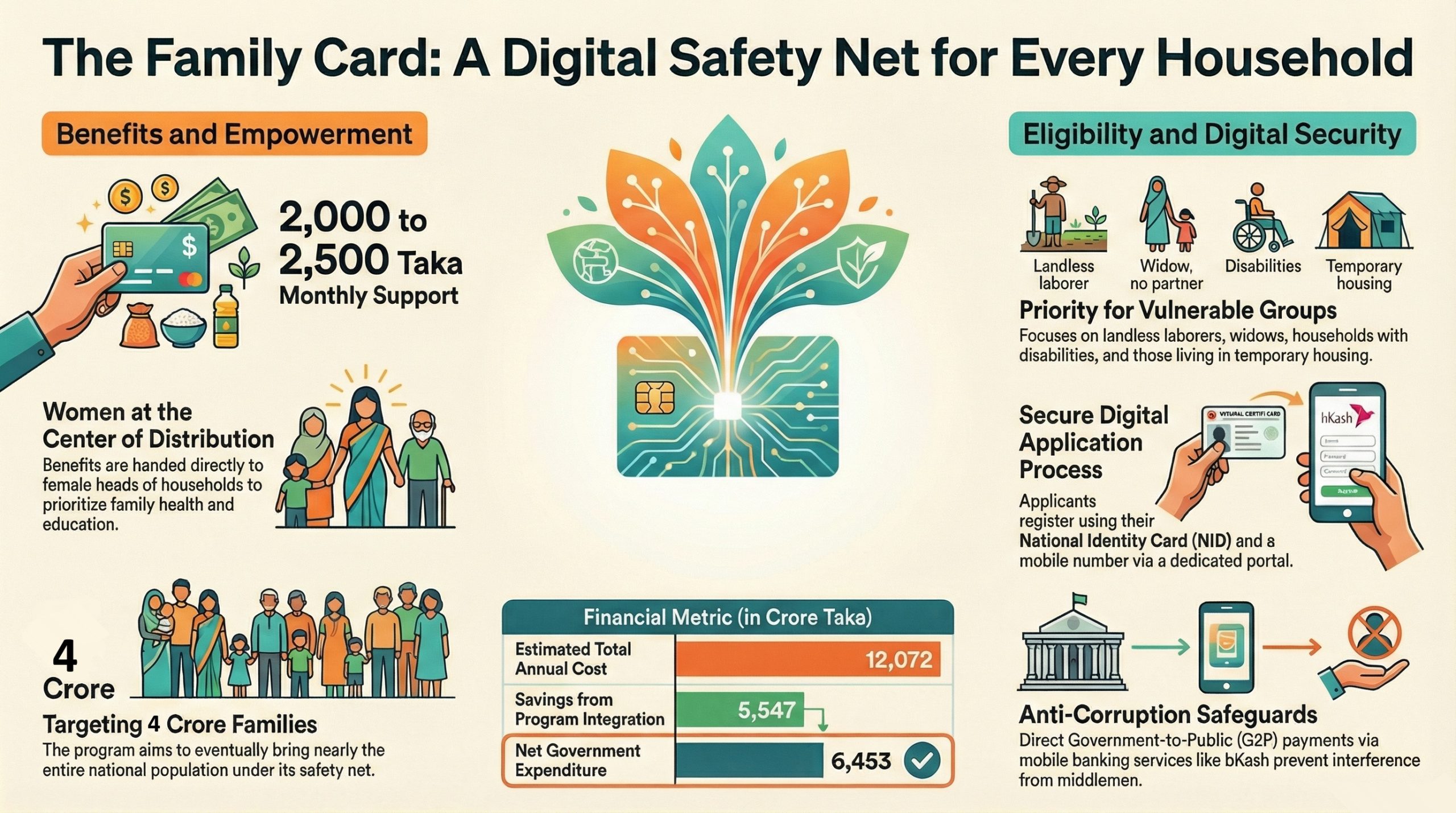
The flagship social security initiative aims to provide direct support to four crore families across the country, targeting poor and lower-middle-class households initially. Benefits will be handed directly to the female head of each household, promoting women’s empowerment.
Pilot project set to begin before Eid-ul-Fitr
The pilot phase will roll out during Ramadan, ahead of Eid-ul-Fitr, initially covering eight upazilas, including Gabtoli in Bogura and Nawabganj in Dinajpur.
Following this trial, the scheme will expand nationwide through local administration and public representatives. A 15-member cabinet committee, formed on 19 February 2026, will oversee the card distribution.
In the first phase, the scheme will issue Family Cards to 18,760 women in Gabtali upazila and 19,185 destitute women in Dinajpur district. Steps are also being taken to include eight upazilas in the programme before Eid.
Cash and commodity support
The programme offers monthly cash assistance or an equivalent value of essential commodities. Each registered family will receive 2,000 to 2,500 taka per month. Beneficiaries may also receive essential commodities such as rice, lentils, edible oil, and salt, either in cash or at subsidised rates.
Officials emphasise that the Family Card will complement existing social safety net programmes rather than replace them. Its universal and non-discriminatory design aims to prevent corruption and prioritise the most underprivileged families.

Initially the target is to bring around 50 lakh Family Card-holder families under the scheme. BNP leaders have indicated that over 50 percent of eligible families are expected to receive the Family Card within three to six months.
The party has stated that this is not only for a specific group, but gradually every family in the country will be brought under this digital card scheme.
During the campaign, it was announced that the programme’s ultimate vision is to bring nearly four crore people across the country under its social safety net.
Women at the centre of empowerment
Prime Minister Tarique Rahman underlined that the scheme is designed to empower women.
He mentioned, studies show that women manage direct support more effectively, spending it on family health, children’s education, and small investments.




The government expects this approach to strengthen local economies at village, upazila, district, and divisional levels, benefiting the national economy overall.
Application process
After the pilot, physical forms will be available at Union Parishad, Municipality, or Ward Councillor offices. A dedicated online portal is being prepared, allowing families to apply from home using their National Identity Card (NID).
Applicants must provide an NID, a passport-size photograph, and an active mobile number to receive a one-time password (OTP).
Only one card will be issued per family, and the assistance is set to exceed all existing social allowances.
Strict measures against corruption
To prevent irregularities and the influence of middlemen, the government is creating a central database based on National Identity Cards (NID).
The system will integrate multiple existing datasets, including national ID, birth and death registries, TIN records, mobile IMEI data, national savings accounts, and social welfare databases.
Social Welfare and Women and Children Affairs Minister AZM Zahid Hossain confirmed a three-level strict monitoring system to ensure only the needy receive benefits. The selection process will remain transparent and free from discrimination. The universal nature of the card aims to prevent the corruption often seen in categorised systems.
While the card is available to various professions, the government believes affluent families will not seek this aid.
Digital integration
Funds will be delivered digitally through mobile banking services like bKash, Nagad, and Rocket using the Government-to-Public (G2P) method.
The Social Security Management Information System (MIS) will verify NIDs, birth dates, and mobile numbers to maintain a clean database and prevent duplicate benefits. This digital approach marks a new innovation in Bangladesh’s social protection framework.
The sources said the Single Registry System contains information on about 3.3 crore beneficiaries across the government’s major cash-based systems, as well as non-cash programmes including 10.40 lakh beneficiaries under the Vulnerable Women Benefit programme and 55 lakh under the Food Friendly programme, with data on more than 4 crore beneficiaries in total. They added that integration work with the TCB Family Card system is ongoing.
The infromation was discloused at an inter-ministerial meeting at the Secretariat on 22 February on finalising an action plan to launch the Family Card. Finance Minister Amir Khasru Mahmud Chowdhury chaired the meeting, which was attended by committee members, senior officials and ministers from the Ministry of Women and Children Affairs and the Ministry of Social Welfare.
Priority beneficiaries
The government will prioritise rural families with extreme poverty, landless labourers, day labourers, households with unemployed members, female-headed households, widows, divorcees, single women, and households with children, persons with disabilities, or autism.
Families living in homes made of mud, bamboo, or straw will also receive priority.
Beneficiaries of existing programmes will be integrated to avoid duplication, ensuring that no household receives multiple cards.
Implementation plan and cost
The inter-ministerial meeting at the Secretariat on 22 February on finalising an action plan to launch the Family Card confirmed, the government estimates providing monthly assistance to 50 lakh families will cost approximately 12,072 crore taka per year.
By integrating existing social safety net schemes, including the Vulnerable Women Development Programme, elderly and widow allowances, mother-and-child support schemes, and food-friendly programmes, authorities expect to save around 5,547 crore taka, reducing the net expenditure to 6,453 crore taka.
Strengthening Bangladesh’s social safety net
BNP leaders describe the Family Card as a groundbreaking social innovation. Social Welfare and Women and Children Affairs Minister AZM Zahid Hossain emphasised that the scheme delivers benefits directly to recipients, ensuring speed, fairness, and transparency.
Environment, Forest and Climate Change Minister Abdul Awal Mintoo confirmed that the pilot will begin before Eid-ul-Fitr, fulfilling a key electoral promise and providing immediate relief to vulnerable households.
The government aims to bolster economic security, empower women, and provide essential support, while maintaining strict oversight to prevent corruption. Authorities highlight that the Family Card is universal, inclusive, and aligned with Bangladesh’s vision of a digitally enabled, transparent social safety net.