






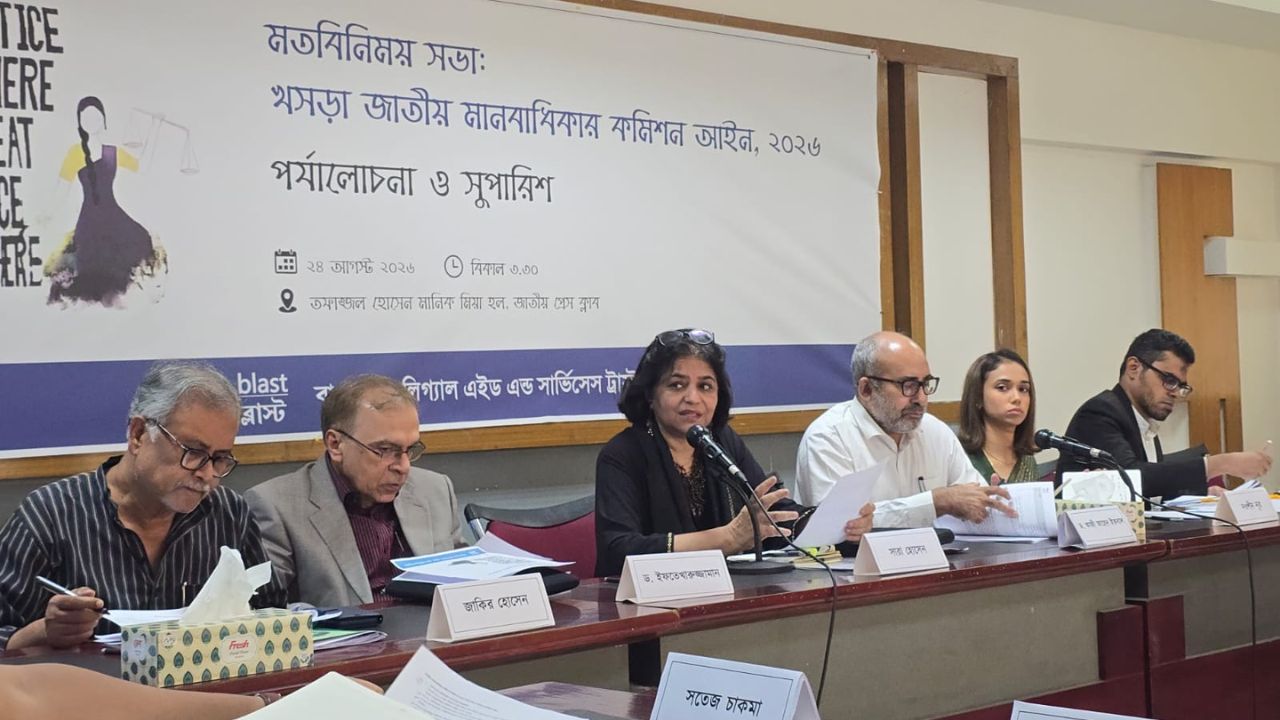
The draft National Human Rights Commission Act 2026, recently approved by Cabinet, will create opportunities to protect human rights violators instead of safeguarding human rights, speakers warned at a discussion on Monday.
The exchange of views was organised by the Bangladesh Legal Aid and Services Trust (BLAST) at the National Press Club.
Speakers at the programme said to make the National Human Rights Commission effective, it must be granted independent powers to investigate allegations of human rights violations against state institutions and law enforcement agencies.
They also stressed the need to ensure a transparent, participatory, and politically neutral system for selecting and appointing commission members.
Transparency International Bangladesh (TIB) Executive Director Iftekharuzzaman cautioned that if the proposed law is passed in its current framework, it could protect violators rather than the victims of human rights abuses.
He demanded that the bill be thoroughly discussed in Parliament and, if possible, sent to the relevant parliamentary standing committee. He added that the draft law must be reviewed by taking into account the opinions of civil society and relevant stakeholders.
Sara Hossain, honorary executive director of BLAST and a Supreme Court advocate, said while the new draft is slightly better than the 2009 Act, marginal progress is simply not enough.
She emphasised that a stronger law is required, drawing lessons from the experiences of human rights violations over the past few years.
Hossain added that the commission’s mandate must span a broad range of human rights, including the right to life and personal liberty, freedom from torture, freedom of expression, elimination of discrimination, and the right to equality.
She also noted that in the past, when sensitive allegations reached the commission, investigations were often halted under the pretext that a lawsuit had already been filed.
However, Hossain argued that the commission must retain the authority to examine whether a person has suffered torture or other human rights violations even if a legal case is ongoing.
Nur Khan Liton, a member of the Human Rights Commission formed during the interim government, warned that unearthing the truth would become extremely difficult if government approval is required at every step – before, during, or after an investigation.
He cited the disappearance of Miraj Sheikh from Mongla in Bagerhat as an example.
He stated that after Coast Guard members picked him up, the relevant authority initially admitted holding him but later denied any knowledge of his whereabouts, while local residents and eyewitnesses faced threats.
According to him, honest, courageous, skilled, and qualified individuals must be appointed to the commission, raising serious questions over how independently the commission can operate under the currently proposed selection and composition process.
Furthermore, speakers warned that if individuals accused of human rights violations or enforced disappearances retain control over the investigation process, they might destroy evidence or influence the probe.
Therefore, the National Human Rights Commission must be granted the independent right to investigate, inspect, and collect information regarding allegations against law enforcement agencies.
Journalist Sohrab Hossain pointed out that the law must clarify whether an ordinary citizen can approach the National Human Rights Commission without obstacles and whether the commission can deliver effective remedies for their grievances.
Other speakers who addressed the event included Vashkar Bhattacharya, Inclusion Advisor of Young Power in Social Action; Anupam Debashis Roy, author and researcher; Sotej Chakma, International Affairs Secretary of the Bangladesh Indigenous Youth Forum; Kazi Zahed Iqbal, Supreme Court advocate; Khan Khalid Adnan, Supreme Court advocate; and Naushin Nur, researcher and human rights activist.


