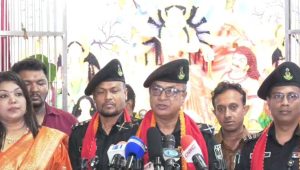
Employment exchanges will be introduced at the district level to connect jobseekers with employers, with disadvantaged and marginalised groups receiving priority, Prime Minister’s Adviser and Prime Minister’s Office spokesperson Mahdi Amin said on Wednesday.
The initiative is aimed at creating a direct link between demand for and supply of labour, he said, noting that several dialogues and consultations have already been held among government agencies over the proposed employment exchanges.
“We are initially going to launch the employment exchange. Our main goal is to establish a direct connection between the demand and supply of employment through this platform,” Mahdi Amin said.
He was speaking at the second session of a national conference titled “Implementing a five-year strategic framework for achieving the SDGs: Policies, partnerships and priorities” at the Bangladesh-China Friendship Conference Centre in Dhaka.
The initiative will bring local employers and jobseekers together at the district level through both online and offline platforms, Mahdi Amin said.
It will also include technical skills development, capacity building and a referral system, with the private sector directly involved in developing workers’ skills and qualifications, he said.
The programme will initially be launched at the divisional level before being expanded to all districts, he added.
Focus on those left behind
Mahdi Amin said ensuring that no citizen is left behind in the country’s growth and development process is a top priority for the government.

“The government’s main goal is to fully integrate disadvantaged people into the mainstream economy and social protection system,” he said.
He said the government was committed to inclusive development and lasting solutions to citizens’ problems.
The second session of the three-day conference focused on the Five-Year strategic framework for inclusive development, reform and development (July 2026-June 2031) and the Sustainable Development Goals.
Mahdi Amin said the government is working to establish an administrative structure that would address citizens’ problems sustainably while creating opportunities for them to improve their own lives.
100,000 new health-sector jobs
The adviser said the government would soon create and recruit people for 100,000 new positions in the health sector, with women to receive priority in 80,000 of them.



He also pledged increased domestic and foreign investment, large-scale job creation and major reforms in the education and health sectors.
Describing the government’s first budget as business- and investment-friendly, Mahdi Amin said the education system would be reformed to equip students with practical skills and social values alongside academic qualifications.
The government plans to gradually introduce midday meals and common uniforms in all primary and secondary schools, he said.
It is also working to bridge the digital divide so that the multimedia-based teaching available in urban schools can reach rural institutions, he added.
Teacher training and improving the status of teachers would also receive priority, Amin said.
Family, Farmer Cards
The government has begun implementing its Family Card programme and is preparing to introduce a Farmer Card for marginal farmers, Amin said.
The Family Card is intended to help women achieve greater economic independence and social empowerment, while the Farmer Card will provide marginal farmers with technology-based services and direct access to weather forecasts, he said.
He also said the government had waived up to Tk 10,000 in outstanding loans and interest for farmers in line with its election pledge.
Focus on fuel, commodity prices
Mahdi Amin said the government had reduced taxes and VAT on more than seven essential commodities, including rice, pulses, edible oil, sugar and flour, to support low-income people.
He claimed the measures had helped prevent artificial shortages created by unscrupulous syndicates.
Despite rising global fuel prices, the government had kept domestic fuel prices stable through strict management, he said.
Mahdi Amin also acknowledged a temporary gas supply disruption caused by a technical problem at an FSRU, or floating LNG terminal.
He said the energy sector was facing major challenges due to accumulated administrative and infrastructure problems over the past 16 years.
The government was working to attract foreign investment in the sector while making efforts to maximise the extraction of domestic natural resources, he said.
‘No one should be left behind’
Mahdi Amin said the government’s development agenda was rooted in the political philosophy of “Bangladeshi nationalism”, which he described as promoting equal rights and development opportunities for people from all sections of society.
He said every citizen-regardless of whether they live in the hills or plains, their religion, ethnicity, political views or physical and social circumstances-must be treated equally.
“Diversity is the true character of Bangladesh,” he said, stressing the need to respect differences while ensuring equal rights, freedoms and opportunities for all.
Mahdi Amin said the government was working to rebuild and reform state institutions damaged over the past 16 years.
He said institutional reform, transparency and accountability were among the government’s key priorities, in line with the BNP’s election manifesto and its commitment to inclusive development.
He also recalled the role of pro-democracy political parties and ordinary people in the historic mass uprising, saying their key aspirations were equality, human dignity and social justice.
The government was committed to building a Bangladesh based on those aspirations through greater transparency and institutional accountability, he added.
Women and Children Affairs and Social Welfare Minister AZM Zahid Hossain, Centre for Policy Dialogue Distinguished Fellow Debapriya Bhattacharya, BNP Standing Committee Member and lawmaker Selima Rahman, and lawmaker Madhabi Marma, among others, attended the event.