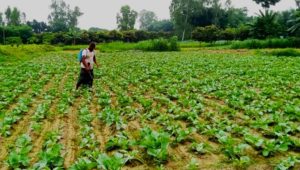
Farmers across the country say a worsening diesel shortage is threatening irrigation during the critical Boro growing season, raising concerns over reduced crop yields, rising food prices and wider food security risks.
“Over the past few days, I have been going from pump to pump but cannot get a single drop of diesel. Meanwhile, my fields are drying and cracking,” farmer Lal Mia from Kamarerchar in Sherpur Sadar told TIMES of Bangladesh, describing his situation.
Similar reports have emerged from multiple districts including Meherpur, Narail, Kurigram, Nilphamari, Chuadanga, Kishoreganj, Sirajganj, Natore, Dinajpur, Chapainawabganj, Thakurgaon and Manikganj.
Field-level information gathered by TIMES correspondents indicates that while some filling stations lack adequate diesel supplies, others have stopped selling fuel in containers, leaving farmers unable to secure what they need. In many areas, diesel is being sold at prices up to 20 taka per litre above the official rate.
According to the Ministry of Agriculture, the country currently has 754 deep tube wells, more than 10.39 lakh shallow tube wells and 1,84,384 low-lift pumps, a large proportion of which are diesel-powered. Irrigation in northern regions and haor areas is particularly dependent on diesel.
Data from the Department of Agricultural Extension shows that around 50 lakh hectares of land are cultivated with irrigation-dependent crops during the dry season. This year’s Boro cultivation target is set at 50.54 lakh hectares, with 48.53 lakh hectares already cultivated as of 8 March. In the Rangpur region alone, 5,09,000 hectares are under cultivation, with 35–40% fully reliant on diesel-powered irrigation.

Agricultural experts say this is the most crucial stage for Boro rice, when consistent irrigation is essential. Any disruption could significantly reduce yields. Boro accounts for approximately 54% of the country’s total rice production, meaning any shortfall could directly affect national food supply and push up inflation.
Despite these concerns, government officials maintain that there is no fuel shortage affecting irrigation.
“There has been no disruption to irrigation activities due to diesel shortages, and monitoring has been strengthened at all pumps to ensure supply for farmers,” authorities said.
However, farmers in several regions describe a different reality. Many report waiting in long queues for hours without success, while others are forced to pay higher prices.




Rahim Mia, a farmer from Sherpur, said, “Most irrigation here depends on diesel engines. But we cannot water our fields properly due to the shortage. The seedlings are drying out. If this continues, yields will be severely affected.”
In Kurigram’s Bhurungamari upazila, farmer Shariful said he was turned away from a filling station when trying to purchase diesel in a container. “They suddenly stopped selling fuel this way. Without diesel, how can we irrigate our fields?” he asked.
Farmers in the greater Rajshahi region—covering Rajshahi, Natore, Naogaon and Chapainawabganj—said irrigation schedules are already being disrupted. Mohammad Jahangir, a farmer in Durgapur, Rajshahi, said he eventually bought diesel at 120 taka per litre from a local retailer after failing to find supply at official outlets.
In Manikganj, farmer Abdul Halim said a solar-powered irrigation system he had hoped would reduce dependence on diesel is now inoperable due to theft and technical faults. “We are not getting enough diesel, and alternatives are not working,” he said.
Others echoed similar frustrations. In Meherpur, farmers reported standing in line for hours without obtaining sufficient fuel, while some have turned to the open market at higher prices, increasing production costs.
The crisis is also raising concerns in the haor areas of Sunamganj, where the Boro harvesting season is approaching. Although 577 harvesting machines are currently operational in the district, all are diesel-powered, creating uncertainty about whether they can be used effectively if fuel shortages persist.
Farmers warn that timely harvesting is critical in haor areas due to the risk of flash floods. “If diesel shortages continue, farmers will be in serious trouble,” said Sujan Mia from Shalla. He added that excessive rainfall has already caused waterlogging, submerging some fields.
At the same time, transport costs for agricultural goods are rising. Farmers in Lalmonirhat said they are struggling to find vehicles to transport potatoes to cold storage, as drivers are demanding higher fares citing diesel shortages.
Agricultural economist Jahangir Alam told TIMES that about 60–65% of irrigation in Bangladesh depends on diesel, while only 25–30% relies on electricity. “Irrigation is critical for Boro crops at this stage. Without regular water supply, yield loss is inevitable,” he said.
He stressed that diesel supply to agriculture must be given top priority. “Even if supply to other sectors is disrupted, farmers must have uninterrupted access. Keeping irrigation pumps operational is essential,” he said.
He also warned that any decline in Boro production would have direct consequences for food security and rice prices. “If production falls, market prices will rise, increasing food inflation. Immediate and effective measures are necessary,” he added.
Meanwhile, the government says monitoring efforts are ongoing. The director general of the Department of Agricultural Extension, Md Abdur Rahim, said that sub-assistant agricultural officers are regularly overseeing diesel supply at the upazila level under the supervision of local administrators.
He noted that about half of the Boro season—running from December to May—has already passed, and recent rainfall has slightly reduced irrigation pressure in some areas.
“So far, there has been no situation where irrigation has been disrupted due to diesel shortages,” he said, while acknowledging that the impact of a prolonged crisis remains to be seen.
As the season progresses, the gap between official claims and farmers’ experiences continues to raise concerns about whether timely intervention can prevent potential losses in one of most critical agricultural cycles.