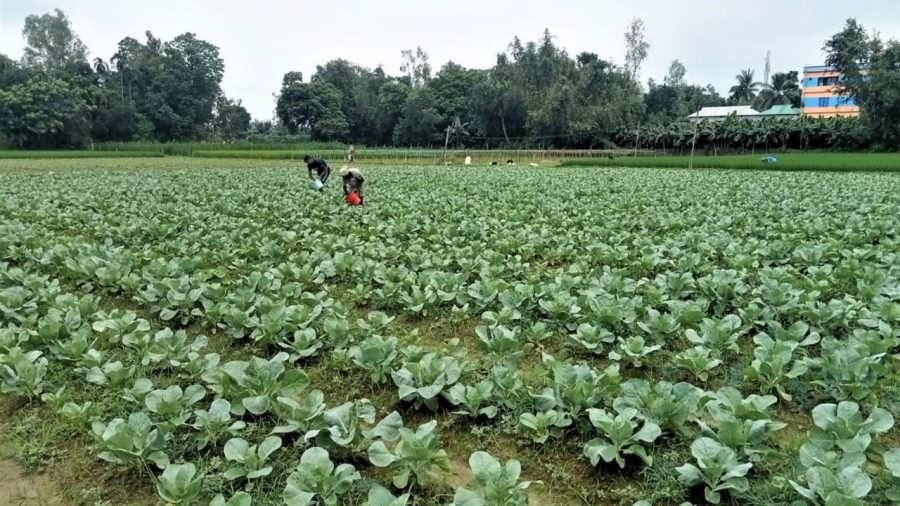



Farmer Abdul Alim of Churamankati in Jashore counts himself fortunate if he can sell a kilogram of beans for Tk30-35 at a wholesale market. Yet the same vegetable, once it has travelled through the supply chain, sells for Tk70 at Dhaka’s Karwan Bazar and Tk100 or more just a kilometre or two down the road.
For Alim, the disparity is galling. Despite rising production costs, farmers like him are struggling merely to break even, while consumers in the capital pay two to three times what growers receive.
“We hear that vegetables sell for double or triple the price in Dhaka. It is painful for us because we often cannot make a profit despite growing them,” he said.
The widening gap between farm-gate and retail prices has become a burden at both ends of the supply chain.
Farmers receive low prices for their produce, while city dwellers struggle to afford fresh vegetables. Perishability, multiple layers of middlemen, transport costs, alleged extortion and what market participants describe as excessive retail mark-ups all push prices upwards.
Comparisons between wholesale markets in Jashore and Bogura and retail outlets in Dhaka show that vegetables can become up to three times more expensive before reaching consumers.
Farmers squeezed by rising costs
Latiful Islam, a farmer from Mahasthangarh in Bogura, said production costs had risen sharply because of higher prices for fertiliser, seeds, pesticides and diesel for irrigation, alongside higher labour wages.

“Production costs have increased significantly this season. But because supply has risen, prices of different vegetables have fallen by Tk10-15 per kg over the past 15 days,” he told TIMES. “Now we are worried about whether we will even recover our production costs.”
While growers face falling wholesale prices, Dhaka consumers continue to pay substantially more.
At Karwan Bazar, Hatirpool, Shewrapara and Kazipara, green papaya sells for Tk25-30 per kilogram, pointed gourd for Tk50-60, beans for Tk70-80, tomatoes for Tk100-120 and aubergines for Tk100-120.
Cauliflowers and cabbages cost Tk50-70 apiece, depending on their size and the market.
By contrast, retail prices at the Chuadanga Bus Stand kitchen market in Jashore town are considerably lower. Papaya sells for Tk10 per kg, pointed gourd for Tk25, tomatoes for Tk50-60 and aubergines for Tk70-80. Cabbages cost Tk30-40 each.




Amjad Hossain, shopping at Karwan Bazar, said high prices were still stretching household budgets despite the approach of winter, when vegetables usually become cheaper.
“Most vegetables cost around Tk100. Prices normally fall as winter approaches, but this year we are seeing the opposite,” he said. “Buying vegetables remains a struggle for people on limited incomes.”
How prices climb en route to Dhaka
Dhaka receives vegetables daily from major producing districts, including Bogura, Sirajganj, Pabna, Jashore, Chuadanga, Naogaon and Gaibandha.
Farmers either transport their produce by van to regional wholesale markets or sell directly to local collectors. From there, vegetables are transported by truck to Dhaka’s wholesale markets, where traders buy them before selling them on to other wholesalers or retailers. Some retailers also buy directly from wholesale depots.
Each transaction can add to the final price, although wholesale rates occasionally fall when supplies are abundant. Transport, labour, market fees and alleged extortion at various points along the supply chain remain persistent costs.
Nazrul Islam, proprietor of Jamuna Traders at Karwan Bazar, said vegetables frequently pass through one or two additional traders after arriving at the wholesale market.
“Once a product reaches us, it may pass through one or two more hands before reaching consumers,” he told TIMES. “If it changes hands twice more, the price can rise by Tk10–15 within Dhaka alone.”
Traders also point to the risk of spoilage, which can substantially reduce the quantity available for sale.
Karwan Bazar wholesaler Abdul Gani said vegetables could deteriorate within hours.
“The colour and condition of fresh produce can change within a few hours. Sometimes, if a trader buys five maunds of vegetables, one maund may spoil before everything is sold,” he said. “Retailers then recover the cost of the spoiled produce from consumers.”

Wholesalers added that truck fares had risen following increases in fuel prices, further pushing up distribution costs.
Calls to cut out middlemen
The Bangladesh Kanchamal Arat Malik Samity, an association of fresh produce wholesalers, believes farmers need better access to markets to secure fair prices.
The association has called for direct supply arrangements and government monitoring of production and harvesting costs, as well as measures to determine appropriate prices at farm, wholesale and retail levels to curb volatility.
Association President Md Imran Master has proposed a central digital platform linking growers and wholesale traders across the country.
“We have become far more technologically advanced. All wholesalers across the country should be connected through a central platform, and the government should develop a central database,” he told TIMES.
Such a database, he explained, would allow wholesalers to identify which farmers were growing particular vegetables in different districts and contact them directly.
“This would reduce unnecessary changes of hands, benefiting farmers, wholesalers and ordinary consumers alike,” he said.
Department of Agricultural Marketing deputy director for Markets Md Kamruzzaman acknowledged that transporting farmers’ produce directly to Dhaka could help bring prices down, although implementing such a system would be difficult.
“It would be better if farmers could bring their produce directly to Dhaka’s markets, but that is hard to achieve,” he said. “At present, eliminating the unnecessary intermediaries through which products pass before reaching Dhaka could substantially reduce prices.”