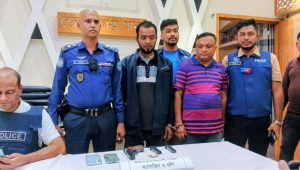
Police have intensified operations to arrest leaders and activists of the Awami League, whose activities have been banned, alongside its outlawed affiliated organisations amid escalating nationwide violence, with the government planning special operations in at least 21 districts.
According to police officials, the crackdown has also been extended to political figures who had remained beyond the reach of law enforcement agencies for more than two years following the 2024 mass uprising.
More than 1,000 leaders and activists have reportedly been arrested across the country over the past two weeks. In the Dhaka metropolitan area alone, police detained 359 people within four days and filed cases against them under the Anti-Terrorism Act.
Those taken into custody include former education minister and Awami League presidium member Nurul Islam Nahid, as well as former Dhaka South City Corporation mayor Mohammad Sayeed Khokon. Several district-level leaders have also been apprehended, while others have reportedly gone back into hiding to evade the intensified drives.
The surge in arrests has placed further strain on the country’s already overcrowded prisons, where the inmate population is approaching three times the official capacity.

The latest crackdown comes as the Awami League and its affiliated bodies attempt to resume political activities following ousted prime minister Sheikh Hasina’s announcement that she intends to return to Bangladesh in December. Concurrently, the country has witnessed a rise in crude bomb attacks and vehicle arson, resulting in several fatalities.
The situation in Gopalganj has drawn particular national attention after two police stations were set ablaze. The residences of three BNP lawmakers were also attacked and torched, while a clinic belonging to one of them came under attack.
Awami League leaders and activists have also become active in several other districts where the party has traditionally maintained a strong foothold. Police records indicate that violence has spread over the past two weeks to Madaripur, Narayanganj, Netrakona, Pirojpur, Rangpur, Cumilla, Meherpur, Habiganj, Barishal, Mymensingh, Khulna, Rajshahi, Faridpur, Chattogram, Tangail, Dinajpur, Narail, Cox’s Bazar, Kishoreganj, Chandpur, Panchagarh, Pabna, Sunamganj, Sylhet, Barguna and Natore, among other districts.
The Awami League has announced another continuous lockdown programme for 29-30 November, prompting intelligence agencies to express concern over potential major acts of sabotage ahead of the dates.


Bangladesh Police Inspector General Ali Hossain Fakir warned on Friday that special operations could be launched if necessary. He made the remarks following a meeting in Gopalganj attended by the directors general of Border Guard Bangladesh (BGB) and the Special Response Battalion (SRB).
Prime Minister Tarique Rahman has also issued a warning, while BNP leaders, activists and members of its affiliated organisations have taken to the field on his instructions.
Police reported that incidents of violence have included flash processions, bomb attacks, arson targeting vehicles and the residences of former and incumbent ministers and lawmakers, as well as road and highway blockades. Violence has also escalated in Narail following the killing of two BNP leaders.
Against this backdrop, authorities are initially planning special operations in 21 districts, with the option of expanding them further should the unrest spread.
Police Headquarters spokesperson and Assistant Inspector General Kamarum Munira told TIMES that the force remained on maximum alert to thwart attempts at sabotage by the party.
“Police are maintaining the highest level of vigilance to ensure that the party whose activities have been banned cannot attempt any acts of sabotage. Any such attempt will be dealt with strictly,” she said.
Officers have stepped up intelligence gathering, surveillance, patrols, checkpoint operations and rapid-response measures to maintain law and order.
On Saturday, BGB personnel were deployed across eight areas, with 18 platoons stationed in Dhaka district, five in the Dhaka metropolitan area, six in Narayanganj, 15 in Gazipur, 29 in Gopalganj, two in Mymensingh, five in Faridpur and six in Cox’s Bazar. A further 49 platoons of Ansar personnel have been deployed across seven districts.
Multiple police sources said that troublemakers had infiltrated garment workers’ protests over demands for higher minimum wages. They added that violence had also spread to several districts in connection with the banned Bangladesh Chhatra League’s call for a complete strike at educational institutions and the Awami League’s lockdown programmes.
The continuing wave of arrests has exacerbated pressure on the country’s prison system, with nearly 1,18,000 inmates currently held in facilities designed to accommodate roughly 46,000.
Department of Prisons spokesperson and jailer Masud Hasan Jewel told TIMES on Saturday that inmate numbers had risen well beyond official capacity. He noted that while an average of 2,700 to 3,100 prisoners were released nationwide each day, as many as 3,400 new inmates were being admitted, resulting in a net daily increase of around 300 prisoners.
Sources at the Dhaka courts confirmed that arrests under the Anti-Terrorism Act had risen over the past fortnight alongside detentions in regular criminal cases, adding that the majority of those held under the anti-terrorism legislation were leaders and activists of banned organisations.