






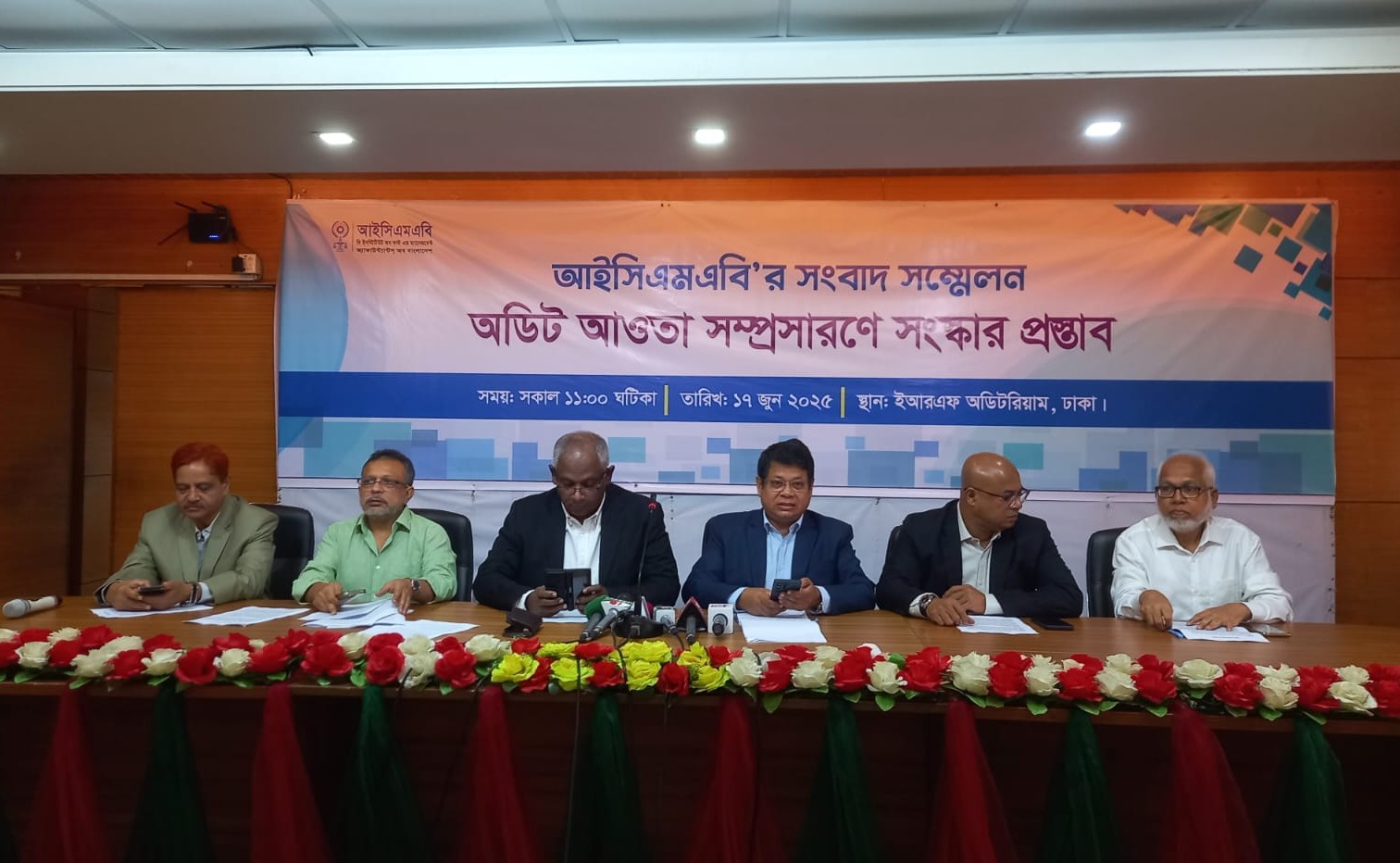
Cost and Management Accountants (CMAs) have called on the government to grant them the authority to conduct statutory financial audits of all entities other than limited companies.
Speaking at a press conference in the capital on Tuesday, Mahtab Uddin Ahmed, President of the Institute of Cost and Management Accountants of Bangladesh (ICMAB), urged that the upcoming Finance Ordinance address this issue. He stated that enabling CMAs to audit and sign the financial statements of proprietorships, partnerships, NGOs, trusts, SME firms, and other non-corporate entities would enhance transparency and accountability across sectors.

Ahmed also called for audit responsibilities under the National Board of Revenue (NBR), energy regulatory bodies, donor agencies, and various fund audits to be opened to CMAs, with the Financial Reporting Council leading the implementation process.

“There are two major types of audits: cost and management audits, which are optional and focus on internal control, and statutory audits, which are mandatory annual financial audits for firms and public interest entities,” he explained.
While the Financial Reporting Act recognizes both Chartered Accountants (CAs) and CMAs as professional accountants, the Companies Act currently does not permit CMAs to perform statutory audits in Bangladesh.
ICMAB leaders criticized the existing auditing framework, highlighting failures by some CAs in preventing financial frauds in the banking and stock market sectors, including the laundering of an estimated $17 billion abroad. They argued that the limited number of practicing CAs has created a monopoly that affects audit quality and governance.
Bangladesh has only 2,005 CAs compared to 375,000 in India, 7,000 in Sri Lanka, and 9,052 in Nepal. Of these, only 500 members of the Institute of Chartered Accountants of Bangladesh (ICAB) are currently in audit practice, tasked with auditing over 300,000 registered firms.
“This situation creates an unhealthy monopoly in the auditing profession,” the CMAs stated, adding that ICMAB has more than 1,800 members and over 30,000 registered students ready to serve as external auditors.
ICMAB leaders claimed that the interim government had included a provision in the draft Finance Ordinance for FY 2025–26 to authorize CMAs to perform certain external audits, but the clause was later removed due to pressure from vested interest groups.
“We don’t want to compete with chartered accountants; we want to collaborate with them,” Ahmed clarified.
Former ICMAB President Mohammad Salim criticized the performance of CAs in the banking sector, noting that only 5% of audit reports on banks included negative opinions, even as the sector faced much bigger frauds.
“In Pakistan, CMAs are permitted to conduct statutory audits of private companies with paid-up capital under three million rupees,” Ahmed pointed out.
He further cited international examples from the UK, Canada, Australia, South Africa, and Nigeria, where statutory audit rights are distributed among multiple professional accounting bodies to foster competition and avoid monopolistic practices. He urged Bangladesh to adopt a similar model.
Also present at the event were ICMAB Secretary Hasnain Thoufiq Ahmed, former presidents Mohammad Salim and Delwar Hosen, Vice President Kausar Alam, and council member Mohammad Jahangir Alam.


