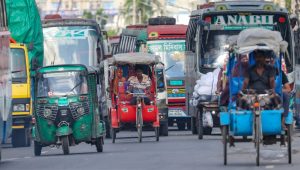



As winter approaches, the dry air becomes an easy medium for carrying harmful fine particles. These enter the body through the respiratory system and affect those who suffer from health complications. Even healthy people can become affected and suffer various health related complications. Experts urge that precautions should be taken by the authorities and citizens for their own safety.
Swiss technology company IQAir recorded Dhaka’s Air Quality Index (AQI) on Thursday at a score of 395. This is translated as ‘hazardous’ levels. The acceptable range for the AQI is 0 to 100 on the standard 0–500 scale. With the capital securing the top spot, Kolkata ranked second with a ‘very unhealthy’ score of 256, followed by Lahore at 220. Mumbai, Karachi, Delhi, and Kathmandu all fell under the ‘unhealthy’ levels with 172, 170, 163, and 161 respectively.
IQAir data shows that Savar scored 152, Tongi with 141, and Gazipur with 105 AQI on Saturday. These industrial areas are some of the hotspots for air pollution, with the release of harmful gases, chemicals, and wastes into the nature. According to a report titled Identification and Apportionment of Sources from Air Particulate Matter at Urban Environments in Bangladesh, almost 85 per cent of Dhaka’s air pollution come from three sources: brick kilns, surface dust and sand, and vehicle emissions. The remaining 15 per cent is made up of lead and biomass burning.

The PM2.5 levels in these areas are also of utmost importance. PM2.5 stands for particulate matter that has a diametre of 2.5 micrometres or less. Dhaka, on Saturday, scored a PM2.5 level of 40 µg/m³ which, according to IQAir, is considered ‘unhealthy for sensitive groups.’ Savar scored a PM2.5 level of 57.3 µg/m³, considered as ‘unhealthy.’



According to the Department of Environment (DoE) and various health institutions, thousands of people in the capital suffer from pollution-related illnesses each year such as asthma, reduced lung function, and so on. This, in turn, also puts significant economic implications, with the cost of healthcare rising due to an increased burden of medical facilities. The World Bank stated that air pollution-related health problems cost Bangladesh’s economy billions of taka annually.
On the other hand, plant life, visibility and agricultural productivity are also some other factors affected. This can lead to long-term ecological imbalances.


To prevent further air pollution, experts say that vehicle emission standards should be strengthened, by regularly testing emissions and enforcing compliances. Dust control measures should be taken at construction sites to reduce spreading further PM2.5 particles. Brick kilns should transition to cleaner technologies, by providing incentives and technical support to kiln owners. Citizens are advised to wear a mask and to use air purifiers for their own good. They are also advised to keep their surroundings clean to prevent further air pollution.
It is urged that the government and environmentalists take necessary measures to avoid further air pollution. Clean air intake is everyone’s fundamental right. It should not be a cause for illness of any sort. AQI scores should be kept at an accessible range for everyone.