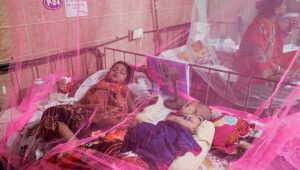
At 15, Sabrin (not her real name) was married to a 60-year-old man in Sona Iltala Union of Mongla, whom she had never met before. After giving birth to two children, she developed lower abdominal pain but initially ignored it. Tests for suspected appendicitis eventually revealed an abnormality in her cervix.
Further examinations found a lesion that could develop into cancer if left untreated. She eventually underwent surgery to remove the affected tissue.
Her experience reflects a wider public health crisis in Bangladesh, where an estimated 8,268 women are diagnosed with cervical cancer and around 4,971 die from the disease every year, according to HPV Information Centre.
Yet the disease is largely preventable through HPV vaccination, regular screening and timely treatment.
The country’s second most common cancer among women continues to claim thousands of lives as screening coverage remains extremely low. Poverty, social stigma, geographical isolation and a shortage of female healthcare providers further discourage women from seeking preventive care.
According to a study published in Research in Health Services and Regions, only 6.2% of women aged 18 to 69 in Bangladesh had undergone cervical cancer screening.
Globally, around 660,000 women develop the disease every year and approximately 350,000 die from it, according to the World Health Organization (WHO) and the International Agency for Research on Cancer. Nearly 90% of cases and deaths occur in low- and middle-income countries.

The government offers free Visual Inspection with Acetic Acid (VIA) screening and ‘see and treat’ services at around 570 facilities under the National Centre for Cervical and Breast Cancer Screening and Training at Bangladesh Medical University (BMU), targeting women aged 30 to 60.
However, the facilities remain inadequate for the country’s population and geographical spread. Women in rural, river-island, coastal and hilly areas often have to travel long distances for screening and further treatment.
For many, even the prospect of treatment is financially daunting.
Dalia (not her real name), a 44-year-old woman from Shyamnagar in Satkhira, said she struggled to afford medicines at a government hospital and feared the cost of cancer treatment.
“Often, because of a lack of money, I can buy some medicines but cannot afford the rest. Even if I find out that I have this cancer, I will not be able to bear the cost of treatment. I would rather not get tested,” she said.




Social stigma and misconceptions also keep women away from screening. Irene (not her real name), from Kalaroa upazila in Satkhira, said elderly people in her village considered the disease a sin or a curse from Allah. “I have not committed any sin. Allah has given me this problem, and Allah will protect me,” she said.
The gender of healthcare providers is another barrier. Beauty, from Burirdanga Union, said she would refuse screening by a male doctor and believed unmarried girls should not undergo the test.
Mansura, from Chila Union, said she had avoided seeking treatment for a uterine problem at the police hospital she visits because it had no female doctor. On a doctor’s advice, she eventually travelled to Khulna 250-bed Hospital for screening.
Lack of awareness is equally concerning. Another woman, Dalia, from Ashashuni, questioned why she should undergo screening when she had no symptoms.
Yet cervical cancer can develop without noticeable symptoms in its early stages, making screening at recommended ages essential.
A study published in PLOS One journal found that nearly half of women surveyed in coastal Satkhira and remote river islands in northern Bangladesh lacked accurate knowledge of cervical cancer symptoms and risk factors. Only 20% knew that human papillomavirus (HPV) could cause the disease, while just 6.2% had undergone screening.
HPV is a common virus, primarily transmitted through sexual contact. Most infections clear on their own, but persistent infection with high-risk types of the virus can cause abnormal cell changes in the cervix, eventually leading to cervical cancer.
The study also found that only 3.3% of women in remote and border areas could make independent decisions about their healthcare, with family reluctance and social stigma often delaying treatment.
Geographical and economic barriers vary across regions. In Rangpur’s river islands along the Teesta and Brahmaputra basins, poverty, child marriage and repeated childbirth compound healthcare challenges. Only 3.1% of women in Rangpur Division had undergone screening, according to a study.

In Sylhet’s tea gardens, poverty, malnutrition, inadequate sanitation and limited reproductive health awareness restrict access to care. A survey by the Centre for Injury Prevention and Research, Bangladesh (CIPRB), among 3,000 female workers at 10 tea gardens in Moulvibazar found signs of cervical cancer in 519 women, around 17%. Most of those identified had reached an incurable stage, according to the survey.
Another BMU study found a high-risk HPV infection rate of 7.1% in rural Sylhet, while the screening rate across the division was only 0.7%.
In Khulna, Barishal and areas bordering the Sundarbans, rivers, poor transport links and natural disasters make screening and follow-up difficult. A study of 900 married women in Jhalakathi, Bagerhat and Cox’s Bazar found high-risk HPV in 2.56% of participants. The screening rate in Barishal Division was only 1.6%.
In the Chattogram Hill Tracts, difficult terrain and limited specialised healthcare further restrict access. Examinations of 284 women who tested positive in VIA screening at Bandarban District Hospital found pre-cancerous cell changes at different stages in 46.2%, while another 2.5% had full-blown cancer.
The WHO aims to eliminate cervical cancer as a public health problem by 2030 through HPV vaccination, screening and treatment. Its targets include vaccinating 90% of girls before age 15, screening 70% of women at ages 35 and 45, and ensuring treatment for 90% of women diagnosed with pre-cancerous lesions or cancer.
Bangladesh is working towards these goals, including through HPV vaccination plans for Class Five students and 10-year-old girls who are out of school.
Professor Jahanara Rahman of the Department of Obstetrics and Gynaecology at Dhaka National Medical College said integrated initiatives, including the ‘see and treat’ approach, could help reduce cervical cancer in resource-poor countries. Women with abnormal screening results should receive prompt treatment where appropriate, rather than face lengthy procedures that could discourage follow-up, she said.
Health economist Mohammad Jobair Khan said institutional capacity must be strengthened across the three pillars of the national strategy – HPV vaccination, screening and treatment of pre-cancerous lesions, and treatment of diagnosed cancer.
Policies and programmes alone would not be enough, he said, stressing that women in remote areas must have access to screening, follow-up investigations and treatment.