






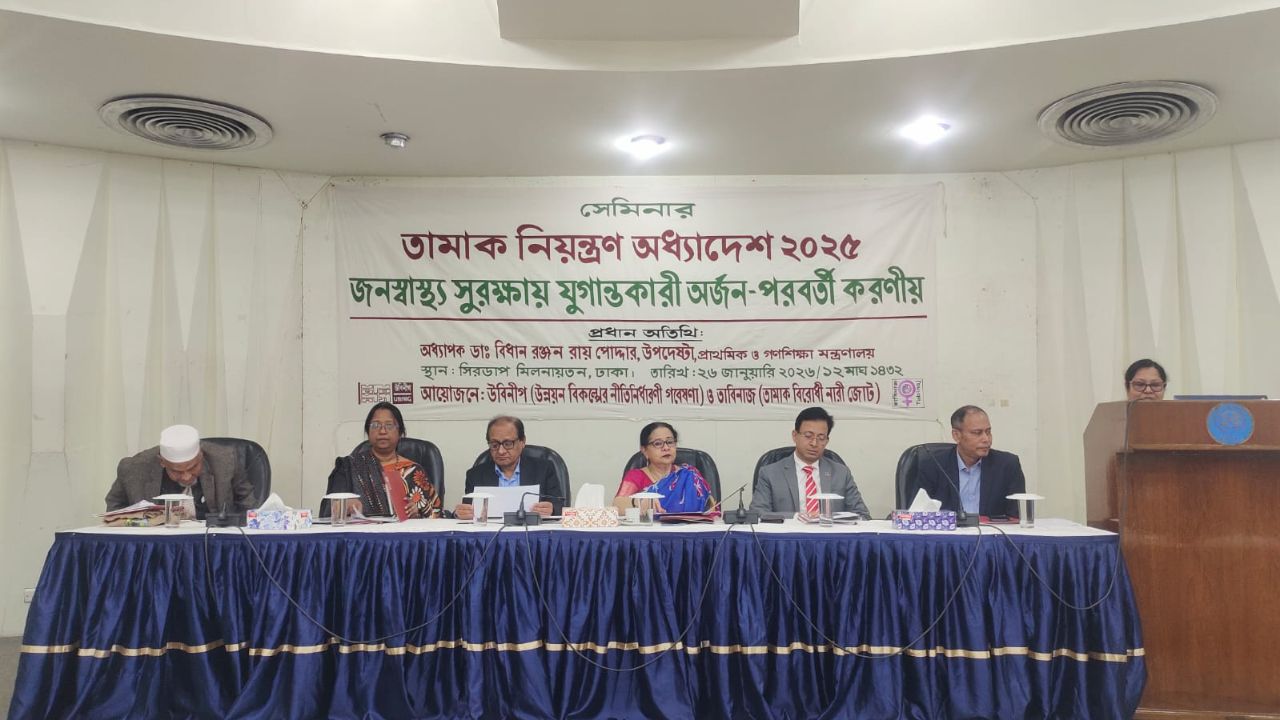
Bangladesh’s newly elected government must make converting the Smoking and Tobacco Products Use Control Ordinance 2025 into law its first priority to protect public health, speakers and participants said at a seminar in Dhaka, warning that the ordinance risks lapsing under constitutional provisions if not enacted during the first parliamentary session.
The demand was raised at a seminar titled Tobacco Control Ordinance 2025: A Landmark Achievement in Public Health Protection—The Way Forward, held on Sunday, 26 January 2026 at the International Conference Hall of the CIRDAP Auditorium in Dhaka. The event was organised by UBINIG Policy Research for Development Alternatives and TABINAZ Women’s Alliance Against Tobacco.
Speakers said tobacco use remains one of Bangladesh’s most serious public health challenges, causing nearly 200,000 premature deaths each year. While the promulgation of the Tobacco Control Ordinance 2025 was described as a major step forward, they cautioned that failure to turn it into law would undermine years of progress in tobacco control.
The seminar was attended by Ministry of Primary and Mass Education Adviser Professor Bidhan Ranjan Roy Podder as chief guest. Special guests included educationist and former caretaker government adviser Rasheda K Chowdhury, Legislative and Parliamentary Affairs Division Additional Secretary Mohammad Mohiuddin, Health Services Division Additional Secretary Sheikh Momina Moni and National Tobacco Control Cell Director General Md Akhtaruzzaman.
Speaking at the event, Professor Bidhan Ranjan Roy Podder said tobacco is extremely harmful and often acts as a gateway to drug use, adding that the ordinance represented a significant achievement in public health protection. He stressed that preserving this achievement required enacting the ordinance into law during the first session of the newly elected parliament.
Sheikh Momina Moni said the Ministry of Primary and Mass Education had already taken steps to discourage tobacco use through recruitment policies and urged similar measures across other teacher recruitment processes to help make educational institutions smoke-free.
Rasheda K Chowdhury said the ordinance should be enacted regardless of which political party forms the next government, calling for a unified demand to ensure its swift passage into law.
Mohammad Mohiuddin described the ordinance as a milestone in health protection and said his division would take the necessary steps to support its enactment. Md Akhtaruzzaman echoed the warning that without parliamentary approval, the ordinance would lapse automatically, calling that outcome a serious setback for public health.
Speakers also pointed to the need for strong political will to counter what they described as misleading campaigns and influence from the tobacco industry. They said full implementation of the ordinance would help Bangladesh align with the World Health Organization Framework Convention on Tobacco Control and the Sustainable Development Goals, particularly the target on good health and well-being.
Public health experts, policymakers, civil society representatives, researchers, journalists and leaders of tobacco control organisations attended the seminar.


