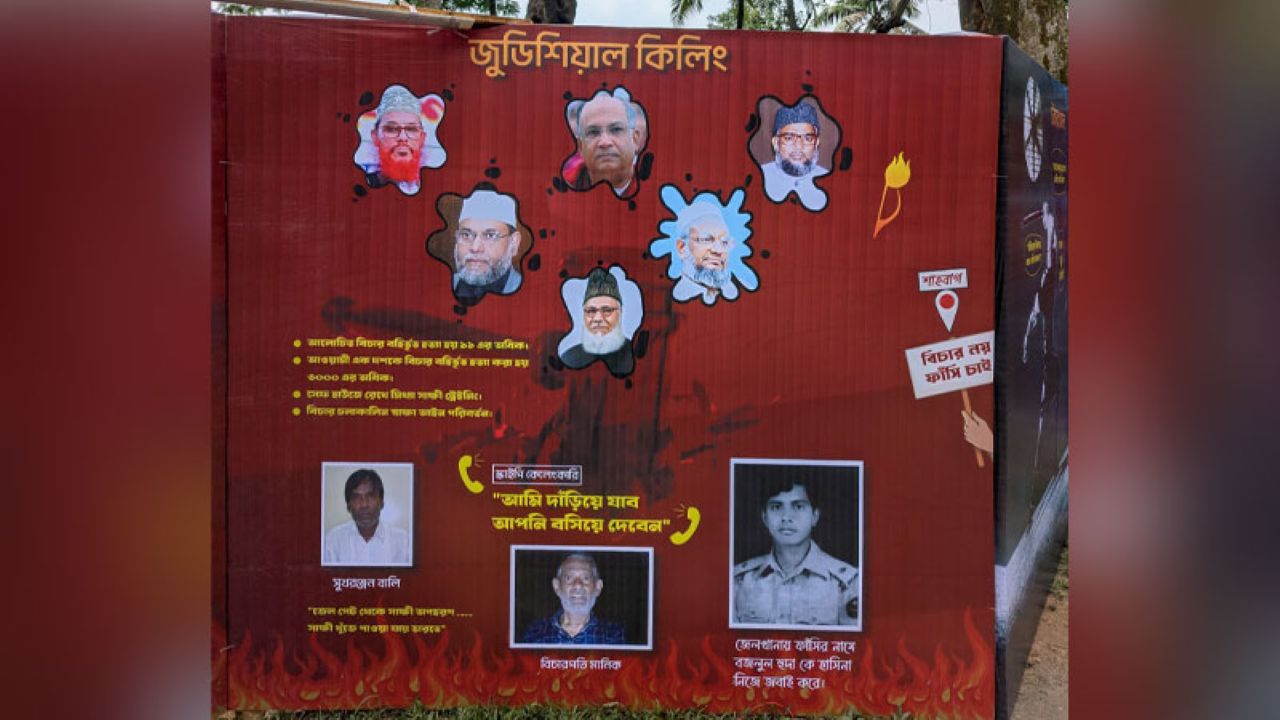



A billboard displaying photos of convicted war criminals has triggered debate at Rajshahi University (RU).
The billboard, titled “Judicial Killing,” was installed on Saturday near Paris Road by a group called Naboculture, directed by Rajshahi University Central Students’ Union (Rucsu) General Secretary Salahuddin Ammar.
The billboard featured images of Delawar Hossain Sayedee, Mir Quasem Ali, Motiur Rahman Nizami, Abdul Quader Mollah, Ali Ahsan Mohammad Mojaheed, and Salauddin Quader Chowdhury. After it was put up, discussions and criticism spread quickly on social media and within the campus.
Speaking to TIMES of Bangladesh, Ammar said, “Several of those whose photos appeared on the Naboculture billboard were convicted by Bangladeshi courts in war crimes cases.”

He added that similar debates had taken place earlier at Dhaka University. “But our billboard’s main theme was ‘Judicial Killing,’ raising the question of whether trials and executions were politically influenced.”
The billboard was created in the context of controversies under Sheikh Hasina’s rule, including enforced disappearances, killings, the “Aynaghar” detention facility, the Shapla Chattar massacre, and debates over the judiciary.


“The purpose was not to absolve anyone of war crimes charges, but to highlight whether their trials and executions were politically motivated,” he said.
Ammar further said, “There are differing views in the country. Some see them as war criminals, while others question the trial process. Public discussions arose over incidents such as the disappearance of witness Sukhranjan Bali and the leaked Skype conversations. That is why the issue of ‘Judicial Killing’ was placed on the billboard.”
Rucsu Vice President Mostakur Rahman Zahid said, “The authorities have not contacted me about this. They know in what sense they did it. I think it was meant to highlight extrajudicial killings. But Rucsu or its funds are not connected.”
Fuad Ratul, convener of the Democratic Students’ Alliance, told TIMES of Bangladesh, “Whether by Rucsu or Naboculture, we will not accept any attempt to normalise war criminals on the RU campus or anywhere in Bangladesh.”
RU Chhatra Dal Organising Secretary Mahmudul Hasan Mithu said, “It is unfortunate that the university platform is being used to implement party agendas, distribute propaganda, and run political programmes. Linking the July‑August mass uprising with irrelevant past political issues has no justification. This is merely an attempt to create division and tension. Sensitive issues like war crimes are being tied to the current political context.”
RU Chhatra Adhikar Parishad President Mehedi Hasan Maruf said, “We remember with contempt the identified members of the Al‑Badr and Razakar forces of the 1971 Liberation War. Bangladesh was liberated at the cost of the sacrifice of 3 million martyrs and the dignity of 200,000 mothers and sisters. Therefore, at an institution like Rajshahi University, displaying photos of individuals convicted in war crimes cases or creating controversial narratives is unacceptable.”
RU Pro‑Vice Chancellor (Administration) Prof Md Abdul Alim said, “We are not yet aware of this matter. We are looking into it.”