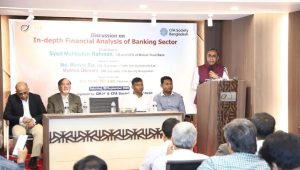
Bangladesh’s banking sector is heading into 2026 facing a difficult balancing act between the ongoing reform and recovery, said Meghna Bank PLC Managing Director Syed Mizanur Rahman.
“In 2026, the core challenge for banks will be balancing recovery with reform,” he said in an interview with TIMES of Bangladesh.
While macroeconomic conditions are gradually stabilising, he cautioned that “deep-rooted structural and institutional vulnerabilities continue to pose material risks to the sector”.
Looking back at the previous year, Rahman described 2025 as “a particularly testing year for the banking sector”.
He said the industry was dealing “simultaneously with tight monetary conditions, high inflation and persistent asset-quality stress”.
Beyond financial indicators, he pointed to a broader confidence problem. “There was also a confidence challenge,” he said, as “a number of issues came to the surface ranging from irregularities in financial reporting and book manipulation in some institutions to the findings of regulators as well as asset quality reviews (AQRs)”.
Rahman noted that “while these reviews were necessary and positive from a long-term reform perspective, they understandably made some customers nervous”.
That nervousness deepened as “concerns grew around whether certain weak banks might eventually be merged, restructured or even exited”, which he said “temporarily affected depositor sentiment”.
Operational pressures also intensified during the year. Rahman said “private-sector credit growth slowed sharply, hovering around 6–7% at times”, while “system-wide NPLs surged to around Tk6.5 lakh crore, exerting pressure on capital and profitability”.

Liquidity stress became more visible as well. “Liquidity conditions also became uneven, especially for weaker banks,” he said.
Moving into 2026, Rahman said conditions have improved, though challenges remain.
“As we move into 2026, I would say the environment has become more stable though not yet fully comfortable,” he said, citing easing inflation, reduced exchange-rate volatility and improved policy communication.
He added that “confidence has started to gradually return, particularly as depositors see that reforms are being managed in an orderly and controlled manner”.
However, he cautioned that “rebuilding trust takes time, and asset-quality challenges remain very much a work in progress”.
Looking ahead, Rahman identified asset quality as the most serious risk.




“The most significant risk remains asset quality,” he said, adding that “high levels of legacy non-performing loans (NPLs) are still weighing on capital adequacy and constraining fresh lending”.
Until resolution improves, he warned that “asset quality will remain a persistent drag on balance sheets and profitability”.
Confidence management is another major concern. Although sentiment has improved, Rahman said “it remains fragile”.
He warned that “any governance lapse, adverse disclosure or weak communication can quickly unsettle customers”, especially in “a highly digitised and socially connected environment where information spreads rapidly”.
He noted that “recent disclosures, asset quality reviews and discussions around weak banks have made customers more sensitive than before”.
Rahman also raised concerns over regulatory liquidity support. While Bangladesh Bank has provided assistance, he said that “while some banks have utilised this support prudently”, others “appear to have misused the support, prioritising short-term interests of owners rather than long-term institutional sustainability”.
He warned that “continued dependence on liquidity support without meaningful reform only heightens risks to solvency, governance, and long-term viability”.
Another emerging risk is uneven sector performance.
“Stronger banks, backed by better capitalisation, governance and technology adoption are likely to grow stronger,” Rahman said, while “weaker banks may continue to struggle with liquidity, asset quality and governance challenges”.
If left unchecked, he cautioned that “this divergence could create broader systemic pressure over time”.
Beyond traditional risks, Rahman said banks must also manage “rising technology, cybersecurity, and compliance risks, which are now as critical as traditional credit and liquidity risks”.
Despite the risks, he said 2026 also offers opportunities.
“A key opportunity lies in digital transformation and digital banking,” Rahman said, noting that “Bangladesh is moving steadily toward a cashless society, and 2026 will be a pivotal year in advancing this vision”.
With digital banks expected to enter the market, he said “competitive intensity, particularly in the retail segment—will increase”, warning that banks failing to adapt “risk losing market share”.
On interest rates, Rahman said they are “likely to remain relatively high in the near term”, though “there may be room for a gradual and cautious easing in 2026”.
He stressed that “a stable, well-communicated interest-rate policy helps rebuild confidence”, while cautioning that banks must balance affordability with sustainability.
Private-sector credit recovery, he said, will be cautious.
“Private-sector credit is therefore expected to improve in a measured and selective manner rather than through a sudden surge,” as banks “are rightly prioritising asset quality over aggressive balance-sheet expansion”.
Assessing reforms, Rahman said measures such as AQRs and stricter loan classification have “significantly improved transparency”.
However, he added that “it would be incomplete to say the root causes have been fully addressed.”
He highlighted legal recovery as a weak point, noting that “the number of Arthorin Adalots is inadequate compared to the volume and complexity of pending cases”, weakening deterrence against willful defaulters.
On weak banks, Rahman said “weak banks with very high NPLs need early, transparent and differentiated intervention”, warning that “delaying action only increases costs and further erodes confidence”.
Regarding the merged Islami bank, he said consolidation “was a necessary step to stabilise the institution”, but cautioned that “the risks lie in integration, asset quality and governance”.
If managed properly, he said “the merged Islami bank can regain confidence and play a constructive role in the financial system”, adding that “clear communication with customers will be critical to ensure stability during this transition”.