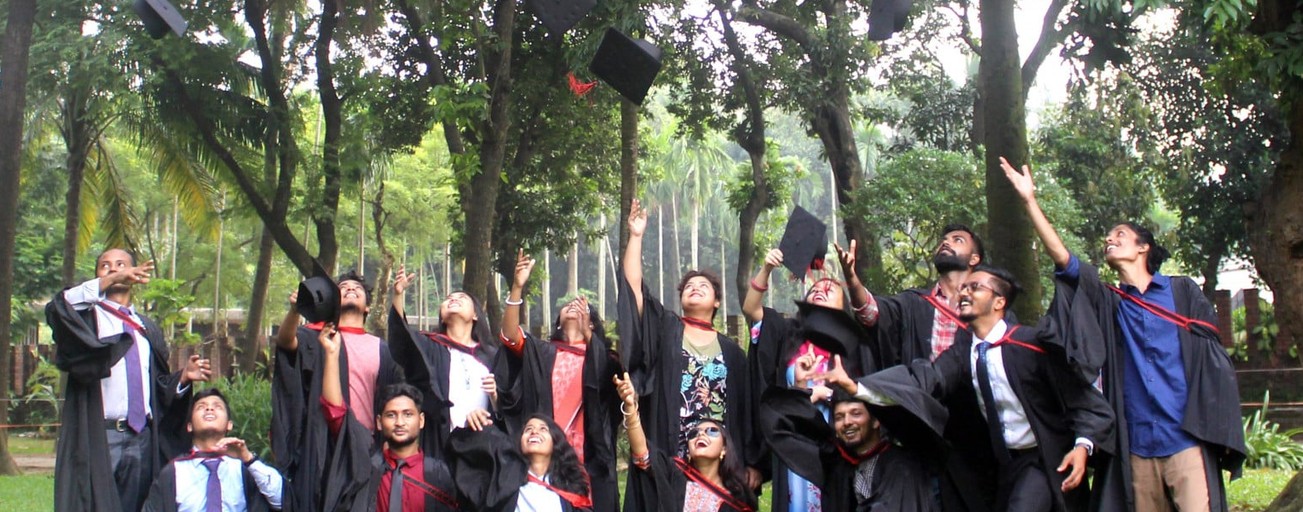



Higher education is the basis for building knowledge, research, creativity, leadership and skilled human resources as well. Countries with a higher level of development have turned quality higher education into one of the main pillars that propelled their economic and social development. Bangladesh has also made tremendous advancement in higher education over the past few decades. The universities have grown, the number of students has increased, and more possibilities of learning about varied subjects have been provided. But this expansion has also brought along several issues of education, research, job prospects and institutional management, which have become serious issues for the nation to discuss.
Hundreds of students compete for admission to their universities of choice each year, after completing their Higher Secondary Certificate (HSC) exams. Securing admission in a public university is nothing but the first step towards higher education, future job prospects, and social mobility in the context of Bangladesh. However, these admission tests provide hope and ambition to students but also put tremendous psychological pressure as well. The years of preparation, reliance on coaching centres, pressure from family members and competition for many students. Many gifted students don’t get to attend their colleges of choice after losing out on a single test, but that doesn’t take away their ability. The importance of this reality must not be ignored by society.
It is important to pay attention not only to the results of the exam but also to the skills, creativity, and opportunities for knowledge development of a student at this important period. Getting a seat at a public university is already a big achievement, but the mission of higher education should be to generate knowledge, further research and development of skilled human resources. Hence, universities, apart from the admission competition, must also pay due attention to quality education.
The higher education system in Bangladesh has the most impressive feat of its existence. After the establishment of some public and private universities in various areas of the country, more students are now getting opportunities to pursue higher education. This is a definite change and a good one. But simply expanding the number of educational institutions is not enough to promote the development of higher education. Ensuring educational quality, improving teaching standards, creating a strong research environment, developing modern infrastructure and providing opportunities for students to acquire practical skills are the key factors that determine the success of higher education.

The need for the modern world to update the curricula of universities has grown to be extremely important. The world is rapidly evolving. The global economy is changing trajectory with AI, information technology, robotics, data analytics, environmental science, and new technologies. Higher education must adjust its courses, teaching methods and learning approaches to ‘catch up’ with these changes. You can’t create a quality, modern generation with old textbooks.
Another important issue that is related to higher education in Bangladesh is administrative problems and the absence of good governance. The lack of decision-making, recruitment systems, academic planning and institutional management are some of the issues faced by universities. Universities need to be effective, autonomous and accountable institutions. The main purpose of educational institutions is not to allow unnecessary intrusions or hindrances, which would hamper academic activities. The primary purpose of educational institutions should not be such that it would create an environment of teaching and research that would be affected by intrusions or hindrances.
The quality of higher education is another impediment to improvement, due to infrastructure issues. Ensuring quality education without having well-equipped libraries, digital learning facilities, a research-friendly environment, and modern laboratories is challenging. In particular, many of the new universities are still struggling to build up sufficient infrastructure and academic facilities. The government and relevant parties must have long-term solutions to overcome these issues and achieve sustainable development in higher education.




However, Bangladesh’s higher education system has great potential despite the current problems. The nation’s youth, its educated young people and the growing access to technology can serve as a great strength in the development of higher education. What is needed is proper planning, effective implementation and a long-term vision. With better coordination of the higher education system between Universities, Government, Industries and International Organizations, great improvement could be achieved.
Raising investment in research is the first and foremost way in which higher education can be improved. More research money needs to be allocated, and universities should be encouraged to undertake innovative and problem-solving research. Opportunities for teachers and researchers for international training, academic collaboration and advanced research should be created. Universities can be places of knowledge production and innovation with a strong research culture.
There is a further need for good linkage of universities with industry and professional bodies to provide students with hands-on experience in addition to their studies. This kind of collaboration will help to narrow the divide between classroom and workplace learning. There should be more opportunities of internship as well as skill development programmes and courses of industry orientation to prepare graduates for the modern job market.
Concurrently, efficient quality assurance systems should be put in place in HEIs. Academic programme evaluation, enhancing teaching, modernisation of curriculum and curricula and introducing and expanding technology-based teaching are all critical to quality. Universities should build the critical thinking, creativity, communication skills and leadership qualities of students besides academic achievement.
There is no alternative to quality higher education for achieving Bangladesh’s development goals. Universities should be places of knowledge creation, research and innovation and only then can a country be a knowledge-based economy. A visionary policy formulation and political will with effective execution are required to solve the current crisis in the higher education system in Bangladesh sustainably. Tightening the number of universities is not enough to make progress, the key is to ensure access to quality education and meaningful learning opportunities.
In Bangladesh, if feasible and effective steps are taken now, the young generation will be able to take a firm footing in global competition. But it will be impossible to establish a knowledge-based society with so many students and institutions without the required reforms. So, the problems of higher education should be given high priority at the national level.
It will take a collective effort from policymakers, educators, researchers, students and society to achieve the betterment of higher education. Bangladesh can overcome the issues amid its present condition, by implementing appropriate changes, transparency, investment and commitment, and can build a higher education system that can be reckoned with globally. It is time to stop expansion and go for excellence: the quality of a country’s future depends on the quality of its education today.
The views expressed in this article are solely those of the author
The writer is an Associate Professor, Department of Communication and Journalism, University of Chittagong; Doctoral Research Scholar, School of Journalism and Mass Communication, Jadavpur University, India. Email: [email protected]