
Many parents use baby walkers hoping to help their children walk sooner, but pediatric specialists warn that these devices can cause serious injuries and disrupt natural development.
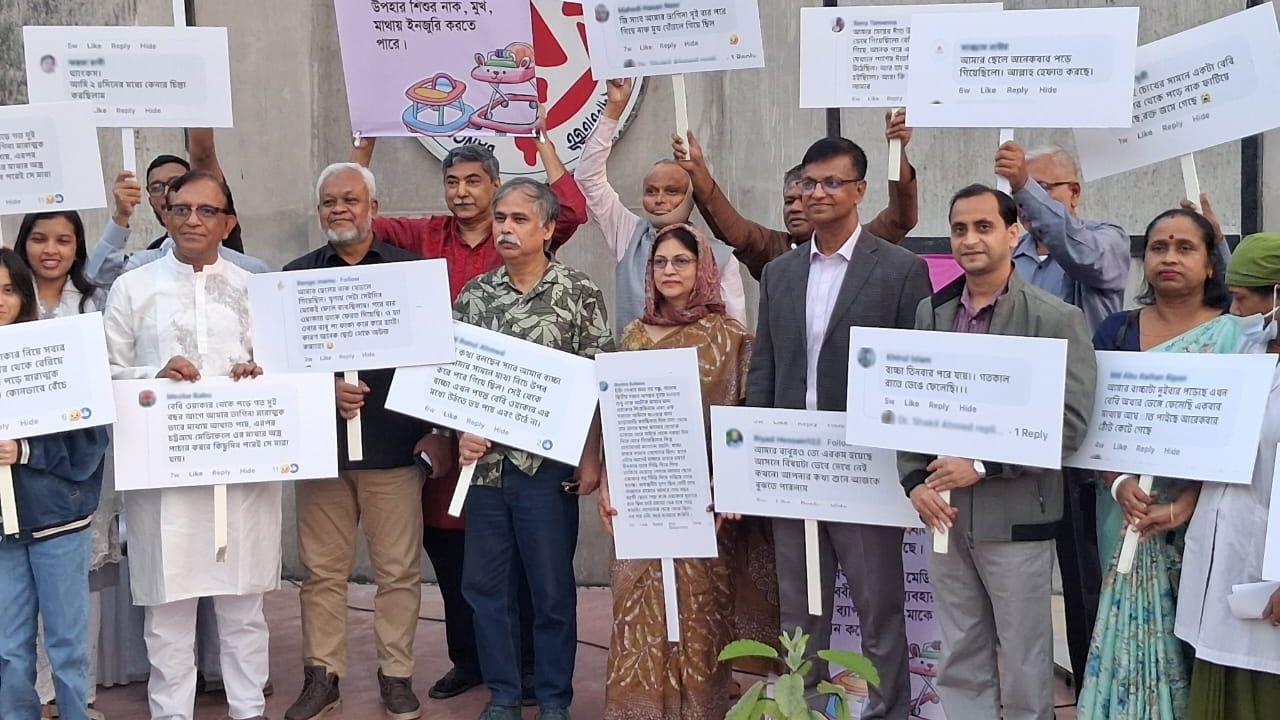
These concerns were highlighted on Friday at a public awareness event at Bangladesh Shishu Hospital & Institute in Shyamoli, organized by Shishur Jonno Shusthota with support from the hospital and Friends Plus.
Speakers presented research showing that the belief that walkers help children walk faster is incorrect. A 2002 study by Southwark Primary Care in London found that walker-using children learn to walk 11 to 26 days later than others.
A 2020 Turkish study reported that walkers also hinder proper spinal balance development. Data from Nationwide Children’s Hospital in the United States shows that 91 percent of walker-related injuries affect the head or face, while research from Case Western Reserve University suggests walkers may impede cognitive development.

Experts warned that babies in walkers can move at 3–4 feet per second, making accidents sudden and difficult to prevent. Between 1990 and 2014, nearly 230,000 children in the US were injured in walker-related incidents, including eight deaths between 2004 and 2008.
These risks have led to strict measures abroad: Canada banned the manufacturing, sale, and storage of baby walkers in 2004, while Bhutan reportedly imposed restrictions in 2024. Professional bodies including the American and Indian academies of pediatrics have also recommended bans.




Prof Dr Md Mahbubul Haque, Director of Bangladesh Shishu Hospital & Institute, emphasized that baby walkers interfere with the natural developmental sequence—sitting, crawling, standing, and then walking—by restricting free movement and visual–motor coordination.
He stressed the need for nationwide awareness, so parents understand the risks.
Prof Dr Md Kabirul Islam, Head of Pediatric Surgery at Dhaka Community Medical College, said many children arrive with facial injuries where stitches were poorly done elsewhere, although such cases often require the precision of plastic surgery.
He noted that even minor suturing may require anesthesia, which many parents hesitate to accept. Injured children often arrive after eating, delaying treatment since anesthesia requires fasting. Complications from earlier treatment are also common.
Prof. Shakil Ahmed observed that children who walk barefoot or on natural ground tend to walk earlier, while those on smooth floors or wearing shoes may take longer—an observation he clarified is not backed by formal research.
Former TIB director Mohammad Rafiqul Hasan urged that child safety awareness be included in school curricula.
Several parents, including Mehdi Masood, Faria Tajrin, and Rafia Jahan, shared firsthand accounts of injuries and complications their children suffered from walker use. The event, moderated by Prof Dr Shakil Ahmed, was attended by senior professionals, including Prof Dr Abdul Hanif Tablu and faculty members of the institute.