US President Donald Trump, Chinese President Xi Jinping and Russian President Vladimir Putin convened in the southern Chinese city of Shenzhen on Thursday for an unprecedented trilateral summit held on the sidelines of the Asia-Pacific Economic Cooperation (APEC) conclave.
Chaired by Xi at Kylin Villa, the meeting marked the first three-way talks between the leaders of the world’s three largest military powers.
Lasting over an hour, the discussions concluded with the release of a joint “peace declaration” aimed at addressing global instability caused by ongoing conflicts, including the US war on Iran and Russia’s war on Ukraine.
Pledges on energy flows and nuclear risk reduction
Under the post-summit declaration, the three nations reaffirmed their commitment to maintaining stable energy flows. Global energy supplies have suffered severe disruptions following the US attack on Iran, Tehran’s closure of the Strait of Hormuz, and Ukrainian strikes on Russian energy infrastructure.
In addition, the leaders agreed to hold a formal dialogue on reducing nuclear risks and preventing nuclear proliferation, acknowledging their unique positions as custodians of the planet’s three largest nuclear arsenals.

Xi emphasised that nuclear weapons should be comprehensively banned and thoroughly destroyed to build a nuclear-free world, a stance incorporated into the joint statement.
Trump confirmed that Beijing agreed on keeping the Strait of Hormuz open and ensuring Iran does not acquire nuclear weapons.


Joint critique of international legal bodies
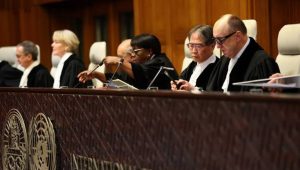
A prominent element of the declaration was a sharp critique of the International Criminal Court (ICC), with all three powers demanding that the ICC and similar institutions refrain from abusing their positions.
Trump denounced the tribunal as a “rogue globalist organisation”. Despite varying geopolitical stances, Washington, Beijing and Moscow share deep grievances against the UN-backed court.
Washington has moved to dismantle the ICC following investigations into US military personnel in Afghanistan and an arrest warrant for Israeli Prime Minister Benjamin Netanyahu. Moscow remains fiercely hostile to the court after it issued an arrest warrant against Putin over the Ukraine conflict.
Meanwhile, Beijing has grown increasingly critical following warrants for leaders like former Philippines president Rodrigo Duterte and petitions regarding allegations in Xinjiang.
Divergent strategic motivations
Analysts note that each leader brought distinct motivations to the table. Trump sought a visible diplomatic achievement amidst domestic pressures following Republican losses in the US midterm elections and frustration over the conflict in Iran.
He also pressed for a broad nuclear arrangement including China to succeed the lapsed New START treaty. For Putin, the summit offered a platform to counter Western economic isolation, assert Russia as an equal global power broker, and promote a multipolar world order without yielding on territorial claims in Ukraine.

Xi utilised the gathering to establish parity with Washington and Moscow while seeking stability to protect China’s economy from tariff escalation and global energy shocks.
Global reactions and conflict resolution
The summit took place alongside parallel European diplomacy in Berlin, where the “Coalition of the Willing” met to coordinate support for Ukraine. Ukrainian President Volodymyr Zelenskyy reiterated that any peace negotiations regarding Ukrainian territory must directly involve Kyiv and European powers.
Kremlin spokesman Dmitry Peskov noted that Ukraine was not the central topic of the trilateral session, though Putin separately indicated Moscow remains open to negotiations despite rejecting immediate ceasefire proposals following recent attacks on the Crimea bridge.
Additionally, Trump invited Putin to attend the upcoming G20 summit in Miami next month, a proposal the Russian leader stated he is actively considering.