Just days after India resumed accepting tourist visa applications from Bangladeshi citizens, Bangladesh’s most iconic graffiti character has symbolically made the journey first.
For the first time, Subodh, the instantly recognisable figure created by the anonymous Bangladeshi street artist HOBEKI?, has appeared in India. The mural not only marks the first confirmed appearance of HOBEKI?’s work across the border, but also opens a new conversation about movement, borders and cultural connection at a moment when people-to-people travel between the two neighbours has begun to reopen.
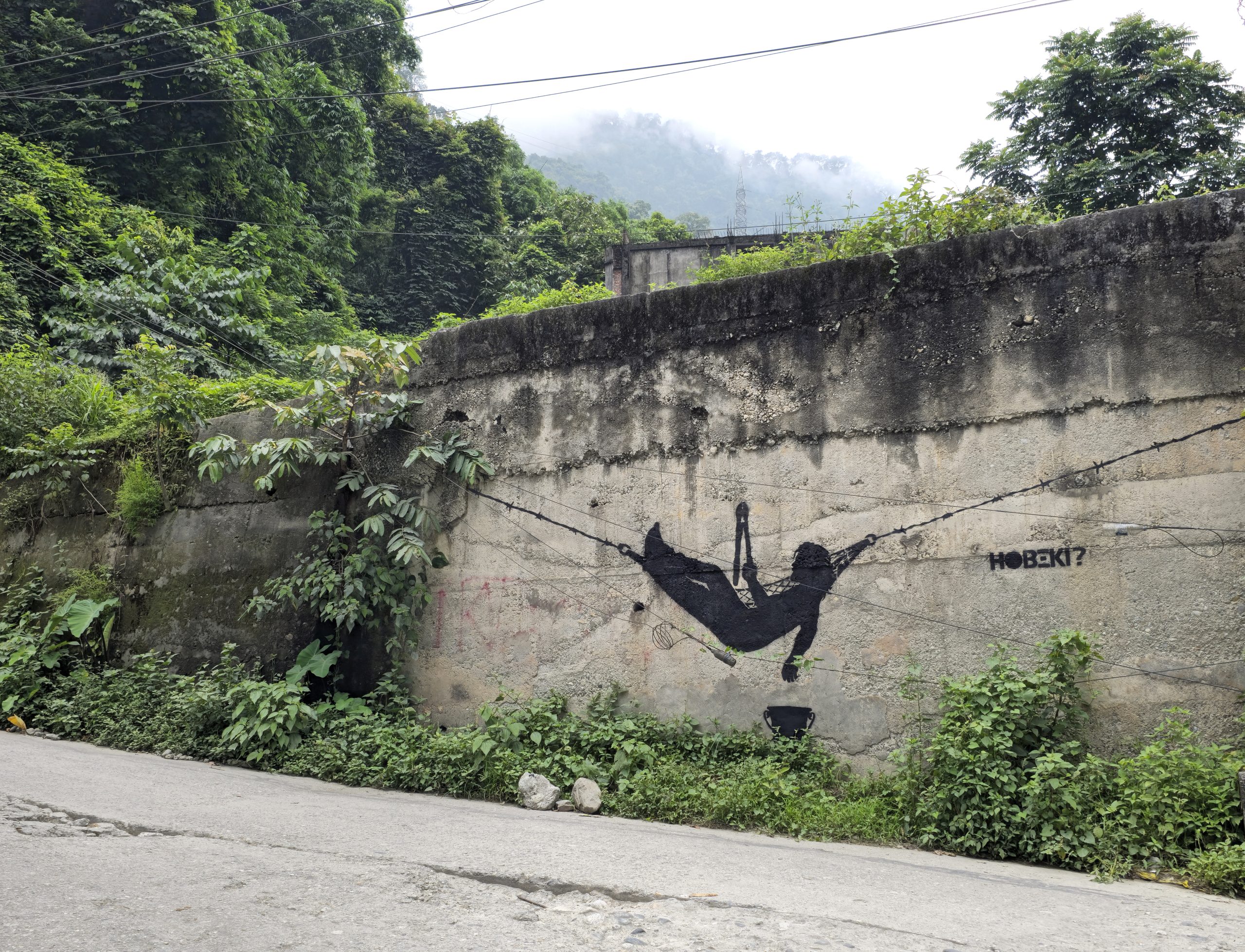
The large-scale mural appeared on 30 June on the south-west wing wall of Majitar Nala Bridge along the Gangtok-Rangpo Road in Rangpo, Sikkim. Created using HOBEKI?’s signature stencil-and-spray-paint technique, it presents a strikingly transformed Subodh.
The anxious young man once seen running with a caged sun has disappeared. In his place, the familiar bearded figure lies in a hammock woven from barbed wire. Bare-bodied, with unkempt hair and ripped jeans, he casually holds a wire cutter while one arm hangs towards a bucket placed beneath him.
The timing has drawn particular attention. Just two days before the mural appeared, India resumed accepting tourist visa applications from Bangladeshi citizens after nearly two years of suspension following Bangladesh’s 2024 political transition. Although the artwork makes no direct political statement, its arrival immediately after the reopening of visa services has prompted interpretations about renewed cross-border mobility, shared humanity and stronger people-to-people ties.

Speaking exclusively to the TIMES of Bangladesh, art analyst and ARTCON founder ARK Reepon described the Majitar mural as a defining emotional shift in the evolution of Subodh.
“Earlier Subodh often appeared as a figure in motion, pushed by fear, urgency, or collapse. This Subodh does not flee. He has arrived. He lies across the border not as a refugee of fear, but as a symbolic traveller. He is not escaping in panic. He is resting with strange confidence, as though he has already crossed the line that others must still negotiate through paperwork, policy, and permission.”
Reepon said the work brings together “freedom, border crossing, hope, diplomacy, people-to-people connection, protest and trespass” through a deceptively simple image.
He described the barbed-wire hammock as one of the mural’s strongest visual metaphors.



“A hammock usually suggests leisure, rest, tourism and freedom of movement. Barbed wire suggests division, danger, territorial control and restricted passage. By combining the two, HOBEKI? compresses a central contradiction of travel in South Asia: the dream of movement and the reality of borders. Subodh turns the border into a resting place.”
According to Reepon, the wire cutter should not be viewed as an instrument of violence.
“It is not shown as a weapon against a person. It is a tool against obstruction. It symbolises the removal of barriers that stand between people and people. It suggests a desire to cut through fear, suspicion, administrative delay and inherited distance.”
He said the bucket beside Subodh adds another layer of symbolism.
“Because the work appears near the Teesta River, the bucket may be read as a possible allusion to water, sharing, scarcity and the unresolved emotional geography of Bangladesh-India relations. It does not state the issue directly. It remains symbolic, which is precisely why it works.”
Reepon also highlighted the importance of the mural’s location.
“A bridge is not only an engineering structure. It is a promise between two sides. By choosing the wing wall of Majitar Nala Bridge, the artwork places Subodh literally on a structure of connection. The bridge becomes both site and metaphor: Bangladesh and India, departure and arrival, memory and future, restriction and passage.”
Subodh’s appearance also reconnects with a longer artistic history. The Telegraph India reported in 2017 that the character had inspired artworks in Kolkata, including on university campuses. Those, however, were regarded as locally adapted interpretations rather than confirmed works by HOBEKI?. The Majitar mural therefore stands as the first known confirmed appearance of HOBEKI?’s Subodh in India and the character’s first symbolic cross-border journey following the resumption of Bangladeshi tourist visa services.
Earlier this year, HOBEKI? revived Subodh in Dhaka as part of the artist’s Stop War series, portraying him stopping a missile with his bare hands. That mural was later lost after the wall carrying the artwork was partially demolished, once again highlighting the fragile nature of public art.
For Reepon, however, the latest mural carries a message that reaches far beyond one border.
“Subodh is the expression of freedom. This time, he does not wish to flee. He arrives, heals, protests, trespasses and travels freely. He does not need a visa, passport or permission in the symbolic world of art. The hammock suggests the right to travel and rest anywhere, while the wire cutter becomes a tool for removing the obstacles that divide people from one another.”
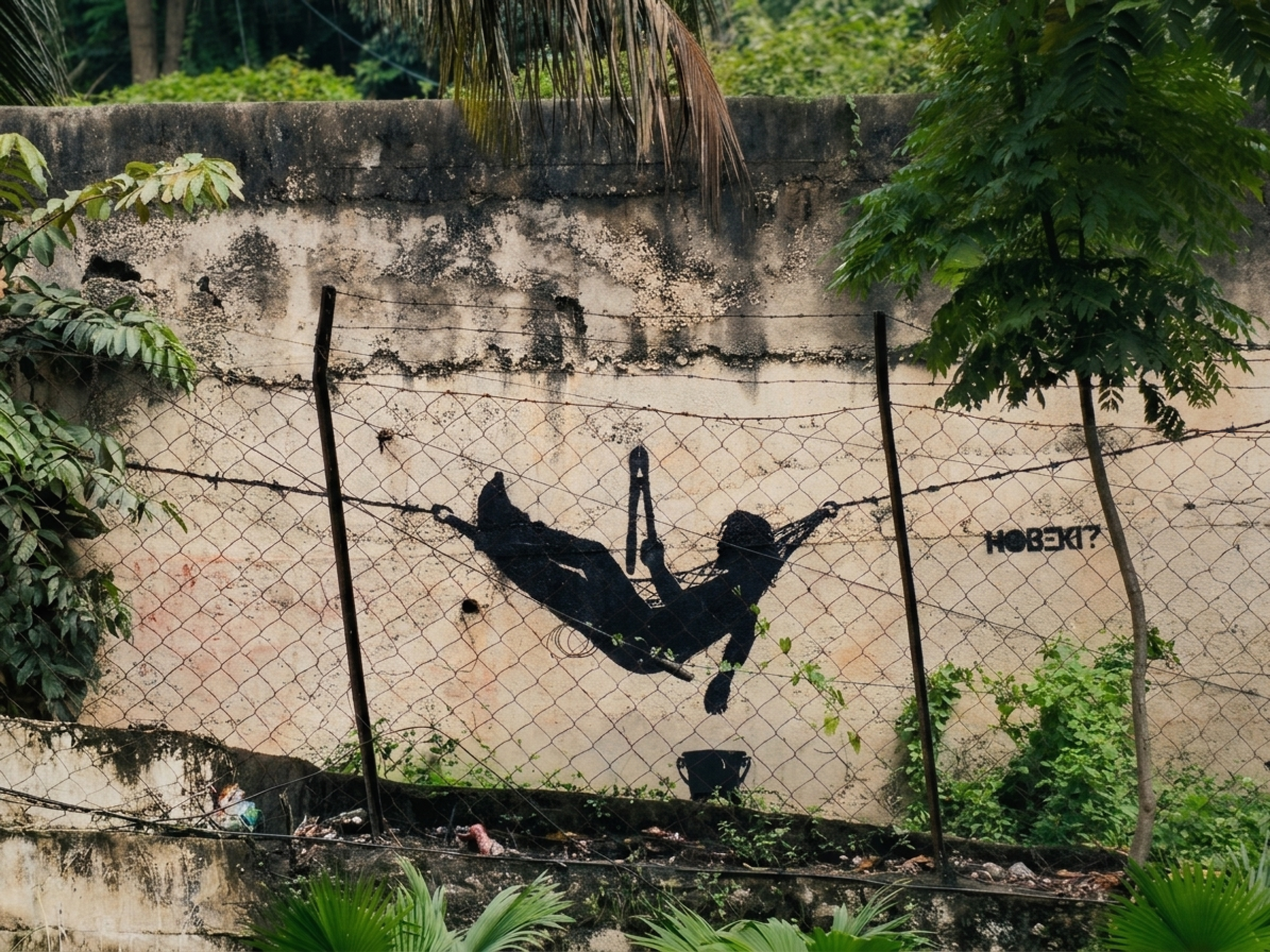
Whether viewed as street art or cultural commentary, the Majitar mural marks a new chapter for Bangladesh’s most celebrated graffiti icon. Its greatest statement may lie not in what it declares, but in when it appeared. As real-world travel between Bangladesh and India cautiously resumes, Subodh has already crossed the border, carrying questions about freedom, connection and shared humanity that art often expresses more powerfully than words.