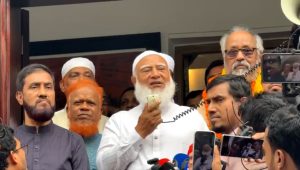



Bangladesh and China can learn from each other and build stronger ties while keeping mutual respect and their respective ideological values intact, Jamaat-e-Islami Secretary General Mia Golam Porwar said on Wednesday.
Leading a party delegation at a Chinese Embassy function in Dhaka, the former lawmaker underlined that party-to-party exchanges remain vital to solidifying friendly bilateral relations, even through changes of government.
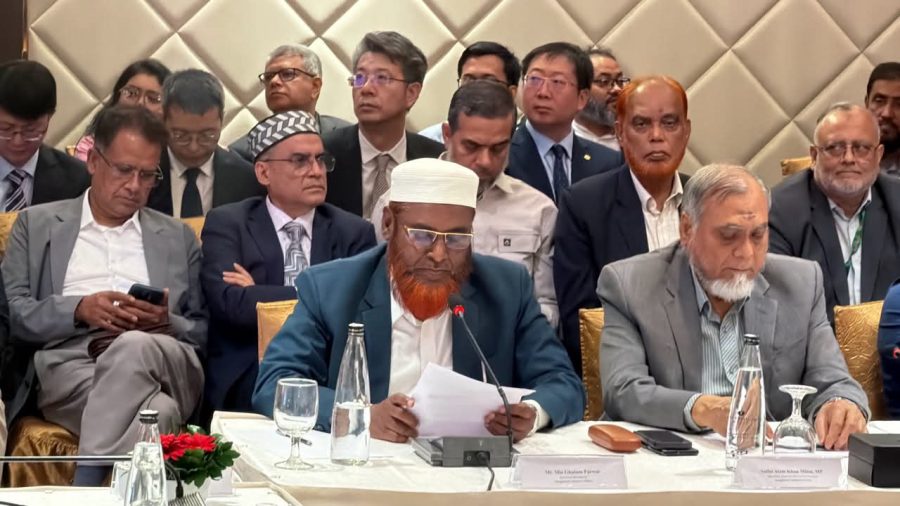
The event, held under the theme “Role of party-to-party exchanges in developing bilateral relations,” took place at the Crystal Hall of InterContinental in the capital at 2:30pm.
The Jamaat delegation comprised Advocate Ehsanul Mahbub Zubair, assistant secretary general; Saiful Alam Khan Milon, MP, Mobarak Hossain, Nurul Islam Bulbul, MP, and Mohammad Salim Uddin, central executive council members; Dr Mosleh Uddin Farid, MP; Mir Ahmad Bin Kasem, MP; Najibur Rahman Momen, MP; Nurunnisa Siddiqua, MP; Advocate Sabikunnahar, MP; and Ali Ahmad Mabrur, member of the foreign affairs advisory committee of the ameer of Jamaat.

Liu Haixing, minister of the International Department of the Central Committee of the Communist Party of China; Dr Liu Yuyin, charge d’affaires of the Chinese Embassy in Dhaka, alongside embassy officials; and leaders of various political parties of Bangladesh were present at the function.
Deepening party ties
At the beginning of his speech, Mia Golam Porwar welcomed visiting minister Liu Haixing and his delegation, expressed gratitude to the Chinese Embassy for arranging the event, and wished overall success for the programme.
He pointed out that regular contact, mutual cooperation, and exchange of experience among political parties of both nations are necessary to further strengthen friendly relations between Bangladesh and China, which have existed since 1975, noting that the two countries celebrated the 50th anniversary of relations last year.




Porwar noted that long-standing contact and relations exist between Bangladesh Jamaat-e-Islami and China, recalling that Maulana Motiur Rahman Nizami (R), the then ameer of Jamaat and industries minister, visited China in 2006.
Later, a delegation led by Dr Syed Abdullah Mohammad Taher, MP, deputy ameer of the party and deputy leader of the opposition in parliament, visited China in September 2024, followed by another delegation led by Dr Shafiqur Rahman, MP, ameer of Jamaat and leader of the opposition in parliament, visiting China upon invitation in July 2025.
The secretary general highlighted that these visits demonstrate that communication and ties between political parties continue even when governments change.
Learning from China
Expressing interest in learning from China’s development experience, Porwar observed that Bangladesh deeply follows China’s growth trajectory, particularly observing the proceedings Communist Party of China’s (CPC) 20th Central Committee fifth plenary session, which stressed discipline, honesty, and maintaining close ties with the public.
He added that China’s experience in poverty alleviation, establishing grassroots governance, and environmental conservation holds special lessons for Bangladesh, emphasising that both countries can learn from each other while keeping mutual respect and their respective ideological values intact.

To bolster future cooperation, Porwar put forward three proposals, suggesting first that the activities of the Bangladesh-China Centre for Party and State Governance Studies be made more effective as a regular platform for exchanging governance and development experience with political parties in Bangladesh.
Second, he called for increasing contact, visits, joint studies, and training programmes among young political leaders of both countries to advance friendly relations in the future.
Third, he emphasised expanding mutual cooperation and experience sharing beyond conference rooms to all levels of society, reaching ordinary people including farmers, workers, students, and small entrepreneurs.
Raising the issue of the Rohingya crisis, Porwar noted that nearly 20 lakh Rohingyas taking shelter in Bangladesh pose various problems for both Bangladesh and the entire region, underlining that safe, dignified, and voluntary repatriation of Rohingyas to their homeland is essential for regional peace and stability.