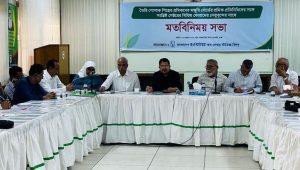
Transparency International Bangladesh (TIB) has refuted claims made by Bangladesh Jamaat-e-Islami regarding its recent research report, describing the statement issued by the party’s secretary general as misleading and a distortion of truth.
In a press release issued on Tuesday, the anti-corruption organisation noted that Jamaat-e-Islami’s claim of ensuring women’s inclusion at all levels by forming separate women’s committees under nominal compliance with the Representation of the People Order (RPO) is an “eyewash” and an attempt to cover up actual political practices.
Expressing surprise at Jamaat labelling the research data as “untruthful” while denying reality, TIB nevertheless appreciated the party for reviewing the report, titled “Institutional Good Governance in Political Parties of Bangladesh,” seriously.
Zero female representation in executive council
TIB explained that the RPO, 1972 mandates political parties to fix a target in their constitutions of reserving at least 33 per cent of committee posts at all levels for women, to be achieved progressively by 2030.
However, an analysis of central committees – defined as central or national executive committees, executive councils, or working councils – showed a severe deficit across political parties in complying with this legal provision.

For Jamaat-e-Islami, data published on its website for the 2023–25 term revealed that its 19-member central executive council contains zero female members, which directly breaches the legal requirement of having female representation in every committee.
Separate women’s wings termed eyewash
Responding to Jamaat’s counter-claim that its central working council includes 21 women, its central majlis-e-shura includes 122 women, and nearly 43 per cent of its rukons (members) are female, TIB clarified that the research focused strictly on central executive committees rather than overall membership or broader bodies like the majlis-e-shura.

It added that the RPO, 1972 places importance on female representation within decision-making executive committees rather than setting total membership quotas, making the secretary general’s examples irrelevant and a distortion of truth.
Highlighting structural differences, TIB observed that while other political parties in Bangladesh maintain a single committee at each level with varying degrees of female inclusion, Jamaat’s constitution provides for separate committees, majlis-e-shura, and working councils for female activists solely to conduct activities among women.
TIB pointed out that Jamaat has no separate central executive council for women and excludes female members from its central executive council and top leadership positions, including ameer-e-jamaat, nayeb-e-ameer, secretary general, and assistant secretary general.
Confining female workers within a restricted boundary under the guise of separate committees does not constitute genuine political inclusion and claiming it as such is an eyewash.
The governance organisation further noted that Jamaat failed to nominate a single female candidate for any constituency in the upcoming 13th National Parliamentary Election, despite claiming that 43 per cent of its members are women, an issue on which Jamaat offered no comment in its statement.
Conflict with national constitution
In addition, TIB highlighted that several provisions in Jamaat’s party constitution conflict with articles of the Constitution of the People’s Republic of Bangladesh.

These include establishing society based on fundamental Islamic beliefs, refusing to recognise sovereign power other than Allah, rejecting non-Islamic rules in social, economic, and political spheres, restricting ties with non-Islamic institutions, setting distinct conditions for Muslim and non-Muslim members, and operating separate wings for women.
Such provisions contradict constitutional principles regarding popular sovereignty, secularism, religious freedom, and non-discrimination on grounds of religion or gender.
Reaffirming the validity of its findings, TIB emphasised that its research adhered to internationally recognised social science methodologies, incorporating interviews with political party representatives, Election Commission officials, political analysts, academics, and researchers, alongside cross-checked primary and secondary data.
TIB urged all political parties, including Jamaat-e-Islami, to give serious consideration to the report’s findings and implement institutional reforms as recommended.