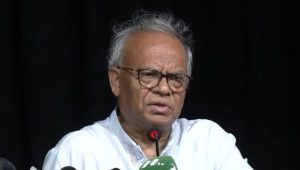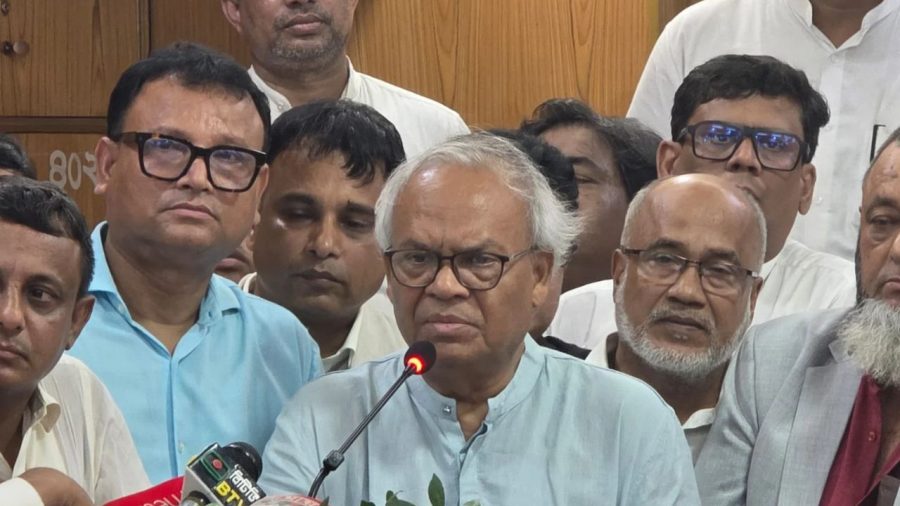



BNP Acting Secretary General Ruhul Kabir Rizvi on Sunday accused Jamaat-e-Islami of repeatedly siding with authoritarian forces, saying its political history was one of surrender rather than revolution.
He made the remarks at an event marking 35 years of the Jatiyatabadi Ainjibi Forum at the Dhaka Bar Association building.
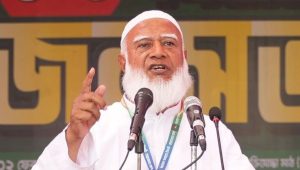
Rizvi criticised Jamaat Ameer’s remarks on Saturday that another revolution was approaching.
“You say another revolution is coming. Jamaat’s ameer said yesterday that a revolution was knocking at the door. Ask any historian, or ask the people, who are the greatest witnesses. Your political history is a history of surrender,” he said.
Rizvi, also political adviser to Prime Minister Tarique Rahman, cited the political events of 1971, 1986 and 1995 to challenge Jamaat’s record.
“Your history is one of repeatedly bowing to autocratic forces. Have you ever carried out a revolution? Have people forgotten 1971, 1986 or 1995?” he asked, accusing the party of collaborating with authoritarian rulers.

He further described Jamaat’s political record as one of submission and subservience to others.
Turning to the seven-point demands and protest programmes of opposition parties, Rizvi said political disputes could not be resolved through street demonstrations or long marches.
He urged political parties to pursue dialogue, arguing that democratic institutions and parliamentary discussions offered the way forward.




On implementation of the July National Charter, Rizvi said the BNP was not opposed to the initiative but maintained that notes of dissent submitted by different parties, including the BNP, must first be addressed through discussions.
“Every solution will come in a democratic environment, in parliament and at the discussion table. It cannot be achieved through long marches,” he said.
He argued that the Charter’s proposals for strengthening democracy could be implemented through constitutional amendments, provided political parties secured the necessary two-thirds majority in parliament.
Recalling the BNP’s 17 years of political struggle, Rizvi said many party leaders and activists had faced persecution. Some had lost limbs or eyesight after being shot by police, he said.
He also defended the government’s initiatives, saying Tarique Rahman had begun implementing election promises from his first day in office.
These included family cards, farmer cards, healthcare services and allowances for imams, muezzins and religious personnel at temples and churches as part of social protection measures.
Referring to the prime minister’s visit to Japan, Rizvi said the government was seeking investment, stronger bilateral relations, infrastructure development and expanded trade.

He alleged that attempts were being made to destabilise the country despite these initiatives.
Citing recent unrest involving attacks on police, arson at police boxes and garment workers’ demonstrations, Rizvi claimed that some of those arrested were leaders and activists of the Jubo League and Chhatra League.
He also recalled his imprisonment under former prime minister Sheikh Hasina’s government, saying he had been held on remand for 35 consecutive days.
Of those, he said, 22 days were spent at the Dhaka Metropolitan Police Detective Branch office and 13 days at Mohammadpur Police Station.
Rizvi praised lawyers who had stood by opposition activists during that period, saying collective resistance had sometimes offered protection when legal remedies failed.
“Under Sheikh Hasina’s courts, legal procedures alone brought no relief. It was the collective strength of those present that sometimes saved us,” he said.