


State Minister for Primary and Mass Education Bobby Hajjaj on Saturday said the government would support students in turning their innovative ideas into practical and sustainable solutions to local problems.
Hajjaj, also the lawmaker for Dhaka-13, said students should be given opportunities to contribute not only to solving problems in their communities but also to national policymaking through their creativity, talent and new ideas.
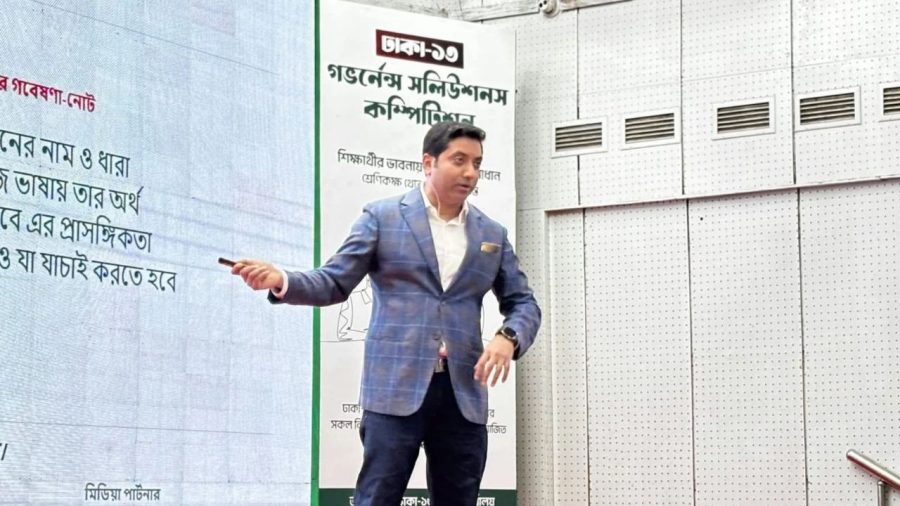
He made the remarks while addressing a special workshop of the ‘Governance Solutions Competition’, organised for students from his constituency in Mohammadpur, Dhaka.
The state minister urged students to identify specific problems for which they could propose realistic and effective solutions, rather than merely highlighting major challenges.
He said their proposals should clearly establish the scale of a problem, who was affected and how seriously it affected them, supported by credible evidence.

Students could use field surveys, interviews with relevant people, news reports and reliable research findings to substantiate their proposals. Artificial intelligence tools could also be used where necessary, he added.
Emphasising practical implementation, Hajjaj said a good solution should not merely appear attractive on paper but must also be feasible in practice.
He said students should identify the authorities whose approval and cooperation would be required, the people and organisations involved, and the personnel, funding and other resources needed to implement their proposals.
Citing traffic congestion outside schools and the management of local canals and waste as examples, he stressed that solutions should combine immediate action with long-term sustainability.




A one-day cleanliness drive would not be enough, he said, adding that public awareness and the participation of all stakeholders were essential for effective waste management.
The state minister also urged students to identify the institutions responsible for legal, administrative and operational aspects of their proposed solutions.
He said no initiative could be sustained without the consent of relevant institutions and the public, along with adequate resources. Practicality, effectiveness and long-term impact would therefore receive particular attention in evaluating the proposals.
Describing the event as more than a conventional student competition, Hajjaj said it offered participants an opportunity to understand how governance and policymaking worked through their own ideas and proposals.
He said the three winning teams would have the opportunity to coordinate with the MP’s office to implement their proposals. Where proposals involved education, the teams would also be able to work with the state minister’s office.
Relevant government institutions and the Jatiya Sangsad would be involved if necessary.

Explaining the selection process, Hajjaj said 124 participating teams would first submit detailed written reports within a specified deadline.
A seven-member judging panel would assess the submissions and select the five best teams.
The shortlisted teams would then deliver 15-minute PowerPoint presentations before a national-level audience and invited guests. Based on their final presentations, the champion, first runner-up and second runner-up would be selected.
Hajjaj said he wanted the talent and creativity of students in Dhaka-13 to be put to meaningful use.
“I want the talent and creativity of Dhaka-13 students to be properly utilised. We want to show the whole country that, if we can make proper use of our students’ ideas and innovative abilities, they can lead the way in initiating change in the country,” he said.
Competition judges, organising team members, teachers from different educational institutions and participating students attended the workshop.