


A country’s history does not always unfold through its leaders and political milestones. Sometimes, it emerges through the conflicting ideals of two generations within a family. This perspective set the tone for the 13th Liberation DocFest Bangladesh on Thursday, 29 October, with the screening of K-Family Affairs, a documentary by South Korean filmmaker Arum Nam.
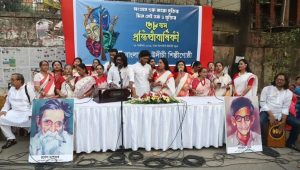
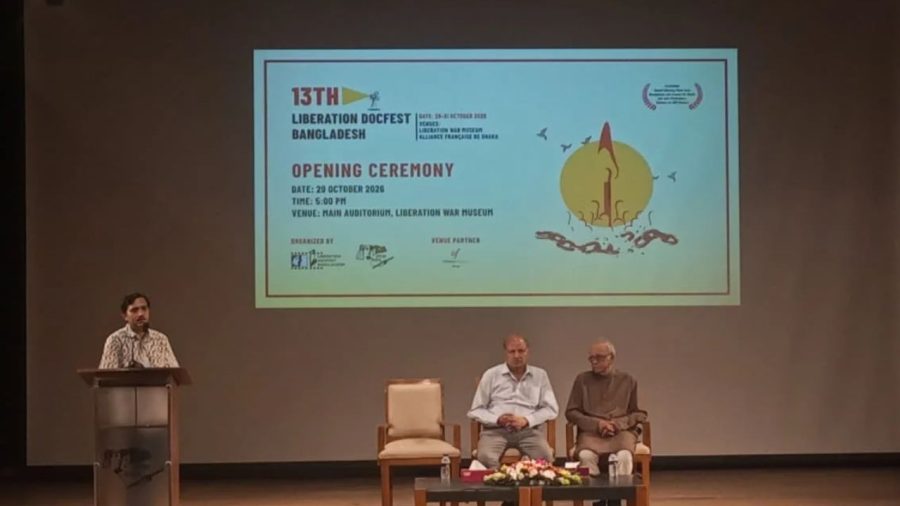
The opening ceremony began at around 5:30pm at the main auditorium of the Liberation War Museum in Agargaon, Dhaka. This year’s edition is being held under the theme “Presence in Absence” and will continue until 31 October.
Dramatist M Hamid attended the inaugural event as chief guest. Mofidul Hoque, one of the founding trustees of the Liberation War Museum, and Farid Ahmed, the festival’s artistic director, were also present.

In his address, M Hamid reflected on the gap between achieving political freedom and building a society rooted in human values. He spoke about the erosion of mutual trust, religious intolerance and the limitations of an education system that gives insufficient attention to humanistic and ethical learning.
The opening film, K-Family Affairs (2023), explores South Korea’s political history through the personal experiences of director Arum Nam and her parents, who belonged to the country’s pro-democracy “386 Generation”. The generation played a significant role in the democratic movement that culminated in mass protests in 1987 and reforms that paved the way for direct presidential elections.




Through home videos and archival footage, the documentary follows the contrasting paths of Nam’s parents. Her father became a civil servant, while her mother remained committed to feminist activism. Their differing approaches to politics and social change lead Nam to question what remains of the democratic ideals that shaped her parents’ generation.
The film traces significant episodes in South Korea’s recent history, including the 2014 Sewol ferry disaster, the movement to impeach former president Park Geun-hye, the #MeToo movement and the 2022 presidential election. Rather than presenting these events as a detached political chronology, it connects them to Nam’s evolving relationship with her parents and her search for a role in society.
By placing private memories alongside public upheavals, the documentary highlights how political ideals can change across generations. This is particularly evident when those who once fought for reform become part of the institutions they sought to transform.
For Bangladeshi viewers, the film’s exploration of authoritarian rule and democratic struggle may evoke parallels with the country’s own history of political upheaval and military rule.

The two countries have distinct historical trajectories, but the documentary raises questions that extend beyond national borders. What happens to a generation’s ideals after it gains power? How does the next generation respond when the promised transformation remains incomplete?
The three-day festival brings together documentary filmmakers from Bangladesh and abroad. Its films explore resistance, displacement, gender equality, generational memory, ecological crises and the legacy of the Liberation War. Selected from international submissions, the programme continues the festival’s focus on freedom, human dignity and human rights through documentary cinema.