Heat and other climate-sensitive health risks cost Bangladesh an estimated $20.7 billion annually, equivalent to 4.6 per cent of its 2024 gross domestic product, as rising temperatures, disease outbreaks and disasters threaten health and livelihoods, a new study has found.
Extreme heat alone caused an estimated $15.8 billion in lost working capacity in 2024, wiping out 29.3 billion potential working hours, according to the Knowledge Hub Institute (KHI).
Farmers and agricultural workers accounted for nearly two-thirds of those lost hours, reflecting the vulnerability of outdoor workers.
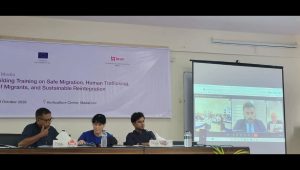
The findings were released on Thursday at BRAC Centre in Dhaka in a report titled “Multi-Dimensional Health Impacts of Climate Change in Bangladesh: Pathways, Costs and Policy Implications”.
The $20.7 billion estimate covers lost working capacity, premature deaths and selected disease costs across several reference years. It excludes air pollution and non-fatal illness costs, while researchers estimate that $1 billion to $3.3 billion of the annual burden is specifically attributable to observed warming.
Weather data from eight divisional headquarters show that days reaching at least 36 degrees Celsius roughly doubled between the 2000s and the 2020s. Rising humidity further increases health risks by reducing the body’s ability to cool through sweating.
Modelled estimates cited in the report link high temperatures to approximately 16,000 deaths in 2023, including deaths involving cardiovascular, kidney and respiratory conditions. Research also found increased diarrhoea and heat exhaustion during very hot weather and higher levels of depression and anxiety in summer.

The study found a strong association between temperature and dengue hospitalisations. A one-degree Celsius increase in average temperature over the preceding four weeks was associated with approximately 21 per cent more dengue admissions two weeks later.
About two-thirds of dengue admissions since 2023 occurred outside Dhaka city, although hospitals in the capital accounted for 57 to 64 per cent of deaths, partly because they receive critically ill patients referred from elsewhere.
Among hospitalised patients, women were 1.8 times as likely to die as men, while those aged 61 and above faced 4.5 times the mortality risk of children.
Dengue hospital treatment cost an estimated $154 million in 2023, excluding outpatient care.
Climate-related disasters added to the burden, causing an average of 416 deaths annually between 2019 and 2024. Floods and cyclones damaged 824 health facilities in 2024, disrupting access to treatment.




The report also highlighted contaminated water, diarrhoeal diseases and links between saline drinking water and pregnancy-related hypertension and pre-eclampsia in coastal areas.
Air pollution, excluded from the headline economic estimate, presents another major health risk. Research cited in the study associated particulate pollution with approximately 263,000 deaths in 2023, while a separate estimate linked fossil-fuel pollution to 30,600 deaths in 2022.
Despite these pressures, public health financing and preparedness remain inadequate.
Households paid approximately 79 per cent of Bangladesh’s current health expenditure in 2023, leaving families exposed to medical bills when illness also reduces earnings.
The Health Services Division spent only 24 per cent of its climate-relevant allocation in the 2024–25 financial year. Researchers found no clear evidence that real health spending increased following severe disaster years.
KHI President Khondaker Golam Moazzem said existing climate policies had not adequately addressed health risks.
“We urgently need sector-specific heat protection guidelines, district-level heat and health action plans, and better utilisation of health budgets,” he said.
He also urged the government to prioritise financing for the Health National Adaptation Plan, including through international climate negotiations.
State Minister for Health and Family Welfare M A Muhit called for a coordinated early warning system involving health, meteorological and other agencies.
“We also need stronger inter-ministerial collaboration, more research and targeted interventions for vulnerable groups, particularly women, children and persons with disabilities,” he said.

Muhit said stronger evidence could support Bangladesh’s case for climate justice and financing at the 31st United Nations climate conference.
The report recommends a national heat-health action plan before the 2027 hot season, linking weather alerts to hospital preparedness, cooling facilities, emergency supplies and outreach to vulnerable groups.
It also calls for workplace guidance on drinking water, shade, rest periods and working hours, alongside agricultural advisories.
For dengue, KHI proposes weekly district risk bulletins combining weather conditions with recent admissions, allowing preventive measures and hospital preparations two to three weeks ahead. It also recommends priority assessment of women and older patients and audits of every dengue death.
The study urges the government to begin funding the Health National Adaptation Plan through identifiable allocations in the 2027–28 budget, introduce contingency financing for heatwaves and outbreaks, release seasonal funds early and publish actual climate-related health spending quarterly.
Other recommendations include free dengue testing and inpatient care in public hospitals during declared outbreaks, pre-positioning water purification supplies and oral rehydration salts in flood-prone areas, and assessing health facilities for flood, storm and electricity risks.
It also calls for investment in renewable energy, energy efficiency, clean cooking and solar-backed electricity for healthcare facilities, while accounting for avoided pollution deaths in energy investment decisions.
KHI proposes a shared climate-health information system combining daily weather and disease records, systematic reporting of heat-related illness and deaths, and annual health accounts identifying climate-related spending.
The report identifies 16 highly vulnerable districts for initial action, with heat protection, dengue early warning, stronger patient care and more effective use of public funds among its immediate priorities.