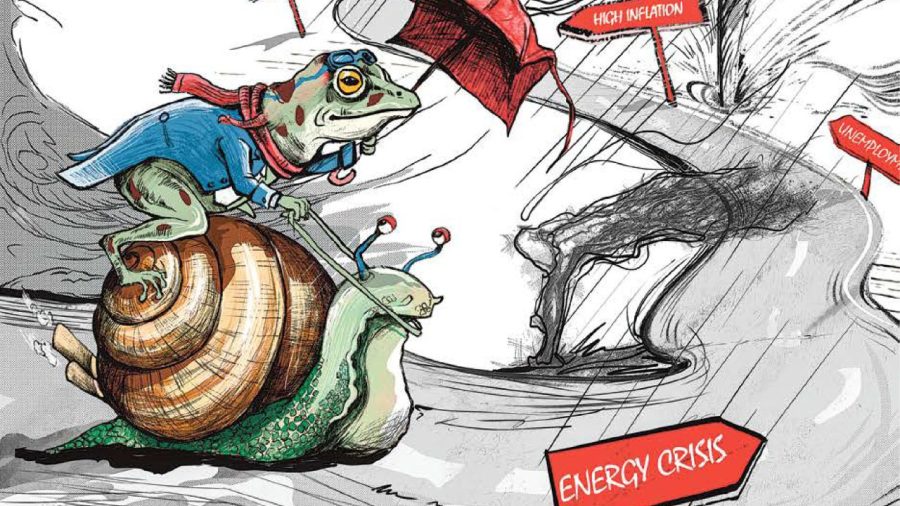

Bangladesh’s prolonged slowdown raises a fundamental question: is this simply another cyclical downturn, or does it reflect deeper structural problems? The evidence increasingly points to the latter. The post-Covid rebound was largely mechanical — the economy was returning toward normal after an extraordinary disruption. What followed has been different. Growth has declined steadily over the past four to five years and is now below 4 per cent. Political transition and geopolitical disruptions have added to the pressures, but they do not fully explain the persistence of the slowdown.
Cyclical weakness can generally be addressed through market adjustment and appropriate policy responses; structural stagnation requires deeper changes. That distinction matters when we talk about Bangladesh’s growth ambitions. The aspiration of 8–9 per cent growth has to be weighed against the constraints currently holding the economy back. Unless those underlying problems are addressed, sustaining even 5 per cent growth could prove difficult.
This is not a challenge unique to Bangladesh, although it is described differently across economic contexts. In developing economies, prolonged difficulty in sustaining growth is often discussed in terms of the middle-income trap, a theme explored in the World Bank’s World Development Report 2024, with countries such as Malaysia and Thailand providing useful examples. In advanced economies, a related debate has centred on secular stagnation, associated notably with Lawrence Summers. The broader lesson is that growth cannot be expected to regain momentum simply with the passage of time; the underlying constraints have to be identified and addressed.
One of the most fundamental constraints on Bangladesh’s growth is basic state capacity — the ability to provide security, enforce contracts and operate essential systems effectively. Concerns over law and order continue to affect the predictability needed for economic activity, while courts, regulators and even informal codes of conduct do not yet provide sufficiently consistent enforcement. Strengthening these basic institutional functions is therefore central to restoring confidence and creating the conditions for sustained investment and growth.
Energy illustrates the point. Bangladesh has around 30,000 megawatts of installed capacity. Even after excluding stranded plants such as Rupsha, which lacks a gas pipeline, and Payra, where coal supply is constrained by navigability problems, at least 22,000 megawatts of usable capacity remains against peak summer demand of around 17,000–18,000 megawatts. Yet the system is unable to deliver reliable supply from this available capacity — a problem that was far less acute only a year earlier.
The Iran war has disrupted LNG markets, with prices more than doubling and availability tightening. But external shocks alone do not explain the shortfall. Many of the underlying problems are legacy issues: generation capacity was expanded without adequate attention to fuel supply, logistics and institutional coordination, leaving some plants stranded or underutilised. These constraints cannot be corrected overnight. The concern is whether the same pattern continues — adding capacity without first ensuring that it can be reliably supplied and operated. That would perpetuate a political economy that has too often favoured capacity creation over sustained performance. Without reliable energy, attracting and retaining investment will remain difficult.
The problems in the power sector are not unique. Similar weaknesses in governance, accountability and regulatory enforcement have long affected other parts of the economy, most notably banking. Both sectors carry significant legacy problems. The question now is whether changes in leadership will also bring changes in the incentives and practices that allowed those problems to persist.

Non-performing loans exceeding 32 per cent are a stark indication of weaknesses in contract enforcement. A functioning banking system depends on credible mechanisms for recovering loans when borrowers default. Rescheduling, restructuring, exit facilities and write-offs can all have legitimate purposes, but when they repeatedly substitute for effective recovery, they weaken repayment discipline and create expectations of future concessions. That ultimately undermines both bank balance sheets and the willingness to lend.
An economy aspiring to 8–9 per cent growth will require investment of roughly 35–40 per cent of GDP, supported by a financial system capable of mobilising and allocating resources on that scale. But when loan recovery is uncertain, and repayment discipline is weak, banks cannot sustainably provide the financing that such investment requires. This is why growth ambitions and institutional reform cannot be separated.
Treating symptoms doesn’t cure the disease
Bangladesh Bank’s Tk60,000 crore stimulus needs to be viewed in this context. Easier credit may provide temporary relief to viable businesses under pressure, but financing alone cannot resolve the constraints that have weakened production. Factories have faced inadequate gas pressure, unreliable electricity, higher import costs following the depreciation of the taka, weaker export orders and difficulties opening LCs as bank balance sheets deteriorated. Unless these underlying constraints are addressed, additional credit risks shift more of the burden onto the financial system and ultimately the state without restoring firms’ capacity to produce and compete. A stimulus can provide breathing space; it cannot substitute for structural reform.
Temporary support, however, does not answer the larger question: where will the next phase of growth come from? Bangladesh has historically relied on three important pillars — agriculture, garments and remittances. Agriculture remains essential for food security, employment and economic stability, but is unlikely on its own to become the next major growth engine. Garments remain the country’s principal export industry, but the immediate challenge is increasingly to sustain existing production and export performance while creating new sources of growth within and beyond the sector.
Of these, remittances have been the most resilient in the recent period, with around $35 billion flowing in last year. They support household purchasing power, particularly in rural areas, while strengthening foreign-exchange availability and thereby supporting imports, investment and production. This has provided an important buffer against external-sector pressures. At the same time, part of the sharp increase in recorded remittances since August 2024 reflects a shift from informal to formal channels. The question is whether that shift can be sustained.




Finding new sources of growth will also require a more effective institutional environment for investment. The consolidation of the investment development authority, economic zone authority and public-private partnership authority into Invest Bangladesh could help reduce fragmentation and improve coordination. But restructuring is not reform in itself. The real test is whether investors see better service delivery and faster, more predictable decisions. That will also depend on progress beyond the investment agency — particularly in energy, finance, regulation and ports.
Creating new engines of growth
The more important question now is where the next engines of growth can come from. Bangladesh has considerable potential to move into more diversified and higher-value manufacturing, and the experience of countries such as Vietnam shows what can be achieved when that potential is supported by the right enabling environment. The challenge is to create the conditions that allow such opportunities to translate into investment, production and exports.
A broader reconfiguration of global manufacturing is already under way, as companies diversify supply chains and some production moves beyond established manufacturing centres, including China. This creates an important opportunity for countries that can offer competitive and credible conditions for investment. Bangladesh is well placed to compete for some of that production, but the opportunity will not come automatically.
The opportunity begins with Bangladesh’s existing manufacturing base, particularly garments. While the sector is currently under pressure, that does not mean its growth potential has been exhausted. Diversification remains limited, with exports concentrated in four or five major product categories and relatively little movement into higher-value segments. Recent tensions between BTMA and BGMEA over yarn imports illustrate the broader challenge: policies intended to support domestic industry must also preserve the competitiveness and flexibility exporters need to diversify. The objective should be to strengthen the domestic textile base without constraining the garment sector’s ability to move into new products and markets.
The opportunity also extends beyond textiles to sectors such as leather, light engineering, automobiles and other areas of manufacturing. As global production patterns shift and firms diversify their manufacturing locations, Bangladesh is well placed to compete for some of this investment. Capturing it will require suitable land, reliable utilities and an investment environment in which firms can operate with confidence.
That confidence also depends on a financial system in which contracts are enforced and defaulted loans can be credibly recovered. Bangladesh once had single-digit NPLs, suggesting that today’s repayment problems are not cultural but reflect changes in incentives and enforcement. Repeated rescheduling and exit facilities, often presented as exceptional measures, have created expectations of further concessions. Restoring repayment discipline therefore requires making recovery credible and exceptional treatment genuinely exceptional.
The next phase of growth therefore has to come from doing more with Bangladesh’s existing manufacturing strengths while building new ones — moving into higher-value products, diversifying beyond garments and positioning the country to capture shifts in global production. The opportunity is significant, but realising it will depend on whether the investment environment can support firms seeking to produce, expand and compete from Bangladesh.
Macroeconomic constraints and opportunities
Creating new engines of growth will also require a macroeconomic environment capable of supporting them. Here, the fiscal position remains a significant constraint. The budget sets a revenue target of Tk6.95 lakh crore against expenditure of nearly Tk9 lakh crore, raising questions about whether the revenue assumptions are realistic. The government’s difficulty in reimbursing the remittance subsidy illustrates the pressure: if existing commitments are proving difficult to meet, delivering expenditure on the scale envisaged in the budget will be challenging.
Meeting the budget target would require revenue growth unprecedented in Bangladesh’s history. At the same time, interest payments, salaries and pensions are taking a growing share of the revenue budget, while the scope to reduce power, gas and food subsidies remains limited. New projects and the increase in government pay add further expenditure commitments at a time when fiscal space is already constrained.
If geopolitical conditions normalise, Bangladesh could benefit from lower energy prices and easing disruptions to shipping and trade. That could help reduce inflation and support a recovery in growth from around 4 per cent to perhaps 5 per cent. But moving from such a recovery to sustained growth of 8–9 per cent would require a very different structural foundation.
The period to 2030 should therefore be used to rebuild the foundations for higher and more sustained growth — restoring macroeconomic stability, strengthening the financial system and improving institutional capacity. This is not an argument for postponing growth; progress on these fronts can itself support recovery and investment. The demographic transition adds urgency to that task, because the benefits of a relatively young population will not last indefinitely.
The demographic dividend works through several channels: a large working-age population expands the labour force, rising employment and incomes support consumption, and working-age households can generate higher savings. Bangladesh still has an opportunity to benefit from all three, but that opportunity is time-bound as the population gradually ages. There is also the possibility of a second demographic dividend if higher savings can be channelled into productive investment.
There is also a gender dividend. Greater participation of women in the labour force would expand the effective workforce and raise household incomes, while bringing more skills and productive capacity into the economy. Bangladesh has made important gains in female employment, particularly through the garment sector, but considerable potential remains untapped.
Conditions for change
The difficulty is that meaningful reform inevitably changes existing arrangements and therefore encounters resistance from those who benefit from them. Changing laws and regulations is difficult enough; changing the way organisations actually function is harder. That is why institutional reform requires not only sound policy design but also the capacity and political commitment to carry it through.
Port reform provides one example. Changes to long-established operating arrangements inevitably affect groups with a stake in the existing system. Bank restructuring presents a similar challenge, particularly when mergers or other reforms alter established relationships among owners, directors, borrowers and regulators.
The broader lesson is that structural problems do not correct themselves with time. Bangladesh has significant opportunities — from demographic change to shifts in global production — but realising them requires deliberate reform. Time is not a policy instrument, and waiting will not restore the foundations for sustained growth.
Author is the former Lead Economist, World Bank Dhaka Office. The views expressed in this article are solely those of the author.