





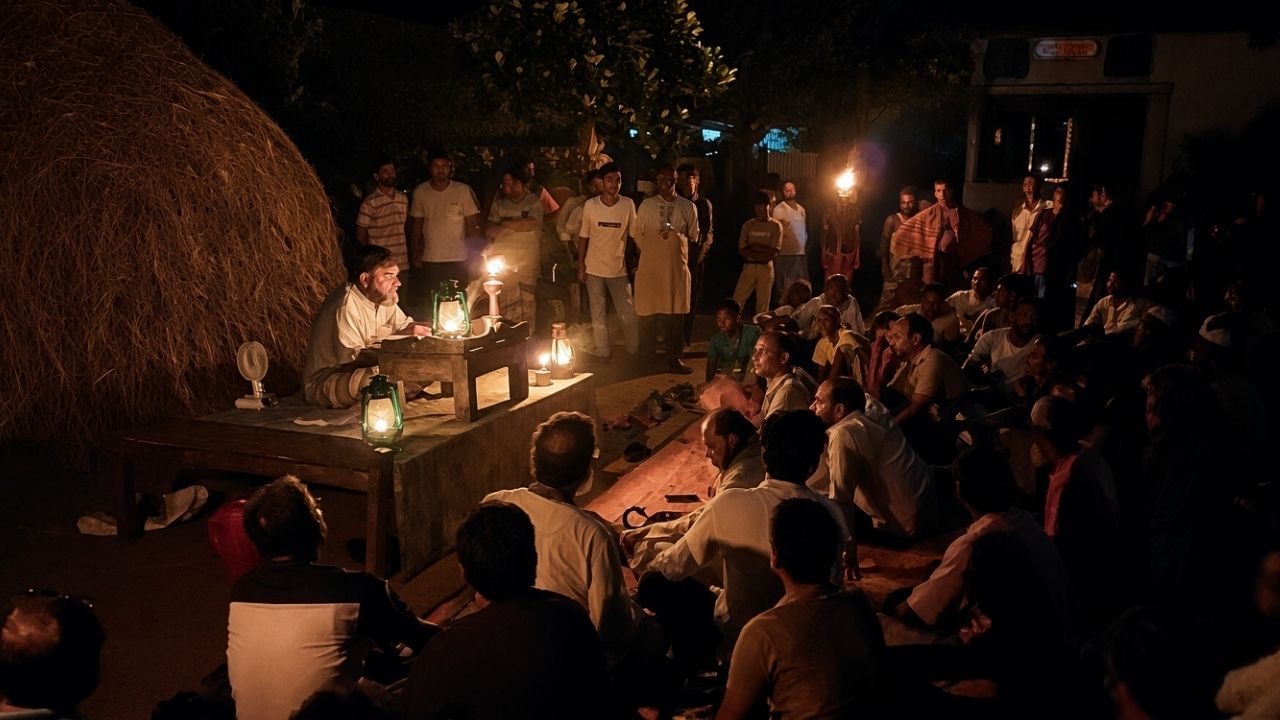
Under the luminous expanse of a full autumn moon, the courtyard of the late Kitab Pramanik’s home in Sonaharpara became a stage suspended in time.
Shadows danced against stacks of harvest straw as the warm, golden flicker of hurricane lamps and oil lanterns cut through the muggy night air.
An absolute, expectant silence blanketed the crowd gathered on woven floor mats. Then, floating over the rustic sanctuary, came a hypnotic cadence – the ancient, melodic art of Puthi recitation.
For the villagers of Bilchalan Union in Pabna’s Chatmohar, nestled deep within the vast Chalan Beel wetlands, Thursday night’s gathering was nothing short of a cultural resurrection. Decades had passed since these traditional folk literature sessions echoed through the rural darkness.
Entering Sonaharpara requires navigating a dusty, broken track from Chatmohar Jardis Mor before following a narrow brick path into the village heart. Yet, by half-past eight, the secluded courtyard was humming.
What began as a modest gathering swelled into a packed venue of women, men, adolescents, and children, joined by culture enthusiasts who had journeyed all the way from Dhaka.
Conducted by Biplab Acharya following opening remarks by organiser Dr Atiqur Rahman Atiq, the performances commenced at quarter-past nine.
Theatre veteran Asaduzzaman Dulal took to the low wooden platform to recite the epic Bibi Sonabhan, while Loimuddin Pramanik spellbound listeners with Gazi Kalu and Champabati.
For an hour, the reciters spun tales of romance, heroism, and myth, their rhythmic chants rekindling a sixteenth-century tradition that had all but flickered out by the late 1980s.
The nostalgic pull was palpable.
Hasan Pramanik, a 70-year-old local farmer, recalled listening to such recitations during agricultural breaks four decades ago.
Retired engineer Imdadul Haque, attending with his son, reflected on how the evening transported him straight back to his childhood in his grandparents’ sitting room, lamenting how modern life has become consumed by mobile screens.
For younger attendees like Faisal Mahmud, who discovered the event on Facebook, it was an eye-opening maiden encounter with Bengal’s roots.
The revival resonated deeply with cultural figures in attendance. Former Chatmohar Press Club president Rakibur Rahman Tukun noted the rarity of such an event in an era dominated by artificial intelligence, urging state intervention to protect Bengal’s indigenous identity.
Five-time National Award-winning sound engineer Ripon Nath, who travelled from the capital, praised the effort but emphasised that sustaining interest amongst new generations requires writing contemporary narratives in the traditional Puthi format, a sentiment echoed by performer Asaduzzaman Dulal.
Once, Puthi recitations, Jatra folk theatre, puppet shows, and travelling poetry were the beating heart of rural life.
Though squeezed out by modern entertainment and a lack of patronage, the moonlit gathering at Sonaharpara proved that the melody of Bengal’s soil still holds the power to unite, enchant, and remind a community of who they are.


