





The light had faded, the picture is that of serenity; yet, amidst the placid surrounding, there is the almost inaudible murmur from resting souls.
Those who sleep and those who walk form a quiet bond – past touching the present, phantoms whispering a mystical hymn.
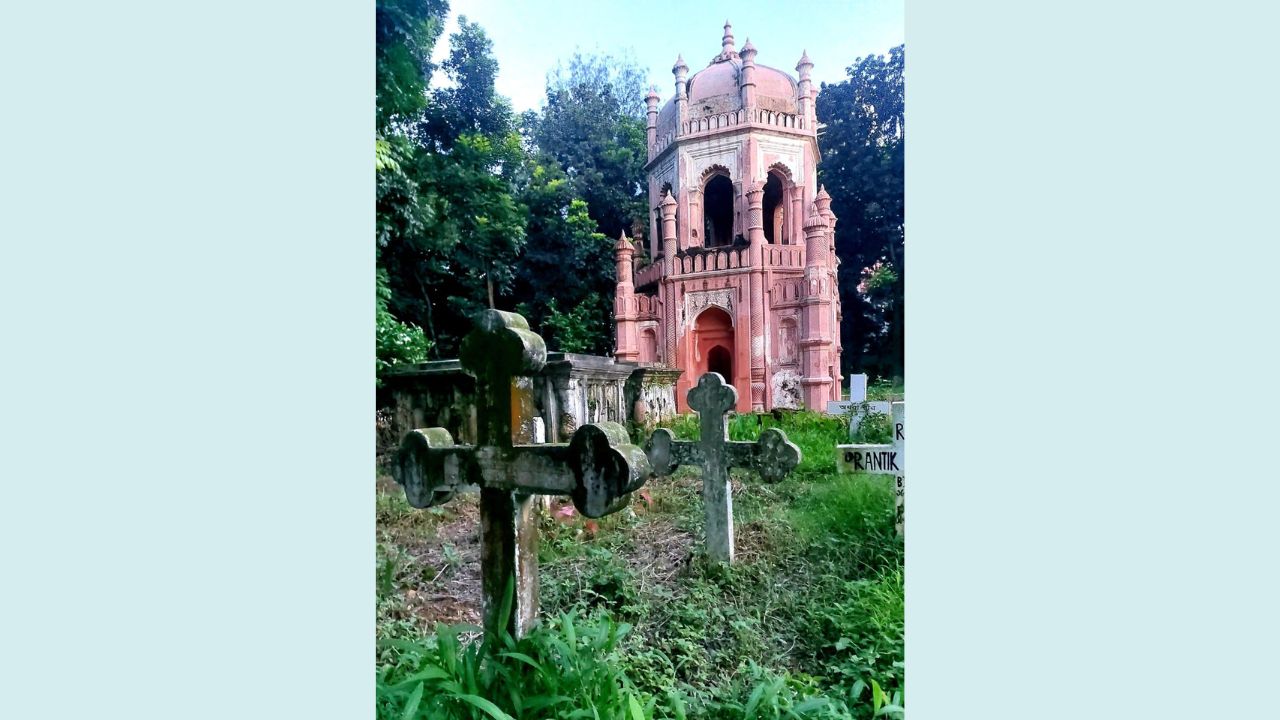
The large orange mausoleum standing under a mellow late afternoon sun creates a melancholic aura.
Columbo Sahib’s Tomb, restored with the support of British Association for Commonwealth Heritage, stands majestic, exuding a mystical aura during sunset.
It invites the visitor to sit on the grass, leave the predatory ideals behind and reflect on life, the metaphysical and, of course, death.

Where am I?
Well, the place is called Wari Christian Cemetery, but this is also known as the Portuguese cemetery because the actual graveyard was established in the 17th century by Portuguese traders.
French gem merchant Jean Baptiste Tevarnier mentioned the cemetery in his 18th century chronicles, German painter Johann Zoffany painted it in the late 18th century, and over the centuries, the cemetery has been the resting place for people from different ethnic back grounds.
The Wari cemetery has a rather spooky character because the scenes inside easily match the traditional image of something supernatural.
Columbo Sahib’s Tomb, declared one of 22 key historic sites of Dhaka by the Department of Archaeology, pulls visitors ever week, says, Bikash Dio, one of the caretakers who lives within the premises.
Every year, an event takes place around Columbo Sahib’s Tomb, but last year, that programme had to be cancelled due to a thunderstorm, he added.

The tomb is the resting place of three persons: two graves seem to belong to adults while the third one is that of someone younger.
The cemetery stays open during the day, but many prefer to come here to rest in the cathartic atmosphere just before dusk.
Aldrin Rozario is such a person.
In his mid-fifties, Aldrin remembers playing around the open space of the cemetery’s entrance as a child in 1979-80.
At that time, Columbo Sahib’s Tomb was covered in thick vegetation, snakes lived inside it and the entrance to the mausoleum was covered by roots and moss, he recalls.
Appreciating the restoration of the tomb, he adds: “now it’s really one of the major historic attractions of Old Dhaka because the atmosphere surrounding it carries the spirt of a long-forgotten era, instilling the need to pause and reflect.”
And yes, there is also the spine-chilling sensation, because the large stone gravestones, the crosses and the trees combine to create a deliciously Transylvanian feel.
Maybe the dark Count Dracula also sent a coffin to Bengal along with the ones he shipped to England!
Aldrin’s friend, Rupom Adhikary, once planned to make a short film with the cemetery as the premise.
The plot is about an old Christian missionary, who, while restoring the grave of a Portuguese merchant stumbles across a rusty bronze cylinder, Rupom’s narrative amidst the post-evening silence gives me goosebumps.
So, can anyone shoot a film here, I ask Bikash, to which he replies: “a permission needs to be taken from Father Albert at the Kakrail Church and, if he approves, we can provide support.”
In the mid 17th century, during the reign of Emperor Shahjahan, the Portuguese living in Dhaka were evicted because they developed a rift with the locals.
History about the conflict is sketchy but reportedly, soldiers from Shahjahan’s governor, supported by disgruntled locals, defeated the Portuguese in a conflict, who then fled to Hoogly.
Many of those resting here are victims of the Bengal famine in 1943 while one section also accommodates graves from the 80s and 90s.
A lover of a Gothic romance, a person seeking respite from the rat race, a confused soul in need for some solace, or a history buff, desperately seeking a time capsule, an afternoon spent here will work wonders.
And after sun sets, a voice just might ask you in a croaky voice: come, come inside this tomb, let me tell you a tale!
As we left, a few lines from poet Lord Byron came to mind: “Death, so called, is a thing which makes men weep, and yet a third of life is passed in sleep.”

