
The first known international appearance of HOBEKI?’s iconic Subodh graffiti has disappeared from a wall in Rangpo, Sikkim, barely five days after it was first reported. Its removal has brought an abrupt end to what had quickly become one of the most discussed works of South Asian street art this year.
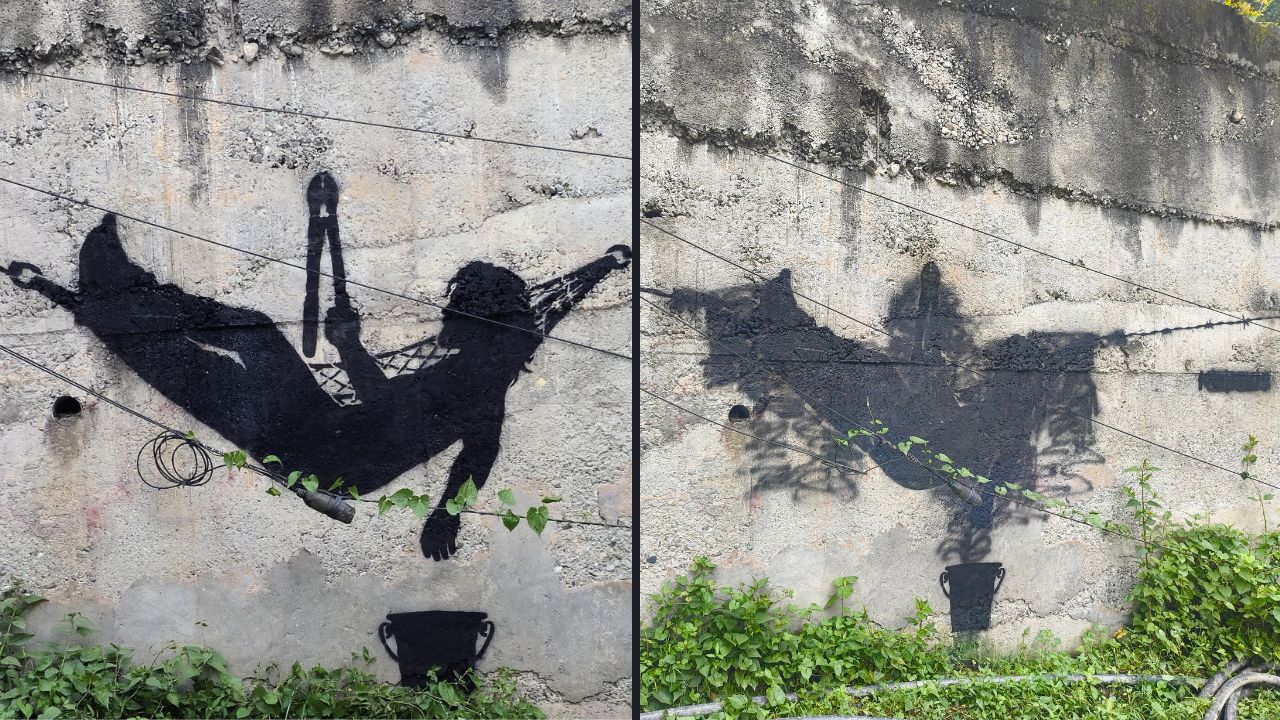
The large stencil mural appeared near the Majitar Nala Bridge on the Gangtok-Rangpo Road around 30 June. It immediately drew attention across Bangladesh and India. It marked the first documented appearance of HOBEKI?’s work outside Bangladesh, prompting widespread discussion in newspapers, television, digital platforms and social media. While some Indian media outlets celebrated it as a striking example of contemporary street art, others questioned its appearance in a strategically sensitive border state. The mural sparked debate over security, public space, diplomacy and identity.
ARTCON has since confirmed that the mural has been removed. No individual or authority has publicly claimed responsibility for its disappearance. No official explanation has been issued, leaving the circumstances surrounding its removal unknown.
The mural itself remained characteristically open to interpretation. It depicted Subodh reclining in a hammock woven from barbed wire while holding a wire cutter, with a bucket placed beneath him near the Teesta River. As with all of HOBEKI?’s works, the anonymous artist offered no explanation, inviting viewers to construct their own interpretations.
Art analyst and ARTCON founder ARK Reepon described the work as an artistic attempt to reconnect people rather than a hostile political statement.
According to ARTCON’s interpretation, the mural sought to strengthen people-to-people ties between Bangladesh and India.
“Its tone is not hostile. It is sharper than diplomacy, but still diplomatic,” Reepon wrote. “It does not accuse any government directly. It simply asks whether people can meet again.”

Rather than portraying India as an adversary or Bangladesh as a victim, ARTCON argued, the work positioned India as “destination, mirror, neighbour and witness”, while Bangladesh became “origin, memory and emotional pressure”. Between them lay Subodh, resting in a hammock made from barbed wire — the very material that usually separates people.
The interpretation further suggested that the work rejected simplistic nationalism. Instead, it questioned whether neighbouring peoples could rediscover cultural intimacy after a difficult political period and whether art could cross borders before policy fully caught up.
The disappearance of the mural has also renewed discussion about the fragile nature of street art. Graffiti is inherently temporary and often disappears because of weather, redevelopment, repainting, political campaigns or commercial advertising. HOBEKI?’s works, however, have repeatedly attracted extraordinary public attention before meeting a similar fate.




Commenting on the incident, Jahangirnagar University Anthropology Department Professor Manosh Chowdhury said he experienced a profound sense of loss after learning that the mural had been removed so soon after its creation.
“The feeling is complex,” he said. “It was a work I might never have had the chance to see in person, and yet it disappeared within days. That creates a strange sense of emptiness.”
He noted that several of HOBEKI?’s Subodh murals in Dhaka had also vanished shortly after appearing. However, he argued that the Sikkim work carried greater symbolic weight because of its location and the significance it acquired almost immediately.
Chowdhury also stressed the importance of documenting ephemeral public art.
“If ARTCON had not documented the work, future generations might never have known that such a mural ever existed,” he said. “This incident once again demonstrates why documentation is so essential whenever an artwork moves people or leaves a meaningful impact.”
Asked who might have removed the mural, the academic cautioned against drawing definitive conclusions.
“There are many possible explanations,” he said. “It could have been the act of an ordinary individual who felt uncomfortable seeing a Bangladeshi artist’s work in such a strategically sensitive location. It could also be linked to security concerns that had already surfaced in sections of the Indian media. Even an administrative decision cannot be ruled out, although authorities usually cover such works with paint rather than remove them in this manner.”
He added that identifying those responsible was ultimately less important than recognising the conversations the artwork had generated.
“This was a work designed to create discomfort and provoke questions,” he said. “Once issues such as borders, security and strategic corridors became attached to it, the mural naturally became a high-stakes artwork.”
Chowdhury also expressed hope that HOBEKI? would not be discouraged by the incident.
“Public space has always been contested,” he said. “Street artists rarely expect their works to survive forever. What matters is how viewers engage with an artwork and how we come to terms with its disappearance. That, too, is part of the artistic journey.”
Since the beginning of HOBEKI?’s public practice, ARTCON has maintained an archive documenting the artist’s works, locations and public reception. With the Sikkim mural now gone, that archive has become the only enduring visual record of what was briefly HOBEKI?’s first international Subodh.
Although the wall has been erased, the questions raised by the artwork continue to resonate. Like many significant works of street art, its physical life proved remarkably short, but its cultural afterlife may endure far longer.