Despite repeated operations by police, the Rapid Action Battalion (RAB), detectives, and joint forces, crime continues unabated in the capital’s Mohammadpur-Adabar area.
Criminals have grown increasingly bold, even targeting law enforcement personnel.
Social media is flooded daily with videos of robberies, assaults, and armed attacks involving machetes, highlighting a deteriorating security situation.
Although law enforcers have conducted numerous special drives since the 5 August political transition and the BNP government’s assumption of power, authorities admit that criminal activities remain difficult to contain.
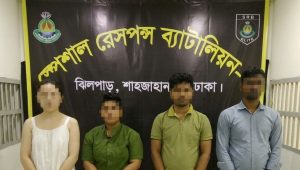
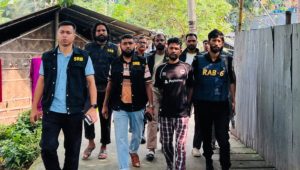
Following a daylight robbery where a mobile finance agent was hacked and robbed of Tk 3 lakh, a police drive in Mohammadpur’s Beribadh led to a violent clash. Two officers and four suspected members of the “Kabjikata Anwar Group” teen gang were injured during the shootout. Police arrested the four suspects and seized weapons.
Residents note that while daylight hours appear relatively calm, armed gangs emerge at nightfall to engage in mugging, robberies, extortion, drug trafficking, and violent clashes.

Professor Muhammad Omar Faruk of the Department of Criminology and Police Science at Maulana Bhashani University of Science and Technology explained that Mohammadpur’s dense population, floating residents, and maze of narrow lanes allow criminals to easily evade law enforcement.
“The area’s geographical and demographic characteristics make effective crime control particularly challenging,” he said.
Dhaka Metropolitan Police (DMP) Additional Commissioner (Crime and Operations) SN Nazrul Islam acknowledged the growing audacity of local criminals.
“The area is densely populated by lower- and middle-income residents. Low-cost housing, unemployment, and the presence of Geneva Camp contribute to various criminal activities. However, regular operations are ongoing,” he told TIMES.




According to Abdullah Al Mamun, Assistant Commissioner of Police for the Mohammadpur Zone, at least 20 to 25 juvenile gangs, comprising 150 to 200 members, remain active in the area.
“They often intimidate residents by brandishing machetes, samurai swords, switchblades, and knives. Every day, police arrest three to four robbery suspects and 15 to 16 drug dealers and other criminals, including juvenile gang members, and send them to court,” he said.
Criminals emboldened after bail
Local traders at Adabar Bazar alleged that many offenders become even more aggressive after securing bail, creating a vicious cycle for law enforcement.
This problem is compounded in the Basila area, where juvenile gangs are particularly active.
Police officials noted that many accused individuals immediately return to criminal activities to recoup the money spent on their legal defense, further straining law enforcement resources.
Power struggle fuels violence
Residents of Shekhertek, Adabar, Munsurabad Housing, and Taj Mahal Road report that criminal groups have intensified efforts to seize control of drug markets, sidewalks, and local business hubs following recent political shifts.
To establish dominance, rival factions have frequently brandished illegal firearms and engaged in violent clashes.
Near Geneva Camp, residents allege that drug syndicates continue to operate despite periodic arrests.
They point to systemic delays in investigations and court proceedings, which allow suspects to quickly secure bail and resume their criminal activities.
Similarly, shopkeepers on Babar Road claim that several notorious criminals enjoy direct or indirect patronage from influential local figures, enabling them to carry out mugging, robberies and extortion with relative impunity.
Multiple sources also link the worsening security situation to the attack, looting, and arson at the Mohammadpur Police Station on 5 August 2024.
The subsequent reduction in police presence and a perceived lack of strict enforcement have significantly weakened criminals’ fear of the law.
Former DMP Commissioner Sheikh Md Sajjat Ali, a longtime resident of Mohammadpur, attributed part of the crisis to the area’s massive floating population.
“Many people from Barisal, Bhola, and the riverine char regions live here temporarily. Some commit crimes and flee, making it exceptionally difficult for police to track their addresses. At the same time, rising unemployment is pushing more people toward crime,” he explained.
To restore law and order, Ali stressed the critical need for increased police manpower and more intensive patrols throughout the zone.