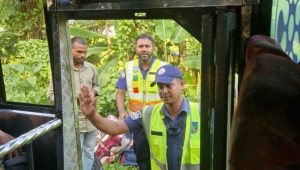
The latest attempt to reach Malaysia illegally by sea in a small trawler from Cox’s Bazar might have gone largely unnoticed, had the overcrowded vessel not sunk in the Andaman Sea.
Human trafficking by sea is not new in the coastal district, but recent incidents suggest enforcement efforts have weakened after earlier crackdowns.
On 9 April, a Malaysia-bound trawler carrying 273 passengers capsized in the Andaman Sea. Only nine survivors have returned to Cox’s Bazar so far, with the rest missing.
The incident has reignited national concern over irregular migration by sea, although local residents say such journeys are widely known in the area.
Abdur Rahman, a resident of Sabrang in Teknaf, said reports of people being trafficked to Malaysia surface regularly.
“Every few weeks, we hear that people are being taken from different parts of Teknaf to Malaysia. But we rarely see action against the brokers,” he told TIMES of Bangladesh.
Cox’s Bazar Superintendent of Police AKM Sajedur Rahman said he had taken up his post only three months ago and was not fully aware of past incidents.
Questions have also been raised over the legal response following the sinking.
Six Bangladeshi survivors of the incident have been named as accused in a case and sent to jail, while those suspected of organising the journey have not been traced.
Police said they acted based on a complaint filed by the Coast Guard.
In a statement, the Coast Guard said a Bangladesh-flagged vessel had rescued nine people found drifting in the Andaman Sea and handed them over.

After receiving initial treatment, they were transferred to Teknaf police station and later produced before a court, which ordered their detention.
Families of the missing say they fear the worst.
None have received any contact from their relatives since the incident, raising doubts about whether any of the 264 missing passengers are still alive.
Officials say more than 100 of those missing are Rohingya refugees, while the rest are believed to be Bangladeshi nationals.
The trawler is thought to have departed from the Teknaf coast, with passengers coming from Cox’s Bazar, Teknaf, Ukhiya and parts of Chattogram.
How the journey began
Accounts from police, witnesses and survivors suggest the passengers were gathered at multiple locations before being taken to sea.
Migrants bound for Malaysia were kept in hideouts, including in the Rajarchhara hills in Teknaf, before being moved in stages, according to investigators.




On 4 April, they were transported in small boats from Inani in Ukhiya and from Noakhali and Rajarchhara to a larger trawler waiting offshore.
Brokers are said to have lured unemployed young men with promises of jobs in Malaysia.
Rohingya women were allegedly targeted with offers of marriage, being told they would be matched with Rohingya men already living abroad and could build a better life there.
Many, seeking to escape the harsh conditions in refugee camps, agreed to make the journey.
Rafiqul Islam, a resident of the Kutupalong Rohingya camp in Ukhiya who survived the incident, said he was taken to Teknaf on 4 April after being promised work.
“I was held on a hill in Rajarchhara,” he said.
“There were around 50 to 60 others there. Late at night, we were taken onto a cargo boat.”
He said that when he boarded, more than 250 people were already packed tightly inside, including over 100 Rohingyas.
Another returnee, Sohan Uddin from Teknaf, had been missing after leaving home with a friend.
His father, Shamsur Alam, said the friend had lured him out under the pretext of playing.
“We later learned he had been sold to brokers and sent towards Malaysia by sea,” he said.
How the trawler sank
Rafiqul Islam said the vessel reached waters near the Andaman Islands on 9 April, when tensions broke out between passengers and crew.
He alleged that the crew took control of the situation and confined passengers in the boat’s ice storage compartment.
“About half an hour later, the boat sank,” he said.
Rafiqul added that he and a few others managed to stay afloat by clinging to water containers and fuel tanks.
“We drifted at sea for two days before being rescued by a Bangladeshi ship,” he said.
Survivors charged as suspected traffickers remain missing
Of the nine people brought back to Cox’s Bazar by the Coast Guard, three Rohingyas, including a woman, were returned to refugee camps.
They were identified as Md Rafiqul Islam, Rahela Begum and Md Imran from the Kutupalong camp in Ukhiya.
The remaining six, all Bangladeshi nationals, have been charged and handed over to police.
They include Md Hamid and Md Sayad Alam from Cox’s Bazar town, Md Akbar, Md Sohan Uddin from Whykong in Teknaf, Md Tofayel Ahmed from Borobil, and Md Hriday from Mirsarai in Chattogram.
Some of the survivors have described the decision to charge them as “very unfortunate”.
Meanwhile, relatives of missing passengers have identified a number of suspected brokers allegedly involved in organising the journey.
Names mentioned include Shaker Majhi, Haidar Ali, Abdul Amin, Syed Ullah, Md Ibrahim, Azizul Haque, Mahmudul Haque, Shafik, Mohammad Ullah, Mojaher Mia, also known as Goramia, and Sayad Alam. All of them are from Teknaf.
Following the sinking, many of the suspected traffickers are believed to have left the area. TIMES of Bangladesh was unable to reach them for comment.
Teknaf Police Station Officer-in-Charge Saiful Islam said police had acted in line with the complaint filed by the Coast Guard.
“We have taken action as per the complaint handed over by the Coast Guard. There was no separate scope for police to act beyond that,” he said.
He added that formal written complaints from individuals would make it easier to take action against those responsible.
“So far, no one has filed a complaint at the police station,” he said.
The Coast Guard has not responded to requests for comment.