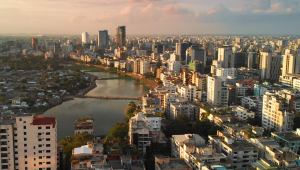
Dhaka city is today moving through a deep urban crisis, one that is deeply alarming. Unplanned urbanisation, rapid population growth, severe traffic congestion, and air and water pollution combined have pushed the capital closer to becoming unlivable. According to recent urban studies, Dhaka Metropolitan Area has a population density of more than 45,000 people per square kilometre, placing it among the most densely populated cities in the world. While the United Nations and urban planners recommend at least 9 to 12 square metres of open space per capita for a loveable city, Dhaka has less than 2 square metres per person.
In this critical reality, Gulshan, Banani, Dhanmondi and Hatirjheel lakes are not merely natural water bodies; they can serve as key foundations for urban regeneration, expansion of recreation, and economic growth. If these four lakes are systematically developed under a Public–Private Partnership (PPP) model into modern tourism hubs or urban recreation centres, Dhaka has a realistic opportunity to emerge as a modern, attractive and loveable tourist city in South Asia. Through the development of the recreation and tourism sector alone, at least 2,000 direct jobs can be created, with the number increasing further if the project is implemented comprehensively. In addition, transport, supply chains, tourism services and small entrepreneurship will generate income opportunities for several thousand more people indirectly. RAJUK and the tourism authorities can take the initiative to implement such a project by actively involving the private sector.
Global experience clearly demonstrates that waterbody-based urban development has positive impacts on both the economy and the environment. Singapore’s Marina Bay, Seoul’s Cheonggyecheon Stream, Amsterdam’s canal network in the Netherlands, and London’s Thames riverfront development are internationally recognised examples of successful urban regeneration. In these cities, riverbanks and lakesides have been transformed into pedestrian walkways, cycling lanes, open parks, restaurants, cultural centres and water-based recreational facilities. As a result, tourism revenues have increased, thousands of jobs have been created, and environmental quality has improved.

Although Gulshan, Banani and Dhanmondi lakes flow through some of Dhaka’s most important residential and commercial areas, encroachment, pollution and unplanned use have severely damaged their aesthetic and functional value. With proper planning, policy support and investment, however, these four lakes can bring about a transformative change in Dhaka’s urban structure.
In this context, the Public–Private Partnership (PPP) model can be considered a practical and sustainable solution. Large-scale urban development projects are often difficult to finance and maintain solely through government funding. Under the PPP model, the government would ensure land availability, policy support, security and environmental regulation, while the private sector would take responsibility for investment, modern design, technology and professional management. Through joint investment, it would be possible to develop planned waterfront promenades, pedestrian walkways and cycling lanes, modern restaurants and café zones, boating and water sports facilities, open cultural stages, art galleries, theme parks for children, green parks, jogging tracks and yoga zones. These initiatives would transform the lakes into not just recreational spaces but active centres of the urban economy.



It is essential to recognise the distinct identity and potential of each lake. Gulshan Lake, connected to diplomatic zones and upscale residential areas, has strong potential to become an international-standard urban tourism destination. International brand restaurants, lake-view cafés, barbecue zones, evening lighting shows and cultural events could attract foreign tourists and the diplomatic community. Banani Lake could be developed as a “Green Urban Recreation Hub,” featuring eco-parks, open-air food courts, street performance zones and small business opportunities for young entrepreneurs.
Dhanmondi Lake is closely intertwined with Dhaka’s historical and cultural identity. Regular book fairs, art exhibitions, Rabindra and Nazrul cultural programmes, and festivals could transform it into a “Cultural Tourism Corridor,” opening new horizons for family-oriented recreation and educational tourism. Hatirjheel Lake, although relatively advanced in terms of infrastructure, still lags behind in tourism development and job creation and has significant untapped potential.
From an economic perspective, development of Gulshan, Banani and Dhanmondi lakes could create a major opportunity for Dhaka. Preliminary analyses by urban development and tourism experts suggest that at least 2,000 direct jobs could be generated in infrastructure construction, restaurant and café operations, retail businesses, security, maintenance, event management and water-based recreation. With full-scale implementation, this number could increase further. Indirectly, transport, supply chains, tourism services and small enterprises would provide income opportunities for several thousand more people.
However, environmental protection must be given the highest priority. Without strict control of water pollution, modern waste management, increased greenery, use of renewable energy such as solar power, and active participation of local residents, such development will not be sustainable. With proper planning, transparency and a commitment to public interest, Gulshan, Banani, Hatirjheel and Dhanmondi lakes can become symbols of a new Dhaka: modern, loveable, environmentally friendly and driven by employment generation.
The writer is Deputy Director-Faculty HR, North South University and Former Vice President, Dhaka University Journalists’ Association (DUJA)