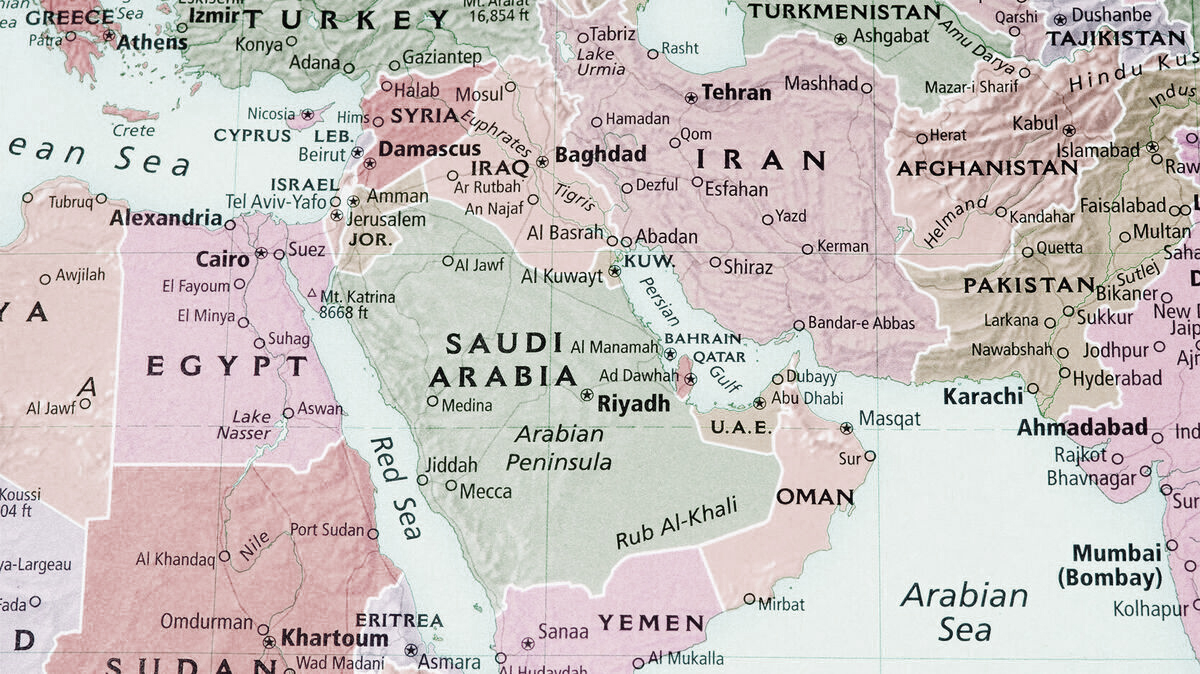

The Cold War formally ended with the Fall of the Berlin Wall and the collapse of the Soviet Union. The Middle East was one of the contested areas. Even at the end of the Cold War, the Arab countries still bear the brunt of that war throughout the decades and its impact is far reaching in their states’ foreign policies. All that things are explicitly revolving between the US and the Arab states backed by Russia, interplaying countries such as Israel, Turkey, Syria, Yemen, Lebanon, Iran, among others.
The 1946 Iranian-Soviet agreement with Stalin delayed the withdrawal of Soviet troops from Iran that put pressure on the US. To counter this, the US declared their unwavering support to Israel, while they also sought friendship with Saudi Arabia to maintain balance of power in the region. The turmoil in the middle east began. Since then, the US has been relentlessly pursuing its foreign policy to establish its hegemony over the state politics of the Arab countries and overplaying with the Russian allies and keep them in corner in the Middle East.
Almost three decades after the end of the Cold War, the Middle East is yet to recover from the shift in the power balance. The rise of resistance groups such as Hezbollah in Lebanon and Hamas in Palestine intensified the US tension in the region. Since 1948, every major war between Israel and its Arab neighbours, from the first Arab-Israeli War to the conflicts of 1956, 1967, 1973, the 2006 Second Lebanon War, and successive Gaza conflicts and beyond, has been marked by the US direct intervention and unilateral support to Israel which dissolved into renewed tension exploited by US hegemony.

The latest Gaza war, which was overtly supported by US Israel, is now in the state of ceasefire. But it remains very fragile as Israel almost is killing Gazans every day and raiding their residence, bombing Hezbollah’s military base in Lebanon and Houthi in Yemen.
The question of whether the Middle East will ever experience peace remains uncertain. This is because the events of the Cold War profoundly shaped the state-state relations in the area, prompting an impact that keeps morphing with time. The rise of resistance groups in the region, politics of power dominance, and the competing interest of the US is a phenomenal display in the Middle East as a tumultuous point of convergence of a complex network of international influence.




This is a new aspect of the war that could bring terrible consequences for the region. This is because in Gaza the emergence of new fighters at the same time will pose a huge threat to Israel who has not been able to eliminate Hamas despite two years of fighting. We have seen many newspapers’ reports that about 60 percent of Hamas’ tunnels are still intact. The remaining 40 percent have not been completely destroyed, they are only partially damaged.
If Israel plans to launch a ground invasion against Lebanon. In response, Hezbollah will enter the war directly. It seems that the daily attacks and all the pressure from America and Europe will not be able to shake Hezbollah’s position in any way.
In addition, Iranian hackers and cybersecurity teams are constantly leaking Israel’s confidential information and documents. They also published the personal information and secret documents of important Israeli figures, including photos. America offered Iran to lift sanctions in exchange for uranium, which Iran rejected out of hatred- another front of tension surfaced in the middle east.
In the current situation, new events are happening every day and numerous small events are taking place simultaneously. Iran is unveiling some technology every day, while America and Israel are increasing their activities in the Arab region. It is heard that Israel may establish a new military base in the United Arab Emirates.
The Cold War is now at a stage of intense tension in the Middle East. This war is as much military as it is psychological. The Arab countries’ ability to make the right decision at the right time will make the difference between victory or defeat.