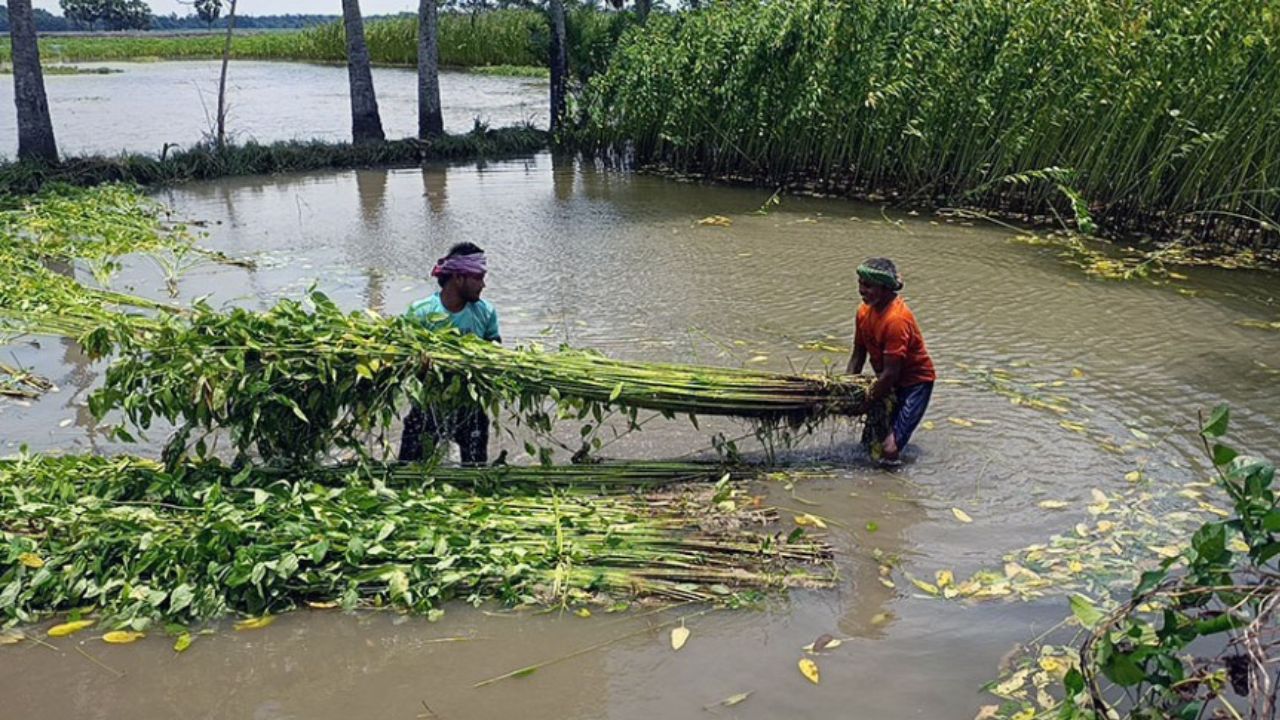



Funding commitments by developed countries to tackle climate change impacts are declining, while 65 per cent of climate finance allocated for developing nations is being provided as loans. Only 6.7 per cent of global climate finance reaches smallholder farmers in developing countries.
Against this backdrop, 30 civic organisations in Bangladesh have demanded unconditional, grant-based funding instead of loans to ensure a just transition of agriculture and food systems.
The demand was announced at a press conference titled “Not Fossil Fuels, Not Loans: Ensure Unconditional Funding for Just Transition of Agriculture and Food Systems”, held at the Dhaka Reporters Unity on Sunday.
The press conference was jointly organised by Bangladesh Food Security Network (KHANI), Bangladesh Working Group on Ecology and Development (BWGED), ReGlobal, Safety and Rights Society, Coastal Livelihood and Environmental Action Network (CLEAN), and Participatory Research and Action Network (PRAAN).
Speakers at the press conference highlighted a sharp decline in climate finance pledges during the first week of the ongoing UN Climate Conference (COP-31) in Antalya, Turkey.

According to an analysis by Carbon Brief, new public climate finance commitments from developed countries dropped from approximately $40 billion annually to $16.7 billion.
Meanwhile, calculations by the United Nations Environment Programme (UNEP) indicate that developing countries will require around $305 billion annually for adaptation activities by 2035.
However, in 2024, international public adaptation finance stood at only $28.2 billion to $36.7 billion, with the major portion delivered as loans.



It was further noted that no specific funding, decision, or numerical target for food and agriculture was established during the COP-31 discussions on food, agriculture, and health.
Consequently, Bangladeshi farmers continue to face severe crises regarding land, irrigation water, loans, insurance, and fair prices for their produce due to the impacts of climate change.
According to calculations by the participating organisations, Bangladesh suffers annual climate-related losses amounting to $65.2 billion (6,520 crore dollars). In this context, the announced $30 million grant accounts for a mere 0.2 per cent of the country’s annual loss.
Bangladesh requires $90.23 billion in foreign assistance to implement its Nationally Determined Contributions (NDC 3.0), making the declared grant just 0.03 per cent of the required amount.
Presenting an eight-point demand for the final outcome of COP-31, Benazir Ahmed, Advisor to the Bangladesh Working Group on Ecology and Development (BWGED), urged immediate international action.
The eight demands comprise: grant-based funding as climate compensation, a permanent funding programme for food and agriculture, renewable energy-based electrification, protection of the rights of farmers and marginal communities, adequate funding for the loss and damage fund, cancellation of unfair foreign debts of climate-disaster-affected countries, and official recognition of agroecology and food sovereignty.
Presiding over the event, KHANI Vice-President Rezaul Karim Siddique called on the government to publish the implementing agency, project areas, number of beneficiaries, and timeline for the announced $30 million grant.

He also proposed agricultural loan waivers, interest-free loans, crop insurance, and government support for sharecroppers, female farmers, and fishermen.
Siddique further emphasized that historically responsible, developed countries must commit to new, multi-year grant-based funding pledges.
He demanded that adaptation funding for Least Developed Countries (LDCs) be provided entirely as grants, alongside a clear timeline to implement the proposal to triple adaptation finance.
He added that climate-resilient farming training alone is insufficient for agriculture, and long-term programmes including financial backing are essential to safeguard farmers’ production systems, livelihoods, and rights.
The press conference was also addressed by Zayed Iqbal Khan, general secretary of Bangladesh Farmer Federation, and Sikander Ali, executive director of Safety and Rights Society.